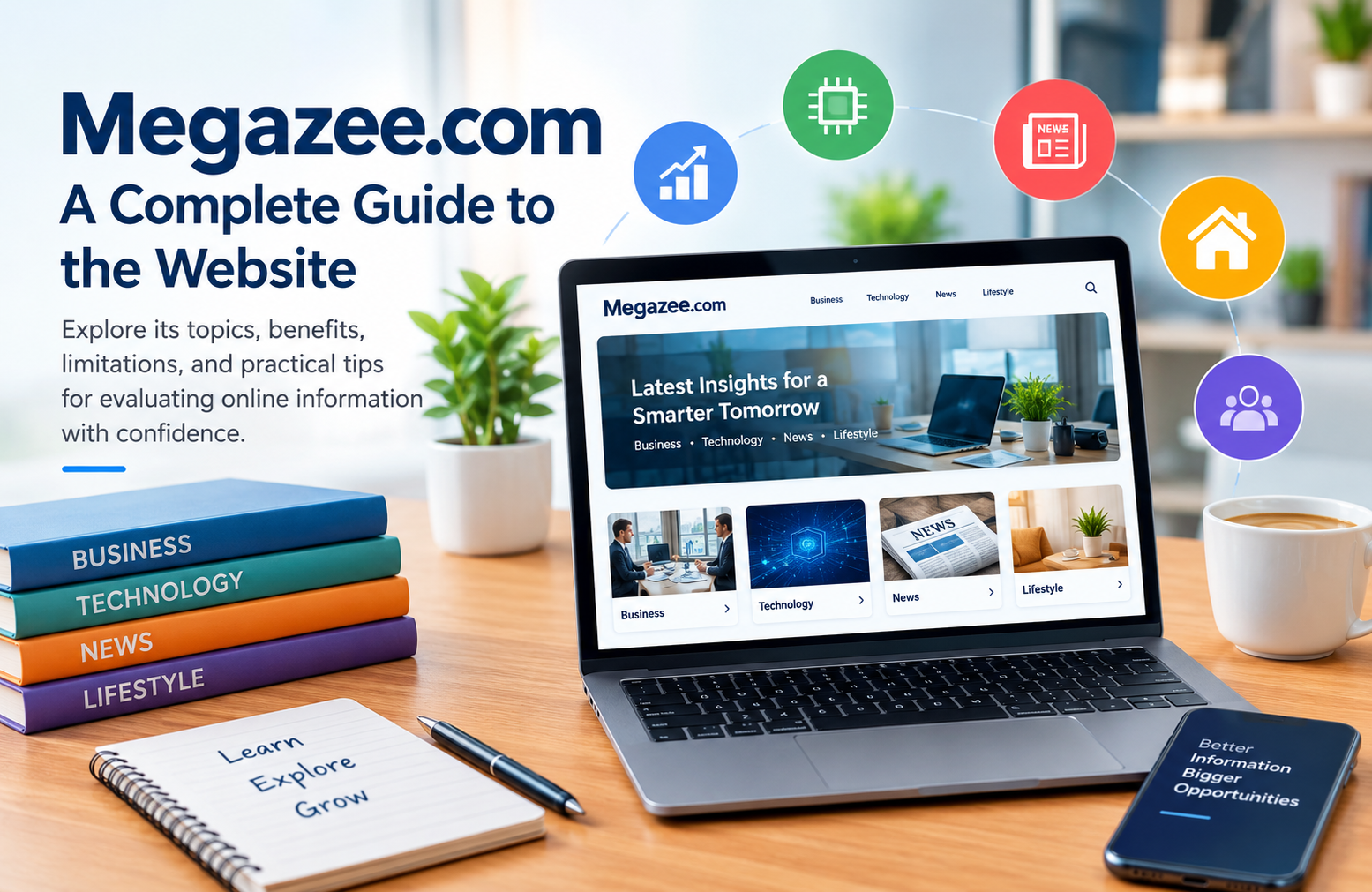
Megazee.com: A Complete Guide to the Website
Megazee.com is an online publishing website that brings together articles on business, technology, news, lifestyle, and other areas of general interest. For readers who want to explore different subjects in one place, the website offers a convenient starting point for discovering information and learning about current topics. However, understanding what the platform publishes, how to navigate its content, and how to evaluate the information it provides can help readers get more value from their visits. This guide explores Megazee.com, its main content categories, potential benefits, limitations, and practical ways to use online publications responsibly.
What Is Megazee.com?
Megazee.com is a digital publishing website that presents informational articles across multiple subject areas. Instead of focusing entirely on one industry, it follows a broad publishing approach that allows readers to explore different topics through a single online platform.
The website’s visible homepage features content related to business, technology, news, and general-interest subjects. Individual articles cover themes such as artificial intelligence, digital innovation, business operations, home improvement, and changes in modern society. Its exact content selection can change as new articles are published and older material becomes less prominent.
This broad approach reflects how many people use the internet today. A reader might begin by researching a business question and later explore a technology trend or a news topic. A multi-category website can make that process more convenient by organizing different types of information under one digital destination.
However, it is important to understand what this format does and does not offer. A website that publishes articles about technology is not necessarily a technology company. Similarly, a platform that covers financial topics should not automatically be treated as a professional financial advisory service.
Megazee.com is best approached as an informational publication. Readers can use its articles to discover ideas, understand unfamiliar subjects, and identify questions that deserve further research.
The value of any individual article ultimately depends on its accuracy, relevance, supporting evidence, and usefulness to the reader.
How Does Megazee.com Work?
A multi-topic publishing website generally works by organizing articles into categories that make browsing easier. Visitors can explore the homepage, select a topic, open an individual article, and continue reading related material.
Megazee.com follows this general publishing format. Its homepage provides an entry point to available content, while category labels help visitors understand the subject of an article before opening it.
The experience can be understood through four basic steps.
1. Visit the Website
The first step is to open the website in a browser. Visitors can use a desktop computer, laptop, tablet, or smartphone with an internet connection.
Starting from the homepage allows readers to see the content currently being highlighted. Featured articles and recent publications can help visitors discover subjects they might not have searched for directly.
For a more focused visit, readers should begin with a specific question. For example, someone interested in business growth might look for information about marketing, productivity, or digital operations.
Having a clear purpose makes it easier to identify useful content instead of browsing without direction.
2. Explore the Available Categories
Category pages can help readers narrow down the material they want to explore. Business, news, technology, and general-interest content serve different purposes, even when their subjects sometimes overlap.
A business article may explain a commercial strategy, while a technology article may discuss a digital tool or emerging innovation. A news article may focus on an event, development, or change that matters at a particular time.
Readers should select the category that most closely matches their needs. If an article covers several subjects, its title, introduction, and headings can help clarify its main purpose.
3. Read Individual Articles Carefully
Once a relevant article is open, the next step is to assess whether it answers the original question.
A useful article should explain its topic clearly, provide enough context, and help readers understand what the information means in practice. Longer content is not automatically better. A concise article that answers a specific question may be more useful than a lengthy page filled with repetition.
Readers should pay attention to the publication date, the author’s information, and any references supporting important claims.
This is especially important when reading about subjects that change quickly, such as artificial intelligence, business regulations, financial products, cybersecurity, and consumer technology.
4. Continue Researching When Necessary
An online article can provide a helpful introduction, but some questions require more detailed investigation.
If a topic affects a major financial decision, a medical concern, a legal matter, or business compliance, readers should consult appropriate primary sources or qualified professionals.
For example, a general article about cybersecurity may explain common risks, but the documentation published by a software provider may be necessary to verify a particular security setting.
Using a general-interest publication as a starting point, rather than the final authority on every subject, helps readers make more informed decisions.
Main Content Categories on Megazee.com
One of the defining characteristics of Megazee.com is its broad subject coverage. This structure gives readers opportunities to explore different areas of interest without limiting themselves to one specific niche.
The precise selection of articles may change over time, so visitors should check the current website to see which topics are available.
Business and Entrepreneurship
Business content can help readers understand how organizations operate, how professionals approach workplace challenges, and how companies respond to changing markets.
Common subjects in this area include business planning, project management, operational efficiency, marketing, outsourcing, and organizational growth.
For example, someone considering a small online business might use introductory articles to learn about customer acquisition, website management, or productivity tools.
A business owner could also explore explanations of automation and digital workflows before deciding which processes deserve improvement.
The practical value of this material depends on how clearly an article connects an idea with a real business problem. Useful explanations should identify the challenge, describe possible solutions, and acknowledge limitations.
Readers should be cautious about articles that promise guaranteed profits, effortless growth, or universal solutions to complicated business problems.
Business decisions depend on factors such as budget, competition, customer demand, available skills, and local requirements. General information can support planning, but it cannot replace research into the circumstances of a particular business.
Technology and Digital Innovation
Technology is another important subject for general-interest online publications.
Articles in this area may explore software, digital services, computing, online security, automation, and technological developments affecting everyday life.
Technology content can be useful for beginners who want to understand unfamiliar terms without immediately studying technical documentation.
For instance, an introductory explanation of cloud computing can help a reader understand how online storage and software services work. A guide to automation may explain how repetitive tasks can be handled with digital tools.
However, technology information can become outdated quickly. Software interfaces change, product features are updated, and security recommendations may evolve as new risks appear.
Readers should therefore check whether an article describes the current version of a product or discusses an earlier development.
When an article recommends a particular tool, it is also worth examining its cost, compatibility, privacy practices, and limitations before making a decision.
News and Current Developments
News-related content helps readers understand developments that may affect businesses, communities, industries, or everyday life.
This material can provide context about an event and explain why it matters. It may also introduce readers to broader subjects that deserve additional attention.
Nevertheless, news information requires careful evaluation because the situation can change after publication.
A report written shortly after an event may not contain every relevant detail. Later information may correct an early assumption, clarify an official statement, or reveal additional circumstances.
Readers should distinguish between confirmed facts, expert interpretation, opinion, and speculation.
It is also useful to check whether an article identifies its sources and whether the information comes from direct reporting or summarizes material published elsewhere.
For major events, comparing the article with an authoritative primary source can help establish what is actually known.
Lifestyle and Everyday Topics
Lifestyle content addresses subjects connected with daily routines, consumer choices, home life, and broader social changes.
This type of material can be accessible to readers who want practical explanations rather than highly technical analysis.
A home-related article, for example, might introduce common maintenance considerations. A lifestyle article might explain a changing consumer habit or discuss how technology influences daily activities.
The usefulness of such content depends on the topic. General advice about organizing a home may be relatively low risk, while information involving electrical repairs, health, or personal safety requires greater care.
Readers should not assume that every lifestyle article is suitable for every situation. Individual circumstances, local rules, and professional requirements can affect whether a recommendation is appropriate.
A sensible approach is to use general information for orientation and seek specialist guidance when a decision involves significant cost or risk.
Artificial Intelligence and Emerging Trends
Artificial intelligence has become an important subject in discussions about business, education, productivity, and technology.
Articles about AI can help readers understand basic concepts, possible applications, and questions surrounding its wider use.
For example, an introductory article might explain how businesses use automated systems to organize information or support customer service. Another might discuss the difference between a generative AI tool and a traditional software application.
These explanations can help readers identify practical uses without assuming that every new technology is automatically beneficial.
AI tools can make mistakes, produce inaccurate information, and reflect limitations in their training or design. Their output may also require human review, particularly when it affects customers, employees, finances, or confidential information.
Readers should look for balanced explanations that discuss both potential benefits and possible risks.
The most useful AI content does more than describe a trend. It helps readers understand where a tool may be appropriate, what problems it might solve, and what still requires human judgment.
Benefits of Using Megazee.com
The main potential benefit of a multi-topic publishing website is convenience. Readers can explore different subjects without committing to a platform dedicated to just one area.
However, convenience is only one part of a useful online reading experience. The quality of the content and its relevance to a reader’s needs remain essential.
Access to Different Subjects in One Place
A broad publishing platform can support readers whose interests change from one visit to another.
Someone researching digital marketing may also want to understand business operations, technology developments, or workplace productivity. A multi-category website can make it easier to move between related subjects.
This approach may be particularly helpful for beginners who are still discovering which topics deserve deeper study.
Rather than requiring detailed knowledge of specialist publications from the beginning, general-interest articles can introduce basic terminology and provide an initial overview.
Once readers understand the fundamentals, they can move toward more specialized resources.
An Accessible Introduction to Complex Topics
Some subjects contain unfamiliar terminology that makes them difficult for new readers.
Clear introductory articles can reduce this barrier by explaining concepts in ordinary language and arranging information into manageable sections.
For example, a beginner learning about digital transformation may first need to understand how software, data, and business processes connect.
An accessible explanation can establish that foundation before the reader moves on to detailed technical material.
Good introductory content should simplify the language without distorting the facts. Important exceptions, risks, and uncertainties should remain visible.
Opportunities for Independent Learning
Online publications allow readers to explore subjects at their own pace.
A student can read an introduction before a class, a professional can review a new concept during a break, and a business owner can investigate an unfamiliar tool before arranging a demonstration.
This flexibility makes online articles useful for informal learning.
Still, reading alone does not guarantee understanding. Readers can improve retention by summarizing an article in their own words, checking unfamiliar terms, and applying the information to a real question.
They should also distinguish between learning about an idea and developing the practical skills needed to use it.
Discovering New Questions and Ideas
A broad website can introduce readers to topics they would not otherwise have searched for.
An article about automation might encourage a business owner to review repetitive tasks. A technology explainer might lead a student to investigate a new career skill.
This discovery process can be valuable when readers remain curious and willing to verify what they learn.
The strongest outcome is not simply consuming more content. It is identifying useful questions, developing a clearer understanding, and finding reliable evidence to support the next step.
Convenient Browsing Across Devices
Web-based articles can generally be accessed through supported browsers on computers and mobile devices.
This allows readers to move between devices according to their needs. A longer article may be easier to read on a laptop, while a short explanation may be convenient on a phone.
The actual experience depends on the website’s design, loading speed, accessibility, and compatibility with the reader’s device.
A well-organized page should make its headings, links, and main text easy to navigate. If a page is difficult to read or contains distracting elements, readers may find it more useful to locate a clearer source.
How to Evaluate the Quality of Articles on Megazee.com
Knowing how to evaluate an article is one of the most valuable skills for anyone who uses online publications.
A professional design or confident writing style cannot prove that information is accurate. Similarly, a high search ranking does not automatically establish expertise.
Readers should evaluate the evidence and reasoning behind each important claim.
Check the Author and Their Expertise
Start by checking whether the article identifies an author and provides meaningful information about their background.
A relevant professional qualification or a history of working in a subject area can help establish expertise, although neither guarantees that every statement is correct.
For specialized topics, readers should look for authors who demonstrate an appropriate understanding of the subject.
If an article discusses a complicated legal issue, for example, relevant legal expertise matters more than general writing experience.
When author details are limited, avoid making assumptions about the person’s identity or qualifications.
Instead, focus on whether the article explains its claims, provides credible evidence, and accurately represents the subject.
Examine the Evidence
Important claims should have an identifiable basis.
That basis might include official documentation, government information, academic research, industry data, or statements from people directly involved in an event.
The appropriate evidence depends on the subject.
A technical claim may be best checked against a product’s official documentation. A legal requirement should be verified through the relevant government or regulatory authority.
Readers should be particularly careful when an article includes statistics without explaining where they came from.
A precise number can look convincing even when its context is missing. Before relying on a statistic, check its source, date, measurement method, and relevance to the question.
Review the Publication Date
The publication date helps readers determine whether information is likely to remain current.
Some subjects change slowly. Basic explanations of established concepts may remain useful for years.
Other subjects change rapidly. Product prices, software features, government policies, and cybersecurity advice can become outdated in a short period.
An article may also be updated after its original publication. In that case, readers should check whether the update addresses the information they need.
If an important decision depends on a current rule or product feature, verify it using the latest available authoritative information.
Separate Facts From Opinions
Not every statement in an article serves the same purpose.
A fact is a claim that can be checked against evidence. An opinion expresses a judgment or interpretation. A prediction describes a possible future outcome.
These categories can appear together in the same article.
Readers should look for clear distinctions between them. If a prediction is presented as a guaranteed outcome, the explanation deserves closer scrutiny.
Balanced articles acknowledge uncertainty when evidence is incomplete. They also explain why a conclusion follows from the available information rather than relying on confident language alone.
Look for Clear Limitations
Reliable explanations do not need to pretend that every question has a simple answer.
A good article may explain that a recommendation depends on budget, location, experience, or other circumstances.
This is especially important when the subject involves financial decisions, health, legal obligations, or technical safety.
An article that acknowledges limitations can be more useful than one that promises a universal solution.
Readers should also consider whether the article’s advice matches their actual situation. A recommendation that works for one organization or individual may not be suitable for another.
Compare Important Claims With Primary Sources
When a claim matters, checking the original source is often the most effective way to verify it.
Primary sources can include official regulations, original research papers, product documentation, company announcements, and government publications.
For general guidance on evaluating helpful, reliable, people-first web content, readers can consult Google Search Central’s guidance on creating helpful content.
This guidance provides a useful framework for understanding why original value, clear purpose, and trustworthy information matter in online publishing.
The goal is not to distrust every article. It is to develop a consistent method for deciding which information deserves confidence and which claims require further checking.
Challenges and Limitations of Multi-Topic Websites
Although a broad publishing platform can be convenient, its format also creates challenges. Understanding these limitations helps readers use the available content more effectively.
Different Topics Require Different Levels of Expertise
A website that covers several industries must address subjects with very different requirements.
An introductory business article may focus on practical concepts, while an article about cybersecurity may need precise technical explanations. A health-related article may require careful interpretation of scientific evidence and professional review.
It is difficult to judge all these subjects using the same standards.
Readers should therefore evaluate each article according to its topic. The expertise needed to explain a basic productivity technique differs from the expertise needed to interpret a complex medical study.
A general-interest publication can introduce many subjects, but it should not automatically replace specialist publications or qualified professionals.
Content Can Become Outdated
Online publishing moves quickly, and older articles may remain accessible long after their original information has changed.
This can create confusion when readers encounter outdated prices, product descriptions, statistics, or instructions.
For example, an article explaining how a software tool works may describe an earlier interface. A business guide may refer to rules that have since changed.
Before applying an article’s recommendations, readers should determine whether its information is still relevant.
An old article is not necessarily inaccurate. Its value depends on the subject and whether its key information remains correct.
Broad Coverage Does Not Guarantee Consistent Quality
A multi-topic website may publish articles with different purposes, writing styles, and levels of detail.
Some pages may answer a narrow question effectively, while others may provide only a general introduction.
Readers should not assume that every article has identical editorial standards simply because it appears on the same domain.
It is better to judge individual pages according to their clarity, evidence, author information, and usefulness.
This approach also avoids the opposite mistake of rejecting every article because one page is weak. A fair evaluation considers the specific material being used.
Commercial Content May Need Additional Scrutiny
Some digital publications include sponsored articles, promotional material, affiliate links, or other commercially motivated content.
Commercial content is not automatically misleading. A well-prepared sponsored article can still provide accurate and useful information.
The important issue is transparency. Readers should be able to recognize when a commercial relationship may influence the content.
When an article recommends a product, company, service, or financial opportunity, consider whether it explains disadvantages as well as benefits.
Be especially cautious of unsupported promises, exaggerated claims, or recommendations that pressure readers to make immediate decisions.
The Website’s Overall Reputation Is Not Proof of Every Claim
People sometimes judge an entire website as either completely trustworthy or completely unreliable.
Neither conclusion is necessarily justified by the domain name alone.
A website may contain useful introductory articles alongside pages that require additional verification. Its design, age, popularity, or apparent professionalism cannot independently prove the accuracy of every statement.
The better approach is to evaluate the article, the evidence, and the importance of the decision being considered.
This method is useful not only for Megazee.com but also for blogs, news websites, social media posts, and other online information sources.
Who Can Benefit From Megazee.com?
The usefulness of a general-interest publication depends on what a visitor wants to achieve.
Different readers may find value in different parts of the website.
Students and Beginners
Students can use introductory articles to build background knowledge before studying a subject in greater depth.
For example, a student encountering a new technology term may benefit from a plain-language explanation before reading textbooks or technical documentation.
The website may also help beginners identify questions they want to explore further.
However, students should avoid treating an online article as their only source for assignments or research projects. Academic work often requires original studies, recognized publications, official data, and proper citations.
The best approach is to use general articles for orientation and then verify important information through sources appropriate to the assignment.
Business Owners and Entrepreneurs
Business owners frequently need to understand unfamiliar subjects without spending hours studying each one.
An introductory article can explain concepts such as workflow automation, online marketing, customer service, and digital operations.
This information may help an entrepreneur identify opportunities for improvement or prepare questions for a specialist.
However, general advice should not be treated as a ready-made strategy for every company.
Business decisions require attention to customer needs, operating costs, competition, available resources, and measurable results.
Before investing in a tool or service, readers should compare suitable alternatives and confirm that the proposed solution addresses a real problem.
Technology Enthusiasts
People interested in digital developments may appreciate having access to explanations of emerging tools and industry trends.
Articles can introduce unfamiliar concepts and help readers understand why a development is receiving attention.
Technology enthusiasts should still distinguish between established capabilities and predictions about future possibilities.
A tool may be impressive in a demonstration but less useful in everyday work. A new product may receive considerable attention without proving its long-term value.
Readers can benefit from combining introductory explanations with hands-on testing and official product information.
Professionals Developing New Skills
Professionals often need to learn about subjects outside their primary area of expertise.
A marketing professional might want to understand data security, while a manager might need an introduction to automation or digital project management.
General-interest articles can help build the vocabulary needed to participate in these discussions.
They can also point readers toward areas where further training may be worthwhile.
Still, reading an article does not establish professional competence. Practical experience, structured learning, and feedback are often necessary to develop a skill.
Curious Everyday Readers
Not every online visit needs to support a formal project.
Some people simply enjoy learning about technology, business, social developments, and other subjects.
For these readers, a broad publishing website can provide an accessible way to discover unfamiliar ideas.
The key is to remain selective. Reading more articles is not always the same as learning more.
Readers gain greater value when they reflect on what they have learned, recognize uncertainty, and follow up on subjects that genuinely matter to them.
How to Use Megazee.com More Effectively
A simple reading strategy can make any online publication more useful.
Instead of opening articles at random, readers can follow a structured process that connects browsing with a clear objective.
Step 1: Define Your Question
Before visiting the website, identify what you want to understand.
A broad goal such as learning about technology may be difficult to manage because it includes countless subjects.
A more specific question, such as understanding how business automation reduces repetitive work, creates a clearer direction.
A focused question also makes it easier to decide whether an article has answered your needs.
Step 2: Choose Relevant Content
Read the article title and introduction before committing to the full page.
Look for a clear connection between the article’s subject and your original question.
If the page focuses on a different issue, it may be better to return to the category and choose another article.
This saves time and reduces the temptation to keep reading material that does not contribute to your goal.
Step 3: Identify the Main Points
While reading, identify the most important ideas.
These might include a definition, a process, a comparison, a key finding, or a practical recommendation.
Try to explain the central message in your own words.
If you cannot summarize the article clearly, consider whether the explanation is confusing or whether the subject requires additional background knowledge.
Step 4: Verify Important Details
Check claims that could affect an important decision.
For example, confirm current software features before purchasing a subscription. Verify a regulation before changing a business process. Consult a qualified professional when an issue requires specialist judgment.
The level of verification should match the possible consequences of getting the information wrong.
A general explanation of a low-risk topic may need little additional research. A claim involving money, safety, or legal obligations deserves much closer attention.
Step 5: Apply What You Learn
Information becomes more valuable when it helps answer a question or improve a practical decision.
After reading, consider what the information means for your situation.
You might create a checklist, compare possible solutions, test a tool, or identify a question to ask an expert.
Do not apply a recommendation simply because an article presents it confidently. Consider whether its assumptions match your circumstances.
Step 6: Revisit the Information When Necessary
Some information remains useful for a long time, while other details need regular checking.
If you save an article for future reference, make a note of its publication date and any details that may change.
When you return to it, verify that the important information remains current.
This is particularly helpful for readers who use online publications as part of ongoing study, business planning, or professional development.
Is Megazee.com Suitable for Research?
Megazee.com can serve as a starting point for general research, provided readers assess the quality and relevance of the material they use.
Its broad publishing format may help visitors discover subjects, understand introductory concepts, and identify areas for further investigation.
However, the suitability of an article depends on the research objective.
For casual learning, a clear overview may be enough to develop a basic understanding. For an academic paper, professional report, or important business decision, stronger evidence may be necessary.
A useful research process includes three stages.
First, use an introductory article to understand the question and identify important terminology.
Second, find primary or specialist sources that directly address the issue. Depending on the topic, these may include official documents, original research, technical manuals, or recognized professional guidance.
Third, compare the available evidence and determine whether the conclusions are supported.
This approach reduces the risk of repeating an inaccurate statement simply because it appears in a polished article.
It also helps readers separate useful background information from evidence that is strong enough to support a conclusion.
How Multi-Topic Publishing Websites Create Value
General-interest publications operate in an environment where readers have many ways to discover information.
Search engines, specialist blogs, social networks, video platforms, and official websites all compete for attention.
A multi-topic publication can offer value by making useful explanations accessible to readers who may not yet know which specialist source they need.
However, variety alone is not a lasting advantage. Readers have little reason to return if the articles do not answer their questions.
Useful publishing depends on several connected factors.
Clear and Specific Explanations
An article should have a clear purpose and explain what readers can reasonably expect to learn.
A title should accurately represent the content rather than promising information that the page never provides.
The introduction should establish the subject quickly, while the main sections should answer the questions raised by the title.
This structure respects readers’ time and makes information easier to understand.
Original Information and Meaningful Analysis
An effective article should contribute something beyond repeating familiar statements.
That contribution might be a useful comparison, a clear example, a practical explanation, or an analysis of limitations.
Originality does not require inventing facts or making dramatic claims. It requires helping readers understand the subject more clearly.
Where evidence is limited, the article should acknowledge that limitation rather than fill the gap with unsupported assertions.
Responsible Content Updates
A useful publishing process includes reviewing information that may become outdated.
Editors can prioritize pages dealing with changing products, regulations, statistics, and other time-sensitive subjects.
Updates should reflect meaningful changes rather than simply changing a date without reviewing the content.
This helps readers distinguish current information from historical material.
Transparency and Trust
Readers benefit when a publication makes its purpose clear and provides appropriate information about authorship, sourcing, and commercial relationships.
Transparency helps visitors understand how the content was prepared and what factors may influence it.
It also makes it easier to evaluate whether an article is appropriate for a particular need.
For any digital publication, trust should be supported by observable evidence rather than promotional language alone.
Final Considerations Before Relying on Megazee.com
Before using an article as the basis for a decision, consider three questions.
Does the article answer the actual question? A page may discuss a relevant topic without providing the specific information you need.
Can its important claims be verified? Check the evidence, the author’s relevant expertise, the publication date, and the reliability of any supporting sources.
Are the consequences significant? If an error could cause financial loss, health risks, legal problems, or safety concerns, seek stronger evidence and appropriate professional guidance.
These questions help establish a practical standard for using online information.
They also prevent two common mistakes: trusting every statement without checking it and dismissing useful information simply because it comes from a general-interest website.
The most effective approach is to remain curious while applying sensible standards of verification. Readers can benefit from accessible explanations without assuming that every article is equally authoritative.
Frequently Asked Questions About Megazee.com
1. What is Megazee.com?
Megazee.com is a multi-topic online publishing website featuring informational articles about business, technology, news, and other general-interest subjects. Readers can use its content to explore topics and identify areas for further research.
2. What topics does Megazee.com cover?
The website’s visible content includes business, technology, news, and general-interest topics. Individual articles may discuss digital innovation, artificial intelligence, business operations, home-related subjects, and wider social developments.
3. Is Megazee.com useful for learning?
Yes, it can be a starting point for learning about general topics. Readers should assess the accuracy and relevance of individual articles and consult specialist or primary sources when they need detailed or authoritative information.
4. Can I rely on Megazee.com for important decisions?
Important decisions should not depend on a single article. Verify key claims through appropriate authoritative sources and seek qualified professional advice when the subject involves health, law, finances, or safety.
5. How can I evaluate information published on Megazee.com?
Check the author’s relevant expertise, publication date, supporting evidence, and clarity of explanation. Compare important claims with primary sources and be cautious of unsupported promises or conclusions presented without sufficient evidence.
6. Is Megazee.com a technology company or an online publication?
Its visible website structure is primarily that of an online publication. Although it covers technology-related subjects, publishing articles about technology does not by itself establish that a website sells software or operates as a technology service provider.
Conclusion
Megazee.com offers a multi-topic publishing format for readers interested in business, technology, news, and other areas of general knowledge. Its broad approach can make it easier to discover unfamiliar subjects, explore introductory explanations, and identify questions worth researching further.
The platform’s usefulness depends on the quality and relevance of the individual article. Readers should examine the evidence behind important claims, check publication dates, consider author expertise, and distinguish general explanations from professional advice.
For everyday learning, a clear introductory article can provide a useful foundation. For academic work, specialist research, or decisions with significant consequences, additional verification is essential.
Ultimately, the most effective way to use Megazee.com is to approach its content with curiosity and critical thinking. Understanding a subject begins with asking good questions, but reliable conclusions require evidence, context, and careful judgment.