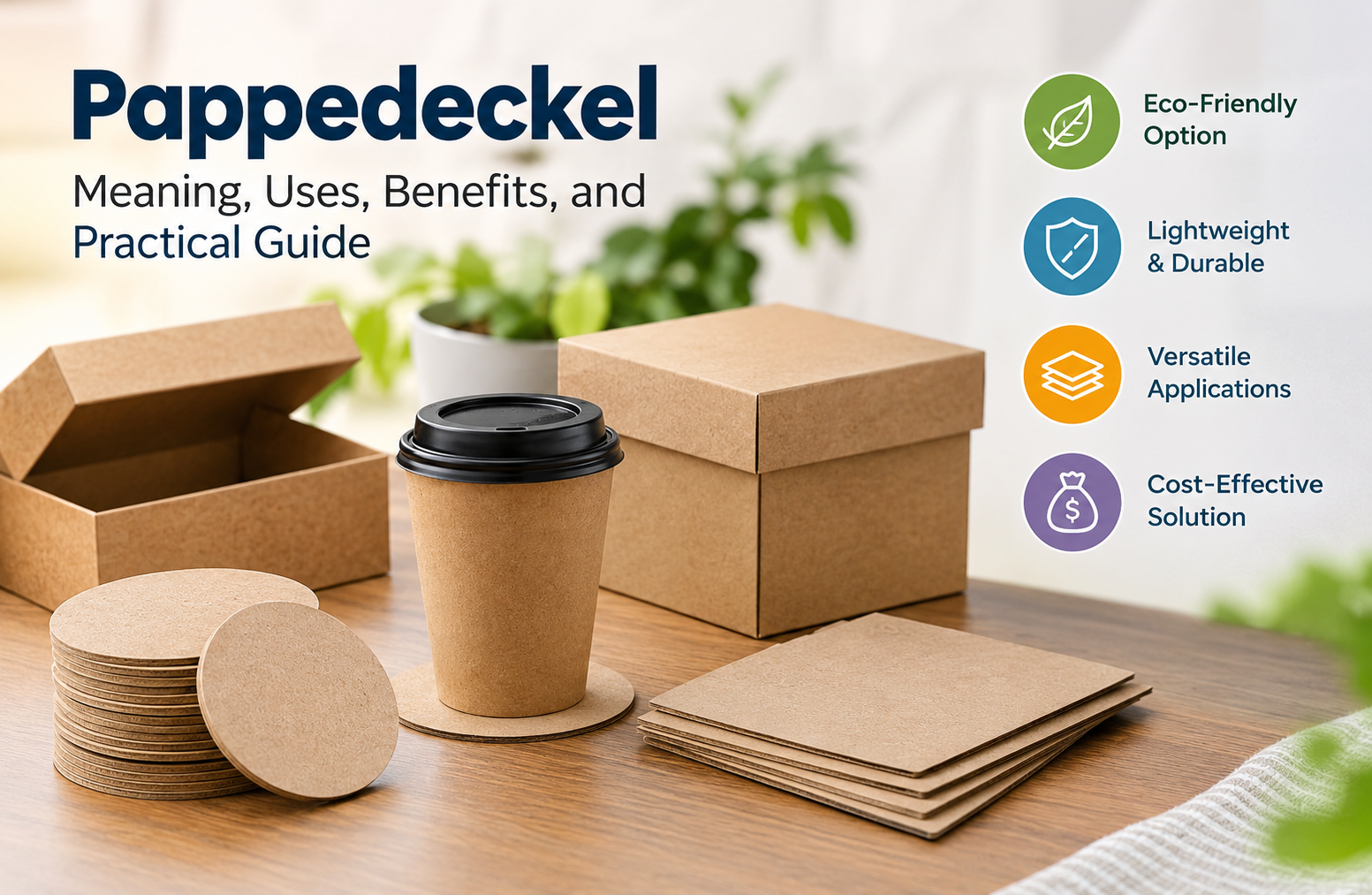
Pappedeckel: Meaning, Uses, Benefits, and Practical Guide
Pappedeckel is a German word associated with cardboard, paperboard, and flat cardboard covers used in everyday life. Depending on the context, it can refer to a cardboard lid, a thick paperboard disc, or a simple protective piece made from compressed paper fibers. Understanding the meaning of pappedeckel helps explain its role in packaging, food service, crafts, storage, and sustainable product design.
Cardboard products are widely used because they are lightweight, easy to handle, and suitable for many different applications. They can protect goods during transport, cover containers, separate products, and support creative projects. However, not every cardboard product offers the same level of strength, moisture resistance, or environmental performance.
The best way to understand this material is to look beyond its basic definition. Its usefulness depends on the type of paperboard, the thickness of the material, the conditions in which it will be used, and the protection required. These factors influence whether a cardboard cover is suitable for food packaging, industrial applications, household storage, or decorative work.
This guide explains the meaning of the term, its common applications, important benefits, practical limitations, and the factors to consider when choosing an appropriate cardboard product.
What Does Pappedeckel Mean?
Pappedeckel is a German compound word formed from Pappe, meaning cardboard or paperboard, and Deckel, meaning lid or cover. Its meaning therefore relates to a cardboard lid or cover, although the precise interpretation depends on the situation in which the word appears.
In everyday German usage, the word may describe a flat cardboard piece that covers an opening or protects the contents of a container. It can also appear in contexts involving drink coasters, packaging components, and other small paperboard products.
The term does not identify one universal material specification. A thin cardboard disc and a thick, rigid paperboard cover may both fit the general description, but their properties can differ considerably.
Understanding the Difference Between Cardboard and Paperboard
Cardboard and paperboard are often used interchangeably in everyday conversation. In manufacturing, however, product descriptions may distinguish between different grades, thicknesses, and structures.
Paperboard is generally a relatively thick paper-based material. It can be made from virgin wood fibers, recycled fibers, or a combination of both. Some products consist of a single layer, while others use several layers to achieve the required stiffness.
Corrugated board is different because it contains a fluted layer between flat liners. This structure provides cushioning and strength, making it particularly useful for shipping cartons and protective packaging.
A cardboard cover does not necessarily need a corrugated structure. Many small covers and discs use solid paperboard because it offers a flat surface and can be cut into precise shapes.
Why Context Matters When Interpreting the Word
A person searching for this German term may be looking for several different products.
For example, a customer looking for a beverage coaster needs a different item from someone searching for a lid for a storage box. Likewise, a manufacturer looking for packaging components may require a particular thickness, coating, or cutting tolerance.
When purchasing or translating the term, consider the intended product rather than relying on the word alone. Product photographs, dimensions, material specifications, and descriptions can help identify the correct item.
Pappedeckel and Its Common Applications
Cardboard covers are useful in many environments because they can be manufactured in different shapes, sizes, and thicknesses. Their practical value comes from matching the design to the task.
1. Food and Beverage Service
One familiar application is the use of small cardboard discs as beverage coasters. These products are placed under glasses, mugs, or bottles to catch condensation and protect surfaces from minor moisture.
Depending on the design, a coaster may also absorb small spills. Its performance depends on the paper fibers, surface treatment, thickness, and amount of liquid involved.
Cardboard covers can also form part of certain food packaging systems. For example, paperboard components may separate food items, cover trays, or provide a protective layer inside a package.
However, not every cardboard product is suitable for direct food contact. A product intended for industrial packaging should not automatically be used with unpackaged food. Food-contact suitability depends on the materials, coatings, adhesives, manufacturing conditions, and applicable regulations.
2. Product Packaging
Packaging manufacturers use paperboard components to protect products and keep packages organized.
A flat cardboard cover can separate items, close a compartment, or prevent the contents from shifting. It may also provide a clean surface for printing product information, branding, or handling instructions.
These components are particularly useful when a package requires a simple divider or cover rather than a complex molded insert.
The main advantage is design flexibility. A manufacturer can often adjust the dimensions, shape, thickness, and printing to fit the product.
Nevertheless, a flat cover is not always sufficient protection. Fragile products may need cushioning, reinforced corners, or a stronger outer container.
3. Household Storage
Cardboard covers can help keep stored items organized and reduce exposure to dust.
They may be used with boxes containing documents, photographs, accessories, craft materials, and other lightweight household goods. A properly fitted cover can also make a storage container easier to stack or move.
The suitability of the material depends on the storage environment. Dry indoor spaces are generally more appropriate than damp basements, uncovered outdoor areas, or locations exposed to leaks.
Cardboard can weaken when it absorbs moisture. For long-term storage, valuable documents and sensitive objects may require more durable containers and additional protection.
4. Arts and Crafts
Paperboard is popular in creative projects because it is relatively easy to cut, fold, glue, paint, and decorate.
Crafters can use cardboard covers as bases for ornaments, miniature models, decorative panels, handmade packaging, and school projects. Circular pieces can become coasters, while rectangular pieces can serve as backing boards or dividers.
The material is also useful for prototyping. Designers can make an inexpensive model before investing in a more durable material or a production-ready component.
For clean results, the cardboard should be selected according to the project. Thin board is easier to cut by hand, while thicker board provides more rigidity but may require stronger cutting tools.
5. Commercial and Industrial Use
Businesses may use paperboard covers as inexpensive components in packing, sorting, and product presentation.
Examples include separators for small products, backing pieces for retail packaging, protective layers between flat goods, and covers for lightweight containers.
In these applications, consistency is important. A manufacturer may need every piece to have the same dimensions, thickness, edge quality, and moisture characteristics.
Even a simple component can affect the efficiency of a packing line. Incorrect dimensions may cause misalignment, slow assembly, or create gaps that reduce protection.
For that reason, commercial buyers should evaluate the material and the manufacturing tolerances instead of focusing only on the unit price.
Key Benefits of Cardboard Covers
Cardboard products offer several practical benefits. Their suitability depends on the application, but a number of advantages explain their widespread use.
Lightweight Construction
Paperboard generally weighs less than many rigid alternatives made from metal, glass, or solid plastic.
A lightweight cover is easier to transport, handle, and incorporate into a package. In high-volume operations, reducing the weight of individual components can also contribute to lower total shipment weight.
The exact savings depend on the alternative material and the design. A reinforced cardboard component may weigh more than a very thin plastic alternative, so comparisons should use equivalent performance requirements.
Flexible Design Options
Cardboard can be produced in many shapes and sizes. Depending on the grade and manufacturing method, it can be cut, creased, printed, laminated, or combined with other packaging materials.
This flexibility allows manufacturers to create components for specific products instead of relying entirely on standard dimensions.
Custom designs can improve the fit between a cover and its container. A better fit may reduce movement, improve appearance, and make packaging easier to assemble.
Cost-Effective Production
Simple paperboard components can be economical, especially when manufactured in large quantities.
Cutting and printing processes can be adapted to different production volumes. Standard shapes may also be available from packaging suppliers, reducing the need for custom tooling.
However, the cheapest product is not always the most economical choice. A low-quality cover that bends, tears, or absorbs moisture too quickly may create waste and increase replacement costs.
Buyers should consider the total cost of use, including storage, handling, rejected pieces, and disposal.
Printing and Branding
Paperboard can provide a useful surface for printed designs, instructions, labels, and product information.
Businesses may use this surface to communicate handling guidance, display a logo, or create a more consistent presentation.
Printing quality depends on the surface finish, material color, ink system, and production method. Coatings can change the appearance and performance of the finished product.
For premium packaging, a sample should be checked before a large order is approved.
Potential Environmental Advantages
Paper-based products can offer environmental benefits when they are responsibly sourced, designed efficiently, and recovered through suitable recycling systems.
Some paperboard products contain recycled fibers, which can reduce the demand for virgin fiber. Lightweight construction can also reduce material use compared with some heavier alternatives.
However, a cardboard product is not automatically sustainable simply because it is made from paper.
Its environmental impact depends on fiber sourcing, manufacturing energy, transport, coatings, adhesives, product lifespan, and end-of-life treatment. A laminated or heavily contaminated product may be harder to recycle than an uncoated alternative.
The most responsible choice is to evaluate the complete product system rather than relying on a single label such as recyclable, natural, or eco-friendly.
Materials and Manufacturing Methods
Understanding how cardboard covers are made helps buyers assess their strength, appearance, and expected performance.
Virgin and Recycled Fibers
Paperboard can be produced using virgin fibers, recycled fibers, or a mixture of the two.
Virgin fibers may be selected where specific strength, cleanliness, surface quality, or consistency requirements apply. Recycled fibers can help make use of recovered paper and reduce the demand for newly sourced fiber.
Neither option is automatically best for every application. The correct choice depends on the required performance, product specifications, available supply, and relevant environmental considerations.
Recycled paperboard may have a different color, surface texture, or strength profile from some virgin-fiber grades. These differences should be considered when appearance or precise mechanical performance matters.
Thickness and Stiffness
Thickness affects how a paperboard component feels and performs, but thickness alone does not determine strength.
Fiber quality, density, layer structure, grain direction, and moisture content can also affect stiffness and resistance to bending.
A thicker piece may provide greater rigidity, yet a poorly selected grade can still buckle under pressure. A product should therefore be tested under conditions similar to its intended use.
For packaging applications, useful tests may include bending resistance, compression, edge quality, and dimensional stability.
Cutting and Finishing
Cardboard covers may be manufactured using die cutting, digital cutting, or other converting processes.
Die cutting is commonly useful for repeated shapes and higher production volumes. Digital cutting can be practical for prototypes, small batches, and custom designs.
The edges should be clean enough for the intended application. Rough edges, loose fibers, and inaccurate dimensions may affect appearance or interfere with automated packaging equipment.
Finishing may include printing, coating, embossing, or lamination. Each process changes the appearance or performance of the final product and may affect its recyclability.
Moisture Resistance
Untreated paperboard can absorb water from spills, humid air, or direct contact with wet surfaces.
As moisture enters the fibers, the material may soften, warp, swell, or lose strength. A coating can improve resistance, but the level of protection depends on the formulation and construction.
Water resistance should not be confused with waterproofing. A product that tolerates brief contact with a few drops may not withstand prolonged exposure or immersion.
When moisture matters, suppliers should provide clear specifications and, where necessary, test results.
How to Choose the Right Product
Choosing a suitable cardboard cover requires more than selecting a shape. The material should match the environment, load, and expected lifespan.
Step 1: Define the Purpose
Start by identifying exactly what the component must do.
Ask whether it needs to cover an opening, separate products, protect a surface, absorb condensation, or improve presentation. These tasks require different material properties.
A coaster may need absorbency, while a packaging insert may need rigidity and accurate dimensions. A storage cover may prioritize a close fit and resistance to routine handling.
Writing down the main requirement makes comparisons between products much easier.
Step 2: Measure the Required Dimensions
Measure the length, width, diameter, and thickness required for the application.
For a round disc, confirm the diameter. For a rectangular cover, record both dimensions and any corner or edge requirements.
If the component must fit inside another product, measure the internal space rather than assuming that the outside dimensions will provide a suitable fit.
Allowances should be based on the design and manufacturing process. A component intended for an automated production line may require tighter tolerances than one used for a handmade craft project.
Step 3: Select the Material Grade
Choose a paperboard grade that provides sufficient stiffness and durability.
For light decorative work, a thinner material may be adequate. For protective packaging, thicker or more rigid board may be necessary.
Consider whether the material will face pressure, repeated handling, friction, or moisture. A sample test can reveal problems that are difficult to identify from a product description.
Step 4: Consider Food Contact and Hygiene
If the product will be used around food or beverages, verify that it is intended for that application.
Ask the supplier about food-contact suitability, coatings, inks, adhesives, and relevant compliance documentation.
A material that looks clean is not necessarily approved for direct food contact. Likewise, a general-purpose recycled board may not be appropriate for every food-related use.
The intended application and applicable regulations should determine the specification.
Step 5: Evaluate Environmental Requirements
Check whether the product contains recycled fiber, whether its coatings affect recycling, and whether local collection systems accept that type of paperboard.
Avoid assuming that all paper-based products can be recycled in every location. Food residue, grease, plastic films, and certain coatings may affect recovery options.
If sustainability is a purchasing priority, request specific information from the manufacturer rather than relying only on broad marketing claims.
Step 6: Compare Samples Before Ordering
When possible, obtain samples from more than one supplier.
Compare the pieces for thickness, stiffness, cutting quality, surface finish, and fit. Test them under realistic conditions, including any expected moisture or handling.
For business purchases, also consider delivery consistency, minimum order quantities, production lead times, and the supplier’s ability to maintain specifications.
A small sample evaluation can prevent larger problems during production or delivery.
Common Challenges and Limitations
Although cardboard covers are practical, they are not suitable for every environment or task.
Sensitivity to Water
Moisture is one of the most common causes of paperboard failure.
A cover exposed to a spill may become soft or lose its shape. In humid conditions, some grades may change dimensions even without direct contact with liquid.
For wet environments, consider a material specifically designed for moisture exposure or use an alternative material where appropriate.
Limited Load-Bearing Capacity
A flat cardboard cover may support light pressure but fail under a concentrated load.
The amount of weight it can withstand depends on its thickness, grade, span, support, and orientation. There is no single safe load rating for all products described by this term.
If a cover will support other items, test the actual design under realistic conditions. Do not assume that a thicker piece will automatically provide sufficient structural strength.
Wear During Repeated Use
Repeated bending, rubbing, and handling can damage paper fibers.
A product designed for one-time packaging may not last when used daily. Edges can fray, surfaces can become marked, and folds may weaken.
For reusable applications, compare the expected lifespan with that of alternatives such as washable plastic, metal, or durable molded materials.
Differences Between Suppliers
Products that look similar may differ in fiber composition, density, cutting accuracy, and surface finish.
These differences can affect both performance and consistency. This is particularly important for businesses that use large quantities or automated packing equipment.
Clear specifications and sample approval help reduce uncertainty.
Recycling and Disposal Confusion
A paper-based appearance does not guarantee that every component can enter the same recycling stream.
Plastic laminates, metalized surfaces, adhesives, and food contamination may complicate recovery. Local recycling rules also differ.
The appropriate disposal method should be based on the actual material construction and local waste-management guidance.
Practical Examples of Everyday Use
Real-world examples show why the intended application matters more than the name of the product.
A Cafe Choosing Beverage Coasters
A cafe may need coasters that absorb condensation, maintain their shape during service, and provide a clean surface for a printed logo.
The owner should compare absorbency, thickness, print quality, and cost per unit. If the coasters are intended for one-time use, long-term durability may be less important than performance during a single service.
A short trial during normal business hours can reveal whether the coasters become saturated too quickly or leave marks on tables.
An Online Store Protecting Small Products
An online retailer may use flat paperboard pieces to separate items inside a shipping box.
The pieces should fit the package, remain stable during handling, and prevent direct contact between products. If the items are fragile, the board may need to be combined with cushioning rather than used alone.
The retailer should evaluate the entire package because a strong insert cannot compensate for an unsuitable outer box or insufficient cushioning.
A Craft Project Using Recycled Board
A student or craft maker may reuse clean cardboard pieces to create models, dividers, or decorative items.
The most important factors may be cut quality, thickness, and ease of gluing or painting. A simple prototype helps determine whether the selected board bends too easily or is difficult to shape.
Reuse can extend the useful life of suitable material, although painted or coated pieces may have different disposal options afterward.
A Manufacturer Ordering Custom Covers
A manufacturer may need thousands of identical pieces for packaging or assembly.
The purchasing team should define dimensions, thickness, material grade, surface requirements, and acceptable tolerances. A supplier should confirm that the manufacturing process can consistently meet those specifications.
Before approving the full order, the manufacturer should inspect a sample and document the agreed requirements. This reduces the risk of receiving components that do not fit the production process.
Sustainability: What Buyers Should Understand
Environmental performance is an important consideration when selecting paper-based packaging, but it requires careful evaluation.
Recycled Content and Responsible Sourcing
Recycled fiber can reduce reliance on virgin material. Responsible sourcing can also help address concerns about forest management and the origin of raw materials.
However, recycled content alone does not describe the complete environmental impact. Energy use, water use, transport, durability, and disposal all contribute to the overall picture.
Buyers should look for specific, verifiable claims rather than vague statements that a product is completely sustainable.
Recyclability Depends on Construction
Uncoated paperboard is often easier to process in paper recycling systems than products with complex mixed-material layers.
Yet acceptance varies by local facility. Some facilities can process certain coatings, while others may not accept the same products.
When recycling is a priority, confirm local guidance and ask the manufacturer about the product’s full construction.
Reuse Versus Single Use
Some cardboard components can be reused if they remain clean, dry, and structurally sound.
Reuse may be practical for storage, craft materials, or internal packaging operations. However, a component used for food contact or exposed to contamination may not be appropriate for reuse.
The best option depends on hygiene, product safety, and the number of uses the material can reliably support.
Avoiding Unnecessary Material
Using the correct dimensions and thickness can reduce unnecessary material consumption.
An oversized or excessively thick component may add cost without improving performance. On the other hand, a material that is too thin may fail and need replacement.
Good design balances strength, weight, function, and end-of-life considerations.
Frequently Asked Questions
What does pappedeckel mean in English?
Pappedeckel is a German term that generally refers to a cardboard lid, cover, or similar flat paperboard component. Its exact meaning depends on the product and context.
What is pappedeckel commonly used for?
Common applications may include beverage coasters, packaging covers, product separators, household storage, and craft projects. The suitable use depends on the material’s strength and moisture resistance.
Is cardboard paperboard recyclable?
Many paperboard products can be recycled, but acceptance depends on their coatings, adhesives, contamination, and local recycling facilities. Check local guidance before disposing of a specific product.
Is pappedeckel suitable for food packaging?
It may be suitable when the product is specifically designed and approved for the intended food-contact application. General-purpose cardboard should not automatically be assumed safe for direct contact with food.
Can cardboard covers withstand water?
Ordinary untreated paperboard is generally vulnerable to moisture. Some specially treated products resist water better, but water resistance does not necessarily mean that a product is waterproof.
How do I choose the correct cardboard cover?
Identify the purpose, measure the required dimensions, select an appropriate material grade, and consider moisture, hygiene, strength, and recycling requirements. Testing a sample before purchasing in bulk is a practical way to reduce risk.
Conclusion
Pappedeckel describes a useful category of cardboard covers and related paperboard components. These products can support packaging, food service, storage, creative work, and commercial operations when their material properties match the intended task.
Their main advantages include lightweight construction, flexible design, accessible production methods, and opportunities for printing or customization. At the same time, buyers should understand their limitations, particularly their sensitivity to moisture, restricted load-bearing capacity, and differences in recyclability.
Choosing the right product begins with a clear understanding of its purpose. Dimensions, thickness, fiber composition, surface treatments, and environmental conditions all influence performance. Food-related applications also require particular attention to suitability and compliance.
Ultimately, the most effective cardboard solution is not necessarily the thickest or cheapest one. It is the product that meets the required performance standards, fits the application, and minimizes unnecessary material without compromising safety or reliability.






2 Comments