Bilieter: Meaning, Uses, Benefits, and Common Confusions
Bilieter is an uncommon term that can be confusing when encountered in online searches, articles, or discussions about tickets and public events. Although the spelling does not have one widely established definition in standard English, it is often associated with ticket collection, admission control, and the work of ushers. Understanding bilieter requires looking at its context, its relationship to similar words, and the situations in which people may use it. This guide explains the term in straightforward language, explores its possible meanings, and shows how to distinguish reliable information from assumptions.
What Is Bilieter?
Bilieter is best understood as an uncommon, context-dependent term rather than a standard English word with one universally accepted definition. In ticket-related contexts, it may be used to describe a person who checks tickets, collects admission passes, or helps visitors enter a venue. However, these duties are more commonly described in English using terms such as ticket collector, ticket attendant, usher, or admission staff member.
The distinction matters because similar-looking words do not always have identical meanings. The Polish word bileter, for example, refers to a ticket collector or usher. The English spelling bilieter resembles that word, but the resemblance alone does not establish that both spellings are interchangeable.
The term may also appear as a website name, an online search phrase, a username, or an unusual spelling in published content. In those situations, it may have no direct connection to a person’s occupation.
The most reliable way to interpret it is to examine the surrounding information. A sentence about theater admission suggests a different interpretation from a webpage discussing a business, publication, or digital service.
A simple explanation
If someone uses bilieter while discussing a cinema, theater, concert, or similar venue, they may mean a person who handles tickets or assists guests at the entrance.
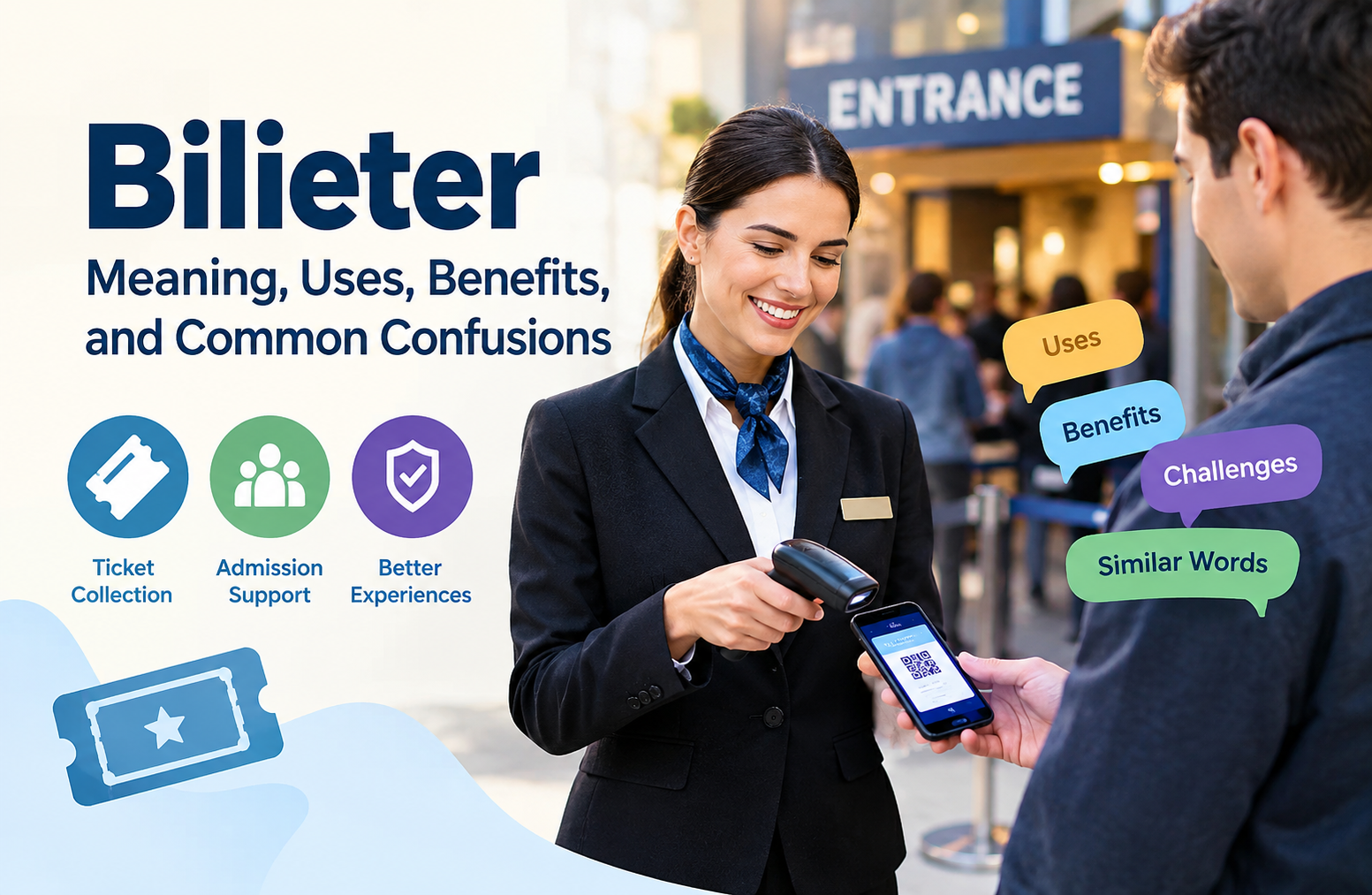
For example, imagine a visitor arriving at a theater with an electronic ticket. An employee scans the ticket, confirms that it is valid, and directs the visitor toward the correct seating area. In ordinary English, that employee might be called an usher or ticket attendant.
Calling the employee a bilieter might communicate a similar idea in a particular context, but it is not the clearest choice for general English writing.
When accuracy is important, established terminology should be preferred over an unfamiliar word whose meaning may not be clear to every reader.
Understanding the Origin and Language Behind Bilieter
Investigating an unfamiliar word requires separating its spelling from its possible linguistic roots. A word may resemble an established term without sharing precisely the same history or accepted meaning.
In this case, one useful comparison is the Polish word bileter, which is associated with ticket checking and collecting. This provides a reasonable explanation for why some online sources connect bilieter with admission duties.
However, it would be inaccurate to claim that the English spelling bilieter has a fully documented origin or a universally accepted historical meaning without stronger linguistic evidence.
The relationship with bileter
The Polish word bileter is a useful point of comparison because it refers to a person associated with tickets, such as a ticket collector or usher.
People researching unfamiliar vocabulary may encounter translated words, transliterations, spelling variations, or terms adapted for audiences who speak another language. These variations can become visible online even when they are not accepted spellings in standard English.
That possibility helps explain the connection between bilieter and ticket-related work.
Nevertheless, readers should distinguish between a documented foreign-language word and an uncertain English spelling. One can help explain the other without making them identical.
The difference between billet and billeter
Another source of confusion is the English word billet. Depending on the context, it can refer to temporary accommodation, particularly accommodation arranged for military personnel. It also has other established meanings, including a piece of metal prepared for further manufacturing.
The uncommon English word billeter is associated with the act of billeting or arranging accommodation. This is different from the ticket-collection meaning associated with Polish bileter.
The similar spelling can lead to incorrect assumptions, especially when an article discusses the words without explaining their separate backgrounds.
A useful distinction is:
- Bilieter: An uncommon spelling whose intended meaning depends on context.
- Bileter: A Polish word associated with ticket collection and ushering.
- Billet: An English word with established meanings that include temporary accommodation and a metal workpiece.
- Billeter: An uncommon English term associated with arranging billets or accommodation.
- Ticket attendant: A clear, established English expression for someone who assists with ticket-related duties.
These distinctions make it easier to interpret unfamiliar text without treating every similar spelling as a synonym.
What Does Bilieter Mean in Different Contexts?
The meaning a reader assigns to an unfamiliar term should depend on the situation in which it appears. Context is especially important when a word is rare, inconsistently spelled, or used across multiple languages.
Theater and cinema
In a theater or cinema, the likely subject may be admission staff.
These employees can check tickets, help visitors find seats, explain basic venue rules, and direct people toward entrances or designated areas. Their exact responsibilities depend on the organization and the job description.
If bilieter appears in a sentence describing these tasks, the writer may intend a meaning similar to usher or ticket attendant.
For a general audience, however, using the familiar occupational title is usually clearer.
Concerts and festivals
Large events need an organized way to admit visitors and direct them through entrances.
Depending on the venue, staff members may scan digital tickets, inspect printed passes, check wristbands, answer questions, and direct guests toward the appropriate section.
The term bilieter might appear in an article about such work, but readers should not assume that it represents a recognized job title used by every event organizer.
A job advertisement, employment contract, or official staff handbook should be interpreted according to its actual wording and responsibilities.
Public transportation
Ticket inspection is also relevant to buses, trains, and other transportation systems.
In some systems, employees verify tickets, check travel passes, or collect fares. Other systems use electronic gates, automated validation equipment, or inspections carried out by authorized personnel.
A ticket-related interpretation of bilieter may make sense in this setting, but established terms such as ticket inspector, ticket collector, and fare inspector are more widely understandable in English.
The correct term depends on the country, transportation operator, and duties involved.
Websites and digital publications
When the word appears as the name of a website, it should be treated as a proper name unless the website itself establishes another meaning.
A publication could use an unusual word as its brand name without claiming that the word is part of standard English vocabulary.
Readers should therefore distinguish between a website’s name, the subjects it covers, and any dictionary definition of the word.
The name alone does not prove that a website operates a ticketing service, sells event passes, or provides a particular digital product.
Historical or accommodation-related writing
If the surrounding text discusses soldiers, lodging, accommodation assignments, or historical arrangements, the intended word may be billet or billeter rather than bilieter.
In this context, the ticket-related interpretation may be incorrect.
The lesson is straightforward: spelling similarities are clues, not proof. Reading the full sentence and identifying the subject of the discussion are essential steps.
What Does a Ticket Attendant Actually Do?
Because bilieter is often associated online with ticket-related duties, it is helpful to understand the established work that may be intended by that interpretation.
Ticket attendants and ushers help visitors enter venues and navigate public spaces. Their responsibilities vary according to the type of organization, the size of an event, and the needs of the audience.
Checking admission tickets
One of the most recognizable duties is checking whether a visitor has a valid ticket or admission pass.
The employee may compare the ticket with an entry requirement, scan a barcode or QR code, or direct the visitor to an automated entrance.
The process helps organizers manage access and identify problems such as invalid tickets or entry to the wrong section.
Helping visitors find their seats
At theaters, concert halls, and other seated venues, ushers may help visitors locate their rows and seats.
This can be particularly useful in large buildings, where visitors may be unfamiliar with the layout or need assistance identifying accessible routes.
Clear directions reduce confusion and help people reach their destinations without unnecessary delays.
Providing basic information
Admission staff are often among the first employees visitors encounter.
They may answer questions about entrances, seating sections, restrooms, accessibility arrangements, event schedules, or venue rules.
They should provide information within their role and refer complex questions to the appropriate supervisor or department.
Supporting an organized entry process
At busy events, staff members may help manage queues, direct visitors toward suitable entrances, and communicate delays.
Their role can contribute to a smoother experience, although overall crowd safety depends on the venue’s planning, trained security personnel, emergency procedures, and other operational measures.
Ticket checking alone does not make an employee responsible for every aspect of crowd management.
Handling ticketing problems
Some visitors arrive with a damaged ticket, an unreadable screen, a booking confirmation instead of an admission pass, or a ticket for a different date.
Staff may explain the next step or direct the visitor to a ticket office or customer service desk.
They should not promise admission or override ticketing rules unless their role gives them the authority to do so.
These examples describe recognized ticket-related occupations, not a verified universal job description for anyone called a bilieter.
Why Ticket Checking and Admission Management Matter
Organized admission is more than a routine task at a venue entrance. It connects customer service, access control, event planning, and the practical management of visitor movement.
Understanding these responsibilities helps clarify why a ticket-related interpretation of bilieter appears in some online discussions.
Better visitor experiences
A well-organized entrance helps visitors understand where to go and what they need to present.
When staff provide clear instructions, people are less likely to form unnecessary queues, enter the wrong section, or miss important information.
The quality of the experience depends on several factors, including staff training, signage, ticket design, venue layout, and the number of people arriving at the same time.
More efficient entry
Ticket validation can help identify invalid or duplicate admissions and reduce confusion at access points.
Digital scanning systems may speed up certain processes, but they still require reliable equipment, clear procedures, and an alternative process for technical problems.
An electronic system is not automatically more effective simply because it uses newer technology.
Clearer communication
Visitors often have different levels of familiarity with a venue. Some attend regularly, while others may be visiting for the first time.
Staff who communicate calmly and clearly can help people understand instructions without making the process unnecessarily difficult.
This is particularly important when visitors are dealing with a language barrier, unfamiliar ticket formats, or changes to the original event arrangements.
Improved access to assistance
Some visitors need help finding an accessible entrance, identifying suitable seating, or understanding a venue’s facilities.
Staff should know how to direct these requests to the appropriate team and follow the venue’s accessibility procedures.
Good admission management considers the needs of different visitors rather than treating every entry as an identical transaction.
Digital Ticketing and the Changing Role of Admission Staff
Technology has changed how many organizations sell, issue, and validate tickets. Printed tickets remain in use, but electronic tickets and mobile passes have become common in many settings.
This development is relevant when discussing ticket-related work, although it does not establish bilieter as the official name of a digital platform or technology.
Electronic tickets and QR codes
An electronic ticket may be delivered through email, a mobile application, or an online booking account.
At an entrance, the visitor presents the ticket on a phone or as a printed copy if the organizer accepts that format. A scanner may verify the code against the event’s admission system.
This approach can reduce dependence on printed materials and allow some information to be managed electronically.
However, it also creates practical concerns. Visitors may have low battery power, poor internet access, a damaged screen, or difficulty locating their booking confirmation.
A well-planned admission process explains the accepted formats and provides a clear way to resolve common problems.
Ticket verification and duplicate entries
Digital systems can help organizers identify tickets that have already been used or that do not match the event.
The exact capabilities depend on the software and how the system has been configured.
Staff should follow the operator’s procedures when a ticket cannot be verified. They should not assume that every scanning error indicates fraud, since technical faults and booking mistakes can also occur.
Privacy and personal information
Online ticketing may involve names, email addresses, payment information, booking references, or other personal details.
Organizations should handle such information according to applicable privacy laws and their stated policies. Employees should access only the information needed for their duties and avoid sharing visitor details with unauthorized people.
Visitors can also take sensible precautions by purchasing through official or trusted channels, protecting account credentials, and avoiding the public sharing of ticket barcodes.
Technology still needs human support
Automated gates and scanning systems can handle routine tasks, but they do not remove the need for assistance.
Visitors may require directions, accessibility support, clarification about an event, or help resolving an unusual ticket problem.
The strongest admission processes combine appropriate technology with trained staff and understandable instructions.
Common Challenges in Ticket-Related Work
Ticket-related duties may appear simple, but busy venues can create situations that require patience, clear communication, and good judgment.
Long queues and late arrivals
When many people arrive shortly before an event starts, entrances can become crowded.
Organizers can reduce avoidable delays by providing accurate arrival guidance, opening suitable entry points, and using clear signage. Staff need to communicate changes consistently and follow established crowd-management procedures.
Visitors can help by checking their ticket details before leaving home and arriving within the recommended entry window.
Invalid or misunderstood tickets
A visitor may present a ticket for the wrong date, a screenshot that cannot be validated, or a confirmation email that is not itself an admission pass.
The correct response depends on the organizer’s rules. Staff should explain the issue and direct the visitor to an authorized support channel instead of making unsupported promises.
Visitors should review the ticket instructions before attending, particularly when an event has specific entry requirements.
Communication barriers
Events may attract people who speak different languages or have varying levels of familiarity with the venue.
Simple wording, clear signs, maps, and consistent instructions can make the entry process easier to understand.
When a question exceeds an employee’s responsibilities, referring the visitor to a qualified colleague is better than guessing.
Equipment failures
A scanner may stop working, a network connection may fail, or an electronic ticket may not display correctly.
Organizers should establish procedures for these situations before an event begins. Depending on the system, staff may need to use an approved backup process or contact a supervisor.
Security should not be sacrificed merely to keep a queue moving.
Unclear responsibilities
Problems can arise when staff do not know who is authorized to resolve a ticket dispute, approve an exception, or handle a safety concern.
Clear role descriptions and escalation procedures help employees respond consistently.
This is one reason job titles and official instructions matter. A vague or unfamiliar label should never be used as a substitute for a clear explanation of responsibilities.
How to Understand Bilieter When You Encounter It Online
If you see the word in an article, website, social media post, or document, a few practical checks can help you interpret it correctly.
Step 1: Read the complete sentence
Do not rely on the isolated word alone.
Look for nearby references to tickets, admission, theaters, transport, accommodation, websites, or businesses. These clues help narrow the possible meaning.
Step 2: Identify whether it is a common noun or a name
A lowercase term used to describe an employee may be intended as a job-related expression.
A capitalized version appearing in a website title, company name, or product heading may instead be a proper name. Capitalization is a useful clue, although it is not conclusive.
Step 3: Compare it with established terminology
If the subject concerns admission, look for established expressions such as ticket collector, ticket attendant, usher, or ticket inspector.
If the subject concerns lodging, investigate the meanings of billet and billeter.
Comparing related terms can reveal whether a source is using a recognized word, a foreign-language expression, or an uncertain spelling.
Step 4: Check a reliable dictionary
A reputable dictionary or translation resource can help confirm whether a related word exists and what it means in a particular language.
For example, the Collins English Dictionary’s Polish-English entry for bileter helps establish the connection between that Polish word and ticket-related work.
It is important to check the exact spelling and language. A dictionary entry for bileter should not automatically be presented as proof that bilieter is a standard English word.
Step 5: Evaluate the source’s claims
An article may confidently define an unfamiliar term without providing reliable evidence.
Look for a clear explanation, relevant references, accurate distinctions between similar words, and evidence that supports any historical or technical claims.
If a source identifies bilieter as a particular company, product, or service, seek confirmation from the relevant official source before relying on that identification.
Step 6: Choose the clearest wording
If you are writing for an English-speaking audience, use a recognized term whenever possible.
For example, write “ticket attendant” when referring to a person checking admission tickets. This wording is immediately understandable and avoids making readers guess what an unfamiliar expression means.
If the original spelling is important to your discussion, explain its uncertainty and distinguish it from established related words.
Is Bilieter a Useful Word in Modern English?
The usefulness of a word depends on whether readers understand it and whether it communicates a meaning more effectively than available alternatives.
Bilieter may be useful when discussing the search term itself, examining an unusual spelling, or explaining how a related foreign-language word is used.
It is less suitable as a general occupational title in English because readers may not recognize it or may interpret it differently.
Clarity is more important than novelty
Unusual vocabulary can attract attention, but unfamiliar wording may also create confusion.
In practical writing, the goal is to communicate an idea accurately. If the intended meaning is a ticket collector, usher, or ticket attendant, choosing the established term makes the sentence easier to understand.
This principle applies to websites, educational material, business documents, job descriptions, and customer service instructions.
Search terms do not always reflect standard vocabulary
People search for unfamiliar words for many reasons. They may have encountered a spelling in an article, copied a term from a message, heard a word spoken aloud, or seen it in another language.
As a result, a search query can be useful even when the spelling is uncommon or the meaning remains uncertain.
A careful explanation should answer the searcher’s question without inventing a history or presenting a guess as a proven fact.
Context determines the best explanation
A language learner may need a translation. A reader researching a website may need to identify the organization behind its name. Someone reading about a theater may simply need to understand an employee’s role.
These are different needs, even though they involve the same search term.
A helpful explanation recognizes these possibilities and provides enough context for readers to identify which one applies to their situation.
Frequently Asked Questions About Bilieter
What does bilieter mean?
Bilieter is an uncommon term without one universally established English definition. In ticket-related contexts, it may be intended to refer to a ticket collector, usher, or admission attendant.
Is bilieter a standard English word?
Bilieter is not widely recognized as a standardized English word with one accepted definition. Its intended meaning should be determined from the context in which it appears.
Is bilieter the same as bileter?
Not necessarily. Bileter is a Polish word associated with ticket collection and ushering, while bilieter is an uncommon spelling that may be used with a similar intended meaning. The two should not automatically be treated as identical.
What does a ticket attendant do?
A ticket attendant may check admission passes, verify electronic tickets, direct visitors toward entrances, answer basic questions, and refer ticket problems to the appropriate department. Exact responsibilities depend on the employer and venue.
Is bilieter related to the word billet?
The spellings are similar, but their meanings are not necessarily related in the way a reader might assume. Billet has established English meanings that include temporary accommodation and a metal workpiece, while bilieter is an uncommon, context-dependent spelling.
How can I find the correct meaning of bilieter?
Read the surrounding text, identify the language and subject, compare similar spellings, and consult a reputable dictionary or official source. Avoid accepting a specific definition without evidence.
Conclusion
Bilieter is an unusual term whose meaning depends on the context in which it appears. It is frequently associated online with ticket collection, admission, and ushering, but the spelling should not be confused with established English vocabulary or treated as having one universally accepted definition.
The Polish word bileter provides a useful comparison for understanding the ticket-related interpretation. By contrast, billet and billeter have different established associations, including temporary accommodation. Recognizing these differences prevents incorrect translations and misleading explanations.
For readers researching the term, the most effective approach is to examine the complete sentence, identify the relevant subject, and verify related words using reliable language resources. In ordinary English communication, established terms such as ticket attendant, ticket collector, usher, and ticket inspector are generally clearer choices when describing admission-related duties.
Ultimately, understanding an unfamiliar word requires more than matching its spelling to another term. Accurate interpretation depends on context, evidence, and a willingness to distinguish what is known from what is merely possible.