Instavade: Features, Safety, Privacy, and What You Should Know
Instavade is a name associated with Instagram analytics, profile activity tracking, and simulated social media insights. People searching for Instavade often want to know whether it can reveal profile visitors, show story interactions, identify unfollowers, or provide access to private Instagram activity. However, understanding what the platform actually does is essential before using it. Some websites associated with this name advertise tracking features, while the website at instavade.net describes itself as an Instagram analytics and engagement simulator that generates illustrative information rather than retrieving real account data. This distinction matters because realistic-looking statistics are not necessarily genuine Instagram activity.
Instagram users naturally want to understand their audience and interactions. A creator may want to know who watches their content, while an ordinary user may wonder whether someone has visited their profile or stopped following them. These questions create demand for third-party tools that promise deeper insights. Yet not every advertised feature is technically possible, and not every website using a familiar name should be trusted automatically.
This article explains the available information about the platform, its stated features, its limitations, potential privacy risks, and practical ways to evaluate Instagram analytics tools. It also explains how to distinguish simulated information from genuine account data, helping readers make informed decisions without exposing their personal information.
What Is Instavade?
Instavade is a name used by websites promoting Instagram-related analytics, activity tracking, and simulated engagement tools. The exact functionality depends on the domain being visited, so it is important not to assume that every website using this name operates in the same way.
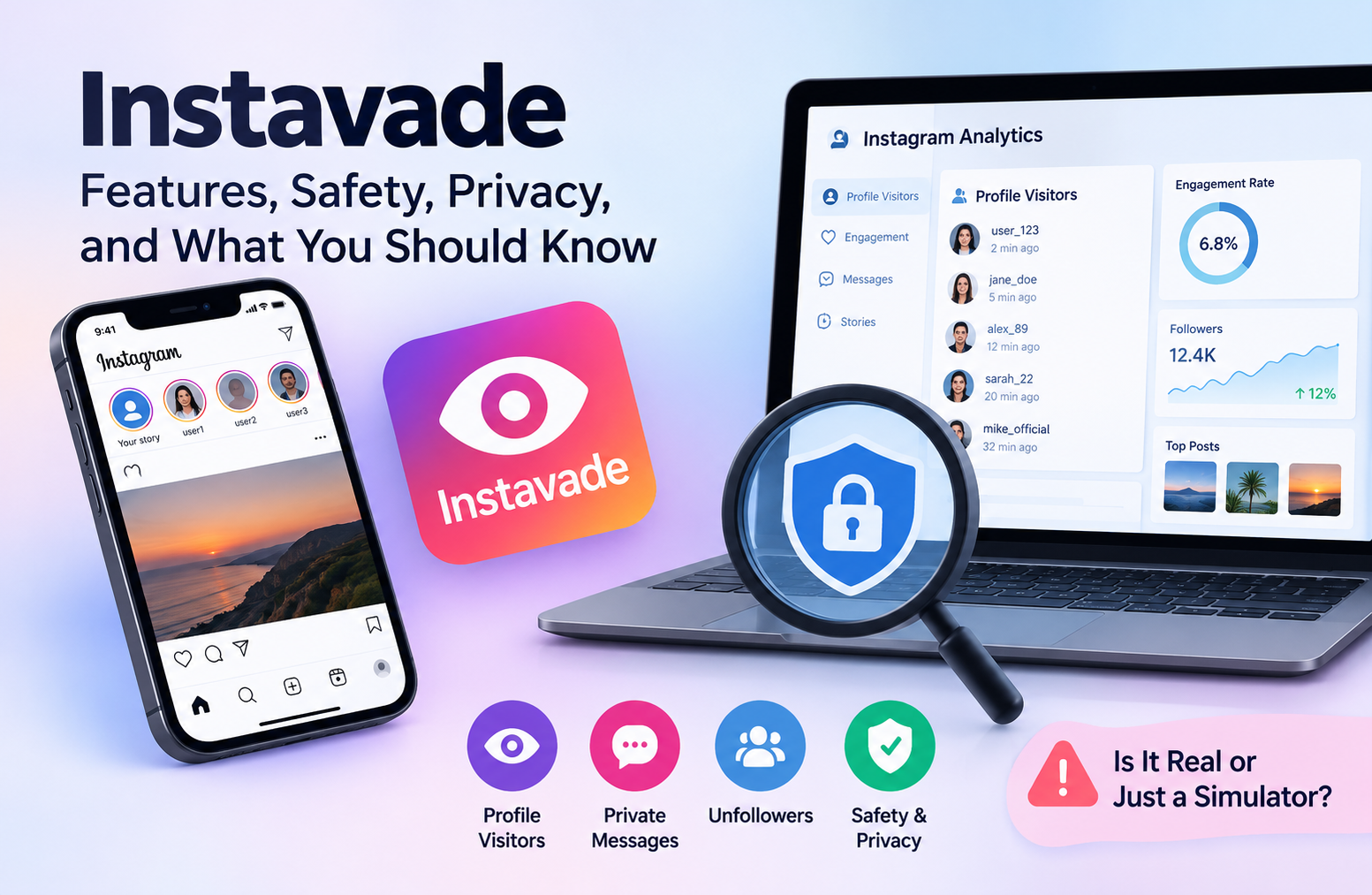
The website at instavade.net describes its service as an Instagram analytics and engagement simulator. According to its published description, the platform generates illustrative profile visitor logs, engagement metrics, and direct message previews for entertainment, digital literacy, and mockup creation. It states that these generated results do not come from actual Instagram accounts.
This means that the simulator can present information that resembles a social media dashboard without providing genuine evidence of who visited a profile or sent a message.
Other websites using similar branding have advertised features such as profile-view tracking, story replay information, and unfollower identification. Those claims must be evaluated individually because a shared name does not establish that the websites have the same owner, technology, privacy practices, or data sources.
Why Are People Searching for This Platform?
Interest in Instagram tracking tools comes from several common questions:
- Can someone see who visits their Instagram profile?
- Is it possible to view Instagram Stories without appearing in the viewer list?
- Can a person discover who unfollowed their account?
- Are third-party Instagram analytics tools reliable?
- Can an online service reveal private messages or hidden interactions?
- Is it safe to use an Instagram tool without logging into an account?
These questions involve different types of information. Some information is publicly visible, some is available only to the account owner, and some is not exposed through Instagram’s ordinary public features at all.
A tool may be useful for demonstrating how analytics dashboards work without being capable of answering questions about actual Instagram users. Recognizing this difference is the first step toward using social media tools responsibly.
Is It an Instagram-Owned Service?
The available description of instavade.net presents it as a third-party simulator, not an official Instagram product. Users should not assume that a website is affiliated with Instagram or Meta simply because it uses Instagram-related branding or terminology.
Before using any service, check its ownership information, contact details, privacy policy, terms of service, and explanations of how its data is obtained. If those details are missing or difficult to verify, treat the service cautiously.
How Instavade Works
The way the platform works depends on which website you visit. For instavade.net, the published description identifies the service as a simulator that generates illustrative information. This is different from an analytics service that obtains authorized account statistics or retrieves publicly available content.
Understanding that distinction makes its advertised functions easier to evaluate.
1. Simulated Profile Visitor Tracking
One feature described by the simulator is a profile visitor dashboard. It can generate a list of example visitors, timestamps, and activity patterns that resemble an analytics report.
However, generated visitor entries should not be interpreted as evidence that the named people actually visited an Instagram profile.
For example, imagine that a dashboard displays five usernames alongside timestamps and visit frequencies. The interface may look convincing, but if the information is generated by the application, none of those entries establishes that the individuals visited the account.
This is an important distinction between a demonstration and a measurement. A demonstration illustrates how information might appear, while a measurement requires actual data from a reliable source.
A simulated visitor dashboard may be useful for interface demonstrations or digital literacy exercises. It is not a dependable method for identifying real profile visitors.
2. Engagement Statistics and Activity Dashboards
Social media analytics commonly involve measurements such as likes, comments, reach, impressions, and follower growth. Genuine analytics can help creators understand how their content performs.
A simulator can reproduce the appearance of these measurements using sample figures. It may show charts, activity percentages, engagement summaries, or other dashboard elements.
These figures are only meaningful as examples when they are generated for demonstration purposes. They should not be used to make decisions about an actual account’s performance.
For example, a simulated dashboard might display an increase in engagement over a particular period. That increase does not prove that a real account gained more interactions during those dates.
Anyone evaluating an analytics tool should ask where the numbers originate, whether the tool has permission to access the relevant information, and whether its documentation clearly identifies sample data.
3. Simulated Direct Message Previews
Some online discussions about Instagram tracking tools claim that certain services can reveal private direct messages. This is a particularly important claim to examine carefully.
The instavade.net description identifies its message previews as illustrative. They are generated examples rather than retrieved conversations.
A realistic chat interface does not establish that the messages came from a real Instagram account. The same is true of timestamps, profile pictures, usernames, and other details shown in a mockup.
Private conversations are protected information. A third-party website should not be trusted merely because it promises to reveal messages that are not available through normal account access.
Be especially cautious if another website using the same name asks you to provide a password, session cookie, authentication code, or other sensitive credential to unlock alleged messages.
4. Story and Interaction Simulations
Story views and interactions are another area of interest for Instagram users. The simulator describes features that resemble story-view dashboards and other engagement displays.
Such interfaces can illustrate how a social media monitoring dashboard might look. However, simulated results cannot establish who watched a particular person’s Story, how often someone replayed it, or whether a specific user interacted with an account.
Real Instagram Story viewer information is different from a simulated list. When Instagram makes a viewer list available to the account owner, that information comes from Instagram’s own feature rather than from a dashboard that invents example entries.
Users should therefore distinguish between tools that display authorized, observable information and tools that create sample activity for demonstration.
Main Features and Potential Benefits
The value of this type of platform depends on what a person expects to accomplish. For a simulator, the most reasonable uses involve demonstrations, interface previews, and learning about the appearance of social media analytics. Its generated data should not be treated as a record of actual Instagram behavior.
An Interface for Exploring Analytics Concepts
A dashboard can make social media metrics easier to understand. Even a simulated interface may help a beginner recognize common elements such as activity logs, engagement percentages, visitor tables, and message layouts.
For example, someone learning about digital marketing could use a mock dashboard to discuss how engagement statistics are organized. A trainer could also demonstrate why individual metrics need context before they are interpreted.
The benefit comes from learning how a dashboard is structured, not from discovering information about real people.
A Demonstration Environment
Simulators can be useful when someone needs example data but does not want to present actual personal information.
Possible applications include:
- Demonstrating the layout of an analytics interface.
- Explaining how activity tables and statistics are presented.
- Creating illustrative examples for a digital literacy lesson.
- Exploring how sample engagement information might be organized.
- Discussing the difference between generated data and verified measurements.
These uses are appropriate when the sample nature of the information is clearly understood.
No Account Login Required According to the Simulator’s Description
The instavade.net website describes its simulator as a tool that does not require Instagram credentials. Avoiding the collection of passwords can reduce one important category of account security risk.
However, the absence of a login requirement does not automatically prove that a website is safe in every respect. A website may still use advertising, collect technical information, display misleading links, or have privacy practices that deserve examination.
Users should also make sure they are visiting the intended domain rather than a similarly named website with different behavior.
A Way to Learn About Data Reliability
Another potential benefit is the opportunity to understand why social media information needs verification.
When a dashboard displays generated numbers, it illustrates how easily an interface can appear authoritative even when its contents do not describe real events. This is a useful lesson for anyone evaluating online analytics tools.
The broader principle is straightforward: presentation quality and data accuracy are separate qualities. A polished interface does not guarantee trustworthy information.
Is Instavade Safe to Use?
Safety depends on the specific website, its behavior, and the information it requests. It would be inaccurate to declare every website using this name safe or unsafe without examining each one separately.
The simulator at instavade.net describes its output as generated and says that it does not access real Instagram account data. That disclosure helps clarify what the service offers. However, a website’s own claims are not a complete independent security audit.
There are also third-party reputation reports that raise concerns about the instavade.net domain. For example, ScamAdviser has published a low trust assessment and identified several warning indicators. Such automated reputation assessments are not definitive proof of fraud, but they are relevant reasons to exercise caution.
A sensible evaluation should consider the service’s stated purpose, technical behavior, security practices, reputation, and requests for personal information.
Warning Signs to Watch For
Before using an Instagram-related website, look for the following warning signs.
- Requests for your Instagram password
A tool that claims to show profile visitors should not automatically be trusted because it requests a password. Entering your credentials into an unverified website could expose your account to unauthorized access.
Use Instagram’s official login process when authentication is genuinely necessary, and review the permissions requested by any connected service.
- Promises to reveal private messages
Claims that a website can reveal another person’s private direct messages without legitimate authorization are a serious warning sign. The promise itself does not establish that the service has access to the information.
If a website demands payment, credentials, or an additional application download to unlock alleged private conversations, avoid proceeding.
- Requests for session cookies or authentication codes
Session cookies and verification codes can sometimes allow another party to access an account without knowing its regular password.
Never share these items with an unverified website or a person claiming to provide a tracking service. Treat requests for them as a significant account security risk.
- Mandatory downloads or browser extensions
A service that presents itself as a simple web-based simulator should not need an unexplained application download merely to display a sample dashboard.
An unknown APK, executable file, or browser extension may introduce risks that are unrelated to the advertised service. Avoid installing software from an unverified source.
- Unsupported guarantees
Be cautious of claims such as guaranteed access to every profile visitor, complete private-account tracking, or real-time access to all conversations.
A credible service should explain its data sources and limitations instead of promising unrestricted access to information that users normally cannot see.
- Unclear ownership and privacy policies
Look for an identifiable operator, a readable privacy policy, terms of service, and a way to contact the provider. A missing or vague policy makes it harder to understand what happens to information submitted to the website.
HTTPS is useful because it encrypts information in transit, but it does not independently prove that the operator is trustworthy.
A Practical Safety Checklist
Use this checklist before interacting with any third-party Instagram service.
- Confirm the exact domain name in the address bar.
- Read the service’s privacy policy and terms.
- Determine whether its results are generated or obtained from a genuine data source.
- Do not provide passwords, authentication codes, or session cookies.
- Avoid unexplained downloads and browser extensions.
- Check independent reputation information without treating automated scores as conclusive.
- Close the website if it makes misleading claims or pressures you to disclose sensitive information.
The safest decision may be not to use a service if its purpose or data practices remain unclear.
Can Instavade Really Show Who Viewed Your Instagram Profile?
This is one of the most important questions associated with the platform.
A third-party dashboard displaying a list of profile visitors does not prove that those people viewed your Instagram profile. The instavade.net simulator specifically describes its visitor logs as generated information.
Instagram does not provide a standard feature that gives users a complete list of everyone who has visited their profile. Consequently, a website claiming to reveal all profile visitors should not be assumed to have access to genuine visitor records.
It helps to distinguish three different activities.
Profile Visits
A profile visit means that someone opened an account’s profile page. Instagram does not ordinarily provide the account owner with a named list of everyone who has visited that page.
Some professional account insights provide aggregate information about profile activity. Aggregate statistics can describe activity levels without identifying every individual visitor.
Story Views
Instagram Stories have their own viewer functionality. Depending on the feature and its availability, an account owner can see information about who viewed their Story.
This does not mean that every third-party tool can retrieve those viewer lists or that the same information exists for profile visits. Story viewing and profile visiting are different events.
Likes, Comments, and Other Interactions
Likes, comments, follows, and other visible interactions can provide evidence of specific actions. For example, a public comment shows that an account interacted with a post.
However, visible engagement does not prove that the same person repeatedly visited a profile, read private messages, or viewed other content without leaving a trace.
The key lesson: Do not confuse observable interactions with hidden activity. If a website presents a list of alleged visitors, check whether its information comes from a verifiable source or is simply generated.
For accurate information about available Instagram features and account controls, consult the official Instagram Help Center.
Can Instavade Show Private Instagram Accounts?
Private accounts are designed to limit who can access their content. When an account is private, the account owner controls which people are approved to follow it and view follower-restricted posts and Stories.
A third-party website cannot legitimately bypass those privacy settings simply by displaying a convincing interface.
Some websites claim that they can reveal private posts, hidden followers, or other restricted information. Such claims should be treated skeptically unless the provider can demonstrate a legitimate, authorized method of obtaining the information.
What Can You See on a Private Account?
The information available to you depends on Instagram’s current features, the account’s settings, and your relationship with the account.
In general, you may be able to see certain profile information, such as a username or profile picture, while posts and Stories remain restricted to approved followers.
If you want to see a private account’s content, the appropriate approach is to send a follow request and respect the owner’s decision.
Trying to bypass these restrictions can expose you to scams and undermine another person’s privacy.
Why Private Account Viewer Claims Are Risky
A website may ask you to complete surveys, install applications, provide account credentials, or pay a fee before supposedly revealing private content.
These steps do not prove that the service can deliver what it promises. They may instead be used to collect information, generate advertising revenue, or encourage users to take actions that put their devices and accounts at risk.
If the claimed feature depends on accessing content that the account owner has restricted, ask how the service obtains that information lawfully and with appropriate authorization.
If the explanation is missing or implausible, do not proceed.
Can Instavade Reveal Instagram Direct Messages?
Private direct messages are another subject that attracts misleading online claims.
The simulator’s published description identifies its message previews as illustrative rather than genuine conversations. These previews should therefore be understood as examples of a messaging interface, not evidence of messages sent or received by an actual person.
A website cannot establish access to private conversations simply by displaying usernames, message bubbles, timestamps, or profile images.
Legitimate access to a person’s messages requires appropriate authorization. A tool that claims to bypass this requirement deserves particular scrutiny.
What If a Website Promises Secret Messages?
Take the following precautions:
- Do not enter your Instagram password into the website.
- Do not provide a verification code or session cookie.
- Do not pay an upfront fee for supposedly hidden conversations.
- Do not install an application from an unverified download link.
- Do not treat a generated chat preview as evidence of a real conversation.
It is also important to avoid making accusations or personal decisions based on unverified screenshots. Fabricated or simulated information can look convincing, especially when it resembles a familiar social media interface.
For most users, the practical benefit of avoiding these services is greater than the uncertain possibility of receiving the information they advertise.
How to Use Instavade Responsibly
If you are considering the simulator for educational or demonstration purposes, approach it with clear expectations. The goal should be to explore how a dashboard looks or to understand social media analytics, not to investigate the private activity of other people.
Step 1: Confirm the Website
Start by checking the exact address you intend to visit.
Several websites can use similar names, and their features or operators may differ. Do not assume that information published about one domain applies to every other domain with the same branding.
Read the page carefully and look for a clear description of what the service does.
Step 2: Understand the Type of Information Provided
Determine whether the displayed information is:
- Generated sample data.
- Publicly available information.
- Statistics obtained through authorized account access.
- Aggregate analytics.
- Information that the provider cannot independently verify.
These categories have different levels of usefulness and different limitations.
For example, generated sample data can illustrate an interface, while authorized analytics may help a creator understand actual content performance.
Step 3: Avoid Sensitive Information
If the service is intended to demonstrate analytics, do not provide information that is unnecessary for that purpose.
Avoid entering passwords, verification codes, recovery details, private messages, or session cookies. Do not upload private screenshots or other personal information unless there is a legitimate reason and you understand how it will be handled.
Step 4: Evaluate the Results
Do not assume that every displayed name, percentage, or timestamp describes a real event.
Look for a clear explanation of how the data was collected. If the website says the output is simulated, treat it as simulated even when the presentation looks realistic.
If a result cannot be verified, do not use it to draw conclusions about another person’s behavior.
Step 5: Decide Whether the Tool Meets Your Actual Need
Different goals require different solutions.
If you want to understand content performance, use genuine account analytics. If you want to see a public Story, use an appropriate viewing method that respects the platform’s current functionality and privacy rules. Also if you want to demonstrate how an analytics interface works, a clearly disclosed simulator may be sufficient.
Choosing a tool based on your actual goal reduces the temptation to rely on unrealistic promises.
Better Alternatives for Genuine Instagram Insights
If your goal is to understand real Instagram activity, it is generally more useful to start with the platform’s built-in features than with a website that generates sample results.
The right alternative depends on the information you need.
1. Instagram Insights for Content Performance
Creators and eligible professional accounts can use Instagram’s built-in insights to understand how content performs.
Depending on the account type and the features currently available, insights may include measurements such as:
- Accounts reached.
- Views and other content interactions.
- Likes, comments, saves, and shares.
- Follower growth.
- Audience and content performance information.
These measurements can help you identify which posts attract attention and which content formats are worth testing further.
For example, if a creator notices that educational carousel posts consistently receive more saves than promotional posts, they can use that observation to guide future content planning.
This is a more reliable approach than interpreting generated engagement percentages as genuine results.
2. Instagram’s Built-In Story Viewer List
If you want to understand who watched your own Story, use Instagram’s native Story features when the relevant viewer information is available.
This provides a platform-based way to review Story activity without relying on an external website’s unverified claims.
Keep in mind that Story viewer information is not equivalent to a complete profile visitor history. A person appearing in a Story viewer list does not establish how often they visited your profile or whether they viewed other content.
3. Follower and Following Lists
If you want to understand changes in your own follower network, Instagram’s follower and following lists are a reasonable starting point.
You can compare the lists at different times to understand changes, although manually identifying every change may be time-consuming.
Third-party follower tools vary in how they collect information, so verify their permissions and data sources before using them. Avoid giving an unfamiliar service access to your account just to automate a simple comparison.
4. Reputable Social Media Management Tools
Businesses and creators who need broader reporting may consider established social media management services.
When evaluating a provider, look for:
- Clearly documented data sources.
- Appropriate authorization and account permissions.
- Transparent pricing and cancellation terms.
- A privacy policy that explains data retention.
- Reporting that distinguishes measured information from estimates.
- Support for the social platforms and account types you use.
A professional analytics service should explain what it can measure and what remains unavailable. No provider should be assumed to have access to every hidden Instagram interaction.
5. A Simple Manual Analytics Method
Not everyone needs a paid tool. A small creator can learn a great deal by recording a few meaningful measurements regularly.
For example, create a simple table with the following columns:
| Date | Content type | Reach | Saves | Shares | Comments |
| Week 1 | Educational carousel | Record actual result | Record actual result | Record actual result | Record actual result |
| Week 2 | Short video | Record actual result | Record actual result | Record actual result | Record actual result |
| Week 3 | Tutorial post | Record actual result | Record actual result | Record actual result | Record actual result |
Replace the example rows with figures from your actual account insights. Compare similar content types over time instead of drawing conclusions from one unusually successful or unsuccessful post.
This approach creates a useful record without requiring you to trust an unfamiliar profile-tracking website.
Instavade vs. Genuine Instagram Analytics
Understanding the difference between a simulator and an analytics service can prevent confusion.
| Feature | Instavade simulator at instavade.net | Genuine Instagram analytics |
| Main purpose | Demonstrating analytics and engagement interfaces | Measuring available account and content activity |
| Profile visitor lists | Generated examples, according to its description | No complete named profile visitor list |
| Engagement metrics | Illustrative or simulated | Measurements available through supported features |
| Direct message previews | Simulated examples | Actual messages are available only through authorized access |
| Story information | Simulated dashboards may be displayed | Native Story features provide supported viewing information |
| Evidence of real activity | Not provided by generated sample entries | Depends on the specific metric and its source |
| Best use | Demonstrations and digital literacy | Content analysis and account management |
This comparison is specific to the published description of instavade.net. It should not be taken as a verified assessment of every website using the Instavade name.
The most important distinction is the source of the information. A generated dashboard and a genuine analytics report may look similar, but their results should not be interpreted in the same way.
What to Do If You Have Already Used an Unverified Website
If you visited a website associated with this name, the appropriate response depends on what you did there. Simply opening a page is different from providing your password, downloading an application, or authorizing account access.
There is no need to assume that your account has been compromised merely because you visited a website. However, if you shared sensitive information, take the following precautions.
If You Entered Your Instagram Password
- Open Instagram through its official app or website.
- Change your password to a strong, unique password.
- Review the account’s login activity and sign out unfamiliar sessions.
- Enable two-factor authentication if it is not already enabled.
- Check your contact information and account settings for unexpected changes.
Also if you reuse the same password on other services, change it on those accounts as well.
If You Shared a Verification Code or Session Cookie
Treat this situation seriously because either item may help someone gain access to your account.
Secure your account through Instagram’s official channels, review active sessions, and revoke suspicious access where possible. If you cannot log in or notice unauthorized changes, use Instagram’s account recovery process.
If You Installed an Unknown Application
Remove the suspicious application if appropriate, review its permissions, and run a security check using reputable security software.
If you entered credentials into that application, change them through the official service. Also review browser extensions and downloads for anything you did not intend to install.
If You Paid for a Service
Review the transaction and the provider’s cancellation policy. If you suspect unauthorized charges or deceptive billing, contact your payment provider and follow its dispute process.
Keep relevant receipts and communications. Do not send additional money simply because a website claims that another payment is needed to unlock promised results.
These steps are sensible precautions, not proof that any specific website has stolen information.
The Role of Privacy and Responsible Social Media Use
Questions about profile visitors and hidden interactions often arise from curiosity, personal relationships, or concerns about online safety. It is understandable to want clarity about social media activity, but unverified tracking tools can create more confusion than useful information.
A generated visitor list may lead someone to believe that a particular person is monitoring their profile. A fabricated message preview may be mistaken for evidence of a private conversation. Acting on those assumptions can damage relationships or lead to unfair conclusions.
Responsible social media use requires a distinction between what is known and what is merely suggested by an interface.
Respect Other People’s Privacy
Private accounts and direct messages exist to give users control over their information. Respecting those boundaries is important even when a website claims to offer a way around them.
If someone has chosen not to share their content publicly, the appropriate response is to respect that decision rather than rely on tools promising hidden access.
Protect Your Own Digital Footprint
Review your account’s privacy settings regularly. Consider who can see your content, send you messages, mention you, or interact with your posts.
Use a strong password, enable two-factor authentication, and review connected applications periodically.
These practices provide meaningful security benefits regardless of whether you use any third-party analytics service.
Interpret Analytics With Care
Even genuine statistics require context. A high number of views does not automatically mean that an audience is interested in a product, and a decline in followers does not necessarily indicate a problem with the account.
Use multiple measurements and compare performance over time. Avoid drawing conclusions about individual people’s intentions from aggregate data.
This mindset is useful for both personal Instagram use and professional social media management.
The Future of Instagram Analytics Tools
Social media analytics will continue to develop as platforms introduce new reporting features, privacy controls, and rules for third-party access.
As these tools become more sophisticated, the appearance of an analytics dashboard may become increasingly difficult to distinguish from a genuine report. This makes transparency about data sources more important than ever.
A trustworthy service should explain whether it uses authorized account information, public data, aggregated statistics, or generated examples. It should also communicate limitations clearly rather than relying on sensational claims.
For creators, the long-term value of analytics comes from understanding audiences and improving content. For ordinary users, it comes from knowing what information is genuinely available and protecting their privacy.
The best tool is not necessarily the one that promises the most access. It is the one that provides useful information, explains its limitations, and handles data responsibly.
Frequently Asked Questions About Instavade
1. What is Instavade used for?
Instavade is associated with Instagram analytics and engagement tools. The website at instavade.net describes itself as a simulator that generates illustrative visitor logs, engagement statistics, and message previews for demonstration and educational purposes.
2. Is Instavade safe to use?
Safety depends on the specific domain and its behavior. The instavade.net website describes its results as simulated, but that statement does not independently establish the site’s overall security. Avoid sharing passwords, verification codes, or session cookies with unverified services.
3. Can Instavade show who viewed my Instagram profile?
The simulator at instavade.net generates illustrative visitor information rather than verified profile visitor records. Instagram does not ordinarily provide users with a complete list of everyone who has visited their profile, so generated visitor lists should not be treated as genuine evidence.
4. Can Instavade reveal private Instagram messages?
The instavade.net simulator describes its direct message previews as generated examples. These previews are not evidence of actual conversations. Be cautious of any website that claims to reveal private messages without appropriate authorization.
5. Does Instavade require an Instagram password?
The instavade.net website describes its simulator as requiring no Instagram login. However, other websites using similar branding may behave differently. Always check the exact domain and leave any site that requests unnecessary credentials.
6. What is the best alternative for genuine Instagram analytics?
Instagram’s built-in insights are a suitable starting point for eligible professional accounts that need information about content performance and audience engagement. Native Story features can also provide available viewer information for your own Stories. Choose tools according to the specific information you need, and verify their data sources before granting access.
Conclusion
Instavade is an example of how Instagram-related tools can create confusion between simulated information and genuine social media activity. The website at instavade.net describes itself as an analytics and engagement simulator, meaning its visitor logs, engagement statistics, and direct message previews should be understood as illustrative examples rather than verified account records.
The most important consideration is the difference between what a website displays and what it can actually establish. A convincing dashboard does not prove that someone visited a profile, replayed a Story, unfollowed an account, or sent a private message. Users should evaluate these claims carefully before relying on the information.
For genuine Instagram insights, the platform’s built-in analytics and privacy features offer a more appropriate starting point. Third-party services should be assessed individually, with particular attention to their data sources, security practices, ownership, and permissions.
Ultimately, understanding the limitations of Instagram tracking tools helps users protect their accounts, avoid misleading information, and make better decisions about their online activity. Transparency, verifiable data, and respect for privacy are more valuable than promises of access to hidden information.