VAL Studio: Services, Projects, and Creative Expertise
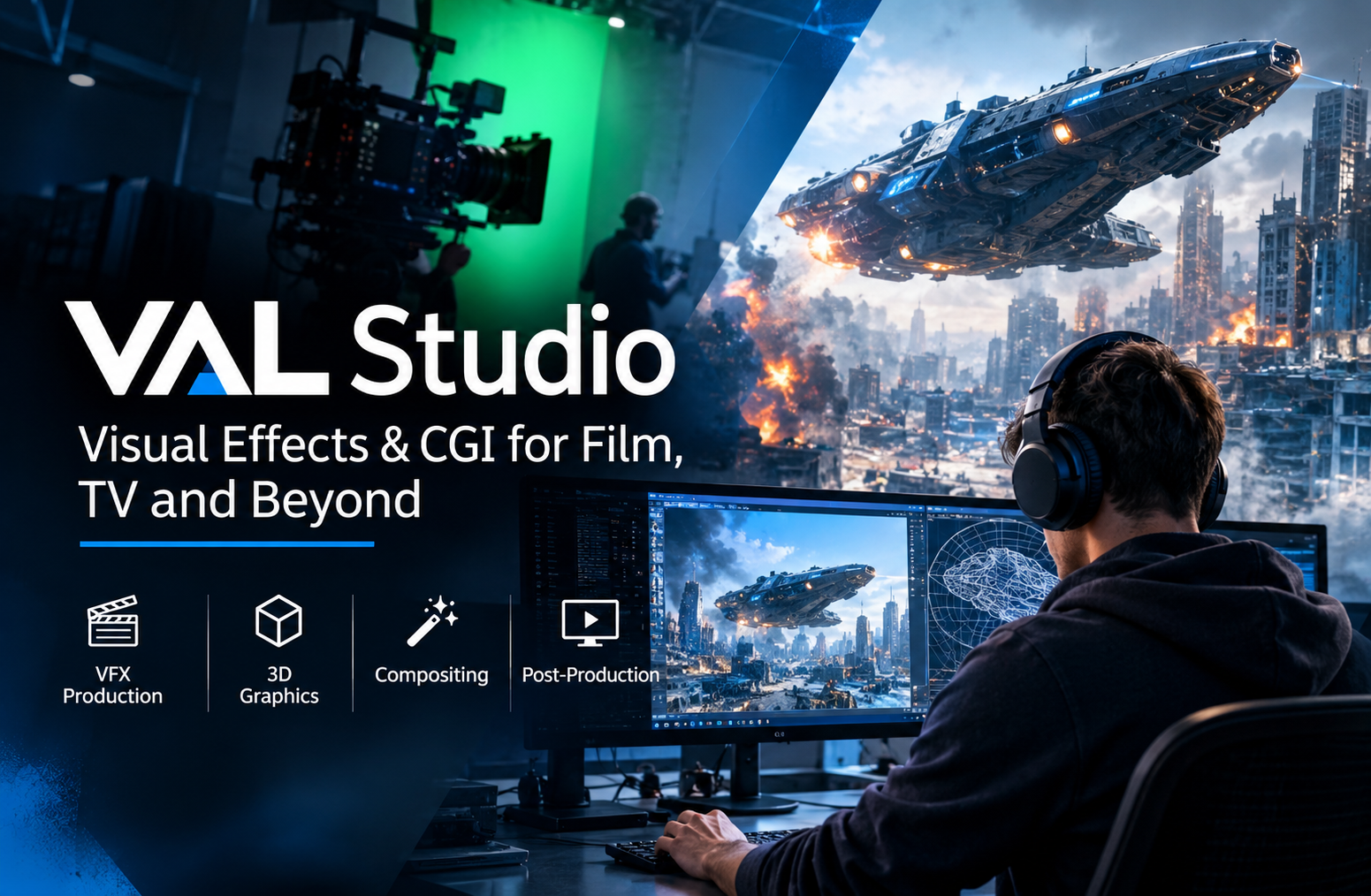
The name VAL Studio is associated with a professional visual effects and computer graphics company that works across film, television, advertising, and digital entertainment. The studio specializes in creating photorealistic imagery, digital environments, and visual effects that help filmmakers bring complex creative ideas to the screen. Its work combines artistic skills with technical production methods, allowing digital elements to blend naturally with live-action footage.
Visual effects have become an important part of modern entertainment. Audiences regularly see digital environments, computer-generated objects, realistic explosions, animated elements, and detailed cinematic scenes without necessarily noticing how much work goes into producing them. Behind many of these moments are specialized teams that understand both the artistic and technical sides of filmmaking. VAL Studio operates in this creative field, providing services that support productions from early planning through post-production.
The company has been associated with projects such as T-34, Icebreaker, The Legend of Kolovrat, Coma, Mira, and The Challenge. These productions demonstrate the type of demanding visual storytelling environments in which computer graphics and digital effects play an important role. The studio also describes experience in advertising, music-related projects, and experimental visual installations.
Understanding this company requires looking beyond the basic definition of a VFX studio. Its production services, technical workflow, creative capabilities, film credits, and approach to collaboration help explain how it contributes to the entertainment industry.
Note: Several unrelated businesses use the name VAL Studio. This article focuses on the visual effects company associated with Visual Arts Lab and the visartslab.com professional presence, not similarly named architecture, fashion, or branding businesses.
What Is VAL Studio?
VAL Studio is a creative production company specializing in visual effects (VFX), computer-generated imagery (CGI), and digital production services. Its work supports filmmakers, television producers, advertising agencies, and other creative professionals who need digital imagery for their projects.
The studio’s central purpose is to help transform creative concepts into convincing visual experiences. Some projects require small adjustments to existing footage, while others involve building entire digital environments. Both types of work require careful planning, technical knowledge, and artistic judgment.
For example, a filmmaker may want to show a large industrial facility, a fictional landscape, or an action sequence that cannot be captured safely or economically in a real location. A visual effects team can create or enhance these elements digitally.
The company describes its services as covering the production process from the initial idea to the final release. This can include consulting, planning visual effects requirements, supervising work during filming, and completing digital effects during post-production.
The Meaning of Visual Effects and CGI
Visual effects and CGI are closely connected, but they do not mean exactly the same thing.
Visual effects refers to the broader process of creating or modifying imagery for a finished production. It can involve combining live-action footage with digital elements, removing unwanted objects, creating environments, and correcting visual problems.
Computer-generated imagery refers to images or elements created using computer software. These may include:
- Digital characters and objects.
- Buildings and landscapes.
- Vehicles and machinery.
- Explosions, smoke, and atmospheric effects.
- Entire computer-generated environments.
- Animated elements used in cinematic sequences.
A VFX studio may use CGI as one part of a larger visual production workflow.
The Company’s Creative Background
VAL Studio has described more than ten years of experience in the visual effects industry. Its professional portfolio includes film and television work, advertising, music-related productions, and experimental visual projects.
The studio has also presented itself as a partner for international productions. This matters because modern film projects often involve multiple production companies, independent artists, technical departments, and post-production teams working across different locations.
Its professional presence identifies Minsk, Belarus, as an important location associated with the studio, while its LinkedIn company profile lists Tallinn, Estonia, as its headquarters. These details should be distinguished rather than treated as proof that the two locations have identical legal or operational status.
VAL Studio Services and Production Capabilities
A visual effects company needs more than software to produce convincing results. It requires artists who understand composition, movement, lighting, perspective, texture, and the technical requirements of professional film production.
The studio’s described services cover several areas of digital production.
1. 2D Production Services
Two-dimensional production remains important even when a project contains advanced 3D graphics.
Before a digital scene is created, artists often need to establish its appearance, layout, and visual direction. This work helps directors and production teams understand how a scene should look before significant resources are invested.
VAL Studio’s stated 2D capabilities include:
- Storyboarding.
- Concept art.
- Matte painting.
Storyboarding helps organize a sequence of shots into a visual plan. It allows directors to communicate camera positions, character movements, and important scene details.
Concept art develops the visual identity of a project. Artists may create reference illustrations for environments, objects, creatures, or other elements.
Matte painting involves creating or extending backgrounds and environments. It can make a real location appear larger or transform an ordinary setting into something entirely different.
These services are particularly useful when a production requires a consistent visual style across multiple scenes.
2. 3D Production Services
Three-dimensional production allows artists to build digital objects and environments that can be viewed from different camera angles.
The company’s described 3D capabilities include:
- Previsualization.
- 3D modeling.
- Texturing.
- Animation.
- Roto-motion.
- Photogrammetry.
Each service has a specific purpose.
Previsualization helps production teams plan complex sequences before filming or completing expensive visual effects work. It can show camera movement, scene composition, and the approximate placement of digital elements.
3D modeling involves creating digital representations of objects, structures, characters, and environments.
Texturing adds surface characteristics to models. These details help digital objects look like metal, stone, glass, fabric, or other real-world materials.
Animation gives movement to digital objects and characters. It may be used for realistic motion, stylized sequences, or complex cinematic action.
Photogrammetry uses photographs of real objects or locations to help construct detailed digital representations.
Together, these processes provide the foundation for convincing CGI.
3. Visual Effects Production
Visual effects are at the center of the company’s professional identity.
The studio has described capabilities that include:
- On-set VFX supervision.
- Matchmoving.
- Effects production.
- Rotoscoping.
- Digital cleanup.
- Compositing.
These services help ensure that digital elements look as though they belong in the original footage.
For example, adding a computer-generated vehicle to a moving camera shot requires accurate tracking. The digital object must follow the camera’s perspective and movement. Otherwise, it may appear to float or move unnaturally.
This is where matchmoving becomes important.
Compositing is another essential stage. It combines different visual elements into one finished image. These elements may include live-action footage, CGI, digital backgrounds, lighting effects, and other visual layers.
Rotoscoping helps separate foreground objects from backgrounds. Cleanup removes unwanted objects, visual distractions, or equipment that should not appear in the final shot.
4. Stereo Production
VAL Studio has also described stereo production capabilities, including 2D-to-stereo conversion and alignment.
Stereoscopic production creates a sense of depth by presenting slightly different images to the left and right eyes.
The process requires accurate alignment and careful attention to depth. Poorly prepared stereo imagery can create visual discomfort, so technical quality control is essential.
This type of work can be useful for productions intended for compatible stereoscopic viewing formats.
Major Film and Television Projects
A studio’s portfolio is one of the best ways to understand its creative experience. Individual projects reveal the types of visual challenges a company has handled and the production environments in which its artists have worked.
The company’s official filmography identifies several projects from different years. These credits provide a useful overview of its involvement in cinematic production.
visual effects studio+1
1. T-34
T-34 | Film 2018 | Moviebreak.de
T-34 is a Russian war action film released in 2018. It features military vehicles, battlefield environments, and large action sequences.
Productions of this type can involve demanding visual effects work. Digital artists may need to combine practical footage with additional environmental details, improve backgrounds, or support complex shots.
The film is among the earlier productions associated with the studio’s professional history. It is an example of the kind of cinematic environment in which realistic computer graphics can support large-scale storytelling.
2. Icebreaker
Российский фильм-катастрофа «Ледокол» взломает жанровые условности | WORLD PODIUM
Icebreaker is another film associated with the company’s earlier work.
Films involving ships, extreme weather, and difficult natural environments can require detailed visual preparation. Water, ice, snow, atmospheric conditions, and moving objects can be challenging to capture consistently.
Digital effects can help filmmakers create believable environments while maintaining the intended visual atmosphere.
The production is relevant when examining the range of cinematic projects connected with the studio.
3. The Legend of Kolovrat
Furious [2017] par Dzhanik Fayziev
The Legend of Kolovrat is a historical action film with fantasy elements.
Historical productions often need detailed environments, large battle scenes, and visual elements that are difficult to produce entirely through practical filming.
Visual effects can support these requirements by extending backgrounds, adding environmental details, and combining different elements into cohesive shots.
The film is also mentioned in the studio’s earlier professional showreel material.
4. Coma
REVIEW: Coma (2020) – FictionMachine.
Coma, released in 2020, is a science-fiction film directed by Nikita Argunov.
Science-fiction storytelling often depends heavily on digital imagery. Fictional environments, unusual architecture, impossible landscapes, and surreal sequences may require a combination of CGI and compositing.
For a production involving imaginative environments, artists must pay attention to more than attractive graphics. Lighting, perspective, scale, and camera movement all affect whether a digital scene feels believable.
Coma is an important title to consider when exploring the studio’s involvement in visually ambitious cinema.
5. Mira
Mira is a science-fiction disaster film released in 2022 and directed by Dmitriy Kiselev.
Disaster and science-fiction productions can involve extensive digital environments and large visual sequences. A production may need to combine real actors, practical sets, digital backgrounds, and computer-generated effects.
These scenes require careful coordination between departments. A digital environment must match the lighting and perspective of the live-action footage. Otherwise, the audience may notice that the elements do not belong together.
The film is included in the studio’s official filmography.
visual effects studio
6. The Challenge
Сквозь невозможное: 10 российских фильмов про космос
The Challenge is a 2023 film directed by Klim Shipenko.
The production is notable for its connection to filming in space. Its unusual production setting demonstrates the importance of technical planning and visual consistency when working outside conventional studio environments.
Visual effects and post-production can help filmmakers refine footage, improve continuity, and create the final cinematic presentation.
The title appears in the studio’s official project list.
7. Povelitel vetra
Лучшие русские фильмы 2023 года: топ-10 читателей theGirl | theGirl
Povelitel vetra, also known as Lord of the Wind, is a 2023 film directed by Igor Voloshin.
Its subject matter and cinematic presentation make it another relevant example of the types of productions connected with the studio.
Films involving large natural environments and dramatic weather conditions can benefit from careful digital enhancement and visual continuity work.
8. Kraken
Kraken is a 2025 film directed by Nikolay Lebedev.
The title is included among the studio’s more recent filmography entries. It is particularly relevant to discussions about modern visual effects because contemporary fantasy and science-fiction productions often require the creation of creatures, environments, and large digital sequences.
However, the presence of a title in a filmography does not establish exactly which shots or effects the studio completed. Individual shot credits and production responsibilities should not be assumed without supporting documentation.
9. Red Silk
Red Silk is another 2025 production listed by the company. The film is directed by Andrey Volgin.
Its inclusion demonstrates the studio’s continued association with feature-film production.
For viewers researching the company, this newer title provides another starting point for exploring its filmography and production history.
Additional Productions
Other titles in the official filmography include:
- Kibertaksi (2024).
- Kiberderevnya (2023).
- Kiberderevnya. New Year (2023).
- Mazhor v Sochi (2022).
- Dobro pozhalovat v semyu (2021).
- Nebesnaya komanda (2021).
These projects show that the company’s work is not limited to one genre or type of production.
visual effects studio
How VAL Studio’s Visual Effects Workflow Works
Understanding a VFX company’s workflow helps explain why professional visual effects require time, coordination, and technical planning.
A finished scene may look simple to an audience, but it can involve several production stages. Each stage has its own responsibilities and quality requirements.
The following workflow explains how a typical professional VFX project can be organized. It describes industry practices rather than claiming that every project at the company follows an identical process.
Step 1: Understanding the Creative Brief
Every project begins with a creative requirement.
A director, producer, or production company explains what needs to appear on screen. The requirement might involve adding a digital object, extending a physical location, creating an entirely fictional environment, or removing unwanted elements from footage.
At this stage, the VFX team needs to understand:
- The purpose of the visual effect.
- The intended appearance of the final scene.
- The number of shots involved.
- The available production footage.
- The delivery format and technical requirements.
- The expected schedule and budget.
A clear brief prevents misunderstandings later.
Step 2: Planning the Visual Effects
Once the creative requirement is understood, the team determines how the work can be completed.
This may involve identifying which elements can be filmed practically and which should be created digitally.
For example, a production may use a physical vehicle while adding a digital background. Another scene may require a fully computer-generated environment.
Planning helps the production team understand the resources needed before filming or post-production begins.
Step 3: Previsualization and Preparation
Previsualization gives the team an early representation of the intended scene.
Artists can use rough digital models and simple animation to establish camera movement, object placement, and timing.
This is especially useful for complicated action sequences.
If the director wants a camera to move through a digital environment, previsualization can help determine the best camera path before expensive final assets are created.
Step 4: Filming and On-Set Supervision
Some effects need to be planned while the cameras are still recording.
On-set VFX supervision helps capture information that artists may need during post-production.
This can include:
- Camera movement and lens information.
- Lighting references.
- Measurements of the filming environment.
- Reference photographs.
- Green-screen requirements.
- Tracking markers where appropriate.
Without accurate production information, even skilled artists may struggle to integrate digital objects naturally.
Step 5: Digital Asset Creation
The next stage involves creating the required digital elements.
Depending on the project, this could include 3D models, textures, backgrounds, animated objects, or atmospheric effects.
Artists must consider how each element will appear from the camera’s perspective.
A digital object that looks impressive in isolation may not work in the final shot if its scale, lighting, or movement is incorrect.
Step 6: Matchmoving and Tracking
Matchmoving connects digital elements to the movement of a real camera.
For instance, if a camera moves around an actor, a digital object placed in the same scene must respond to that movement correctly.
Tracking helps maintain the relationship between the camera, the footage, and the digital environment.
This process is essential for realistic integration.
Step 7: Compositing
Compositing brings the separate elements together.
Artists combine live-action footage, digital assets, backgrounds, effects, and other image layers.
They also adjust factors such as:
- Colour balance.
- Lighting.
- Shadows.
- Reflections.
- Image sharpness.
- Depth and perspective.
The goal is to make the final image appear consistent rather than like a collection of unrelated elements.
Step 8: Review and Final Delivery
Before delivery, the work needs to be reviewed.
The team checks visual continuity, technical quality, and whether the finished shots meet the creative requirements.
Corrections may be needed if an object looks unnatural, an edge is visible, or a digital element does not match the surrounding environment.
The final files are then prepared according to the production’s delivery specifications.
Technology and Software Used in Professional VFX Production
Technology is a major part of the modern visual effects industry. However, software alone does not produce high-quality results.
Artists need to understand how to use professional tools to solve creative and technical problems.
Digital Compositing Software
Compositing software allows artists to combine different visual elements into a finished image.
A professional compositor may work with hundreds of image layers, masks, tracking information, and visual adjustments.
The studio’s professional recruitment and industry presence have been associated with tools such as Foundry Nuke.
Nuke is widely used in professional compositing workflows, particularly for complex film and television projects.
Camera Tracking and Matchmoving Tools
Camera tracking software helps artists recreate the movement and perspective of a real camera inside a digital environment.
Tools such as 3DEqualizer are used in the wider industry for camera tracking and matchmoving tasks.
Accurate tracking is important because digital objects must behave as though they exist within the original filming environment.
3D Modeling and Animation Tools
Three-dimensional production involves creating digital objects and environments.
Artists need to understand:
- Geometry.
- Materials.
- Lighting.
- Camera placement.
- Animation.
- Rendering.
These elements work together to produce believable computer-generated imagery.
Rendering and Computing Resources
Rendering converts digital scenes into images or sequences that can be used in the final production.
Complex scenes may contain detailed models, realistic materials, lighting calculations, and particle effects.
These requirements can demand significant computing resources.
An efficient rendering pipeline helps teams manage deadlines and maintain consistent output quality.
Importantly, the precise software configuration used for each VAL Studio project is not fully documented in its public company overview. Specific applications should not be attributed to every production without direct confirmation.
Real-World Applications of VAL Studio’s Services
Visual effects are useful in more industries than many people realize.
Although feature films are an important part of the company’s portfolio, its stated focus also includes television, advertising, music-related productions, and experimental installations.
Film Production
Film production is one of the clearest applications of professional VFX services.
Directors use visual effects to create scenes that would be difficult, expensive, dangerous, or impossible to capture entirely through practical filming.
Examples include:
- Digital environments.
- Fictional buildings and locations.
- Large-scale action sequences.
- Atmospheric effects.
- Computer-generated objects.
- Background extensions.
The advantage is creative flexibility. A production can build a visual world without needing every element to exist physically.
Television Production
Television productions also use digital effects.
Series may need consistent visual environments across many episodes. A professional VFX pipeline helps ensure that digital elements remain visually consistent throughout the production.
This can involve background replacement, object removal, compositing, and CGI.
Advertising and Commercials
Advertising is another area where visual effects can provide value.
Brands often need polished imagery that presents products in a controlled and visually attractive way.
CGI can help create digital product demonstrations, unusual environments, and animated sequences.
For example, a commercial may use computer-generated elements to show how a product works or to present an imaginative version of everyday life.
The creative challenge is to make the result visually engaging while keeping the message clear.
Music-Related Productions
Music videos and promotional content can use visual effects to develop a distinctive visual identity.
Digital environments, animated elements, and compositing can help directors create a specific atmosphere that supports the music.
These effects may be subtle or highly stylized, depending on the creative direction.
Experimental Visual Installations
Experimental installations use digital imagery in ways that may go beyond conventional film and television.
They can involve creative environments, projected visuals, and computer-generated imagery designed for artistic experiences.
Such work requires a flexible approach because the final presentation may have different technical and creative requirements from a traditional movie scene.
What Makes a Professional VFX Studio Valuable?
Choosing a visual effects partner is an important decision for any film or advertising production. The quality of the final result depends on creative ability, technical knowledge, communication, and production management.
Several factors explain why studios with a broad range of services can be valuable to filmmakers.
1. Support Throughout Production
A studio that can participate in early planning and later production stages can help identify visual effects requirements before they become expensive problems.
For example, a director may want to create a digital building extension. If the VFX team is involved before filming, the camera setup and reference material can be planned more effectively.
This can reduce unnecessary corrections during post-production.
2. Combining Artistic and Technical Skills
Visual effects are not simply a technical activity.
A technically correct image can still look wrong if its lighting, composition, or visual style does not match the scene.
Artists must understand the creative intention behind each shot.
The combination of visual judgment and technical execution is therefore essential.
3. Handling Different Types of Projects
A broad service offering can help a production company work with one creative partner for multiple requirements.
For example, a project may need concept art, 3D modeling, animation, tracking, and compositing.
When these tasks are coordinated properly, the production can maintain a more consistent visual direction.
4. Supporting International Productions
Film production frequently involves collaboration between companies in different countries.
A VFX studio with experience in international projects needs to manage communication, technical standards, file delivery, and production schedules.
These skills are important because even small misunderstandings can affect a project’s delivery.
5. Working With Complex Visual Requirements
Some scenes require much more than adding a simple digital object.
They may involve several layers of CGI, live-action footage, environmental effects, camera tracking, and detailed compositing.
Experience with complex visual work helps a team understand how to divide these requirements into manageable production tasks.
Challenges in the Visual Effects Industry
The visual effects industry offers significant creative opportunities, but it also faces practical challenges.
Understanding these issues provides a more realistic picture of what companies such as VAL Studio need to manage.
Tight Production Deadlines
Film and television schedules can be demanding.
A production may need hundreds of shots completed within a limited period. Each shot can involve several stages of work and multiple rounds of feedback.
If one stage is delayed, the remaining production schedule may also be affected.
Proper planning and communication are essential.
Balancing Quality and Budget
High-quality CGI can require skilled artists, specialized software, computing resources, and substantial production time.
However, every project has a financial limit.
The challenge is to identify where detailed effects are essential and where a simpler approach can achieve the same storytelling purpose.
A well-planned production does not need to make every shot unnecessarily complicated.
Maintaining Realism
Photorealism is difficult because audiences are familiar with how real objects and environments behave.
They notice unnatural shadows, incorrect reflections, unrealistic movement, and inconsistent lighting.
Even a small visual error can make a digital element look artificial.
Artists must carefully study the original footage and match the characteristics of the real environment.
Managing Large Digital Files
Visual effects projects often involve large amounts of data.
These may include:
- High-resolution image sequences.
- 3D models.
- Texture files.
- Animation data.
- Camera information.
- Reference footage.
- Compositing projects.
Teams need reliable storage, file management, backup systems, and organized naming conventions.
Without these practices, production can become confusing and inefficient.
Communication Between Departments
A VFX project may involve directors, producers, cinematographers, editors, compositors, animators, and technical supervisors.
Each department has different responsibilities.
The visual effects team must understand the director’s creative requirements while also communicating technical limitations clearly.
Regular reviews and organized feedback help prevent unnecessary revisions.
Keeping Up With Changing Technology
New software, rendering methods, and production techniques continue to influence the industry.
Artists must keep developing their skills.
However, adopting new technology should not become the main objective. The important question is whether a new method improves the quality, speed, or reliability of the final production.
How to Evaluate VAL Studio Before Working With It
If a production company is considering VAL Studio for a project, reviewing its portfolio is a sensible starting point.
A film credit alone does not reveal the exact scope of a company’s contribution. A more detailed evaluation should consider the specific services required and the studio’s ability to deliver them.
Here are practical steps to follow.
Step 1: Review the Official Portfolio
Start by examining the studio’s official website and showreel.
Look for examples that match the visual style of your project.
For instance:
- Science-fiction projects for digital environments.
- Action productions for complex effects.
- Commercial work for product imagery.
- Animation projects for moving digital assets.
A relevant portfolio is more useful than a long list of unrelated credits.
Step 2: Identify Your Production Requirements
Before contacting a studio, prepare a clear explanation of the work.
Decide whether you need:
- Full CGI production.
- 3D modeling.
- Background replacement.
- Object removal.
- Digital environment creation.
- Matchmoving.
- Compositing.
- On-set VFX supervision.
Knowing the exact requirements makes it easier to evaluate whether the studio is suitable.
Step 3: Prepare Reference Material
Reference material helps communicate the intended result.
You can prepare:
- Storyboards.
- Existing footage.
- Reference photographs.
- Creative examples.
- Camera information.
- A written description of the scene.
These materials can reduce confusion during the initial discussion.
Step 4: Discuss the Production Schedule
Ask how the proposed work will fit into your overall production schedule.
Important questions include:
- What is the expected delivery date?
- How many review rounds are included?
- What information must the client provide?
- How will changes be handled?
- What happens if the creative requirements change?
These questions help establish realistic expectations.
Step 5: Clarify Technical Requirements
Before production starts, discuss the required file formats, image resolution, frame rate, colour management, and delivery specifications.
These details matter because different productions may have different technical requirements.
A professional workflow should establish them before substantial production work begins.
Step 6: Confirm Responsibilities and Pricing
A written project agreement should explain the scope of work, responsibilities, payment structure, delivery dates, and revision process.
It should also clarify ownership and permitted use of the finished material.
This is particularly important for commercial projects and international productions.
Step 7: Request a Test or Initial Sample When Appropriate
For a large project, a small paid test can sometimes help evaluate the working relationship.
It may reveal how well the team understands the brief, handles feedback, and maintains technical quality.
A test should represent the actual production requirements rather than being an unrelated demonstration.
VAL Studio’s Professional Background and Industry Presence
A company’s public identity is important when researching its history and professional credibility.
The visual effects company maintains a professional website under the Visual Arts Lab name. Its contact information identifies the email address post@valstudio.by.
Its official website presents the company as a full-service visual effects and computer graphics studio, with a focus on photorealistic imagery for movies, television, and commercials.
The company also highlights its involvement in international productions and its ability to support projects from early development to release.
visual effects studio
Leadership and Creative Teams
Visual effects production depends on collaboration between several professional roles.
Typical responsibilities within a VFX company include:
- Producers who manage schedules, resources, and communication.
- VFX supervisors who oversee visual and technical requirements.
- Compositors who combine digital and live-action elements.
- 3D artists who create models, environments, and animation.
- Coordinators who organize production information.
- Technical artists who support production tools and workflows.
Public professional profiles have associated individuals such as Ilya Pilatovich and Alexey Dubko with the company.
However, individual job titles and current management responsibilities should always be verified through recent professional information rather than assumed from older credits.
Location and International Work
The company’s professional information has connections with Minsk, Belarus, and Tallinn, Estonia.
Its ArtStation professional profile identifies Minsk, while its LinkedIn company page lists Tallinn as its headquarters.
The official website provides contact information for project enquiries.
This distinction is useful for people researching the company because online business profiles, production locations, and legal registration details do not necessarily describe the same thing.
How to Contact the Company
People interested in its services can use the contact information published on the official website.
The listed contact details include:
- Email: post@valstudio.by
- Telephone: +375 (29) 632-50-70
For a professional enquiry, it is useful to include the project type, estimated number of shots, expected timeline, and any available reference material.
The official website is the most appropriate place to review its current services, portfolio, and contact information.
The Future of Visual Effects and Digital Production
The visual effects industry continues to develop as filmmaking technology changes.
New tools are making some production tasks faster, while audience expectations for realistic digital imagery continue to grow.
These developments create both opportunities and challenges for established VFX companies.
Artificial Intelligence in Visual Effects
Artificial intelligence is becoming part of discussions about modern digital production.
AI-assisted tools can support tasks such as image preparation, reference generation, object detection, and certain repetitive production activities.
However, professional visual effects still require human creative judgment.
A filmmaker needs more than an attractive image. The final result must fit the story, camera movement, lighting, and visual continuity of the entire production.
AI tools can assist some processes, but they do not automatically solve every production problem.
More Realistic Digital Environments
Advances in 3D technology and rendering continue to improve digital environments.
Artists can create detailed landscapes, buildings, objects, and atmospheric conditions.
These developments give filmmakers greater flexibility when planning scenes that would otherwise require expensive physical locations.
Increasing Demand for Cinematic Advertising
Brands increasingly use high-quality visual content to communicate product features and establish recognizable identities.
This creates opportunities for studios that understand both cinematic production and commercial storytelling.
The challenge is to create imagery that supports the advertising message rather than distracting from it.
Growth of Digital Entertainment
Streaming services, games, online video, and interactive entertainment have expanded the demand for digital visual content.
These industries share several technical requirements, including 3D modeling, animation, compositing, and digital asset creation.
A studio with experience across multiple production formats may find opportunities to apply its skills in different creative markets.
The Importance of Human Creativity
Technology may change the way visual effects are produced, but creative decisions remain important.
A convincing scene requires an understanding of how people experience movement, light, space, and emotion.
The most effective visual effects are often those that support the story without drawing unnecessary attention to themselves.
That principle remains relevant regardless of which software or production technology a studio uses.
VAL Studio Compared With a General Digital Design Agency
It is important to understand that a VFX studio and a general digital design agency do not necessarily provide the same services.
Both may work with digital images, but their production requirements are different.
| Area | VFX Studio | General Digital Design Agency |
| Main focus | Film and digital visual effects | Branding and digital communication |
| 3D production | Often a core capability | Depends on the agency |
| Compositing | Common specialist service | Not always offered |
| Film production | Often part of its work | Usually not a core service |
| Animation | Often used in CGI and film | Often used for marketing |
| Camera tracking | Important for VFX | Less common |
| Advertising | May create commercial effects | Often handles broader campaigns |
| Post-production | Major service area | May offer limited editing |
This distinction matters when choosing a creative partner.
A business looking for a logo, website, or social media identity may need a branding agency. A filmmaker looking for complex digital scenes or CGI may need a dedicated visual effects company.
The right choice depends on the actual production requirements.
Important Things to Know Before Choosing a VFX Company
Before selecting a production partner, it helps to understand the factors that affect the quality of visual effects work.
Portfolio Quality Matters More Than Marketing Claims
A company may describe itself as highly experienced, but its portfolio provides a better starting point for evaluation.
Look for consistency across different shots and projects.
Pay attention to whether digital elements blend naturally with real footage.
Technical Accuracy Is Essential
An attractive image is not necessarily a production-ready visual effect.
The final footage must meet technical requirements, including resolution, frame rate, colour handling, and delivery specifications.
Communication Should Be Clear
A production team should be able to explain what is achievable within the available budget and schedule.
Unclear promises can lead to misunderstandings.
Creative Feedback Should Be Structured
Visual effects often require revisions.
A clear feedback process helps artists understand what needs to change and prevents repeated work caused by vague instructions.
Credits Should Be Verified
A studio’s appearance in a filmography establishes an association with a project, but it does not automatically establish responsibility for every effect in the film.
When evaluating a company’s experience, seek specific examples, breakdowns, or credits that demonstrate the work relevant to your needs.
This is a more reliable approach than relying only on promotional descriptions.
Frequently Asked Questions About VAL Studio
1. What is VAL Studio?
VAL Studio is a visual effects and computer graphics company associated with Visual Arts Lab. It specializes in CGI, digital production, and photorealistic visual effects for films, television, and advertising.
2. What services does the company provide?
Its publicly described services include 2D production, 3D modeling, texturing, animation, photogrammetry, matchmoving, rotoscoping, compositing, digital cleanup, and on-set VFX supervision.
3. Which movies are associated with VAL Studio?
Its published filmography includes T-34, Icebreaker, The Legend of Kolovrat, Coma, Mira, The Challenge, Kraken, and Red Silk, among other productions.
4. Where is VAL Studio located?
The company’s professional presence has connections with Minsk, Belarus, and Tallinn, Estonia. Its ArtStation profile identifies Minsk, while its LinkedIn page lists Tallinn as its headquarters.
5. Does VAL Studio work on television commercials?
Yes. Its official website identifies movies, television, and commercials as its main areas of focus. Its visual effects and computer graphics capabilities can support different types of screen productions.
6. How can someone contact VAL Studio?
Interested clients can contact the company through its published email address, post@valstudio.by, or telephone number, +375 (29) 632-50-70. Its official website also provides additional contact options.
Conclusion
VAL Studio is a visual effects and computer graphics company with experience across film, television, advertising, and other digital productions. Its professional services cover several important stages of visual production, including concept development, 2D artwork, 3D modeling, animation, matchmoving, and compositing.
Its published filmography includes productions such as T-34, Icebreaker, The Legend of Kolovrat, Coma, Mira, The Challenge, Kraken, and Red Silk. These projects provide an overview of the company’s involvement in different cinematic environments and production types.
One of the most important aspects of its work is the combination of artistic creativity and technical production. Creating convincing visual effects requires more than advanced software. It involves careful planning, accurate camera information, realistic lighting, detailed digital assets, and effective collaboration between production departments.
The company also reflects the wider development of the visual effects industry, where CGI and digital production have become essential tools for modern storytelling. As filmmaking, television, and digital entertainment continue to evolve, specialized production skills will remain important.
For anyone researching the company, its official portfolio, published filmography, professional profiles, and direct contact information provide the most useful starting points for understanding its background and capabilities.