UploadWords .com USA Tech: A Complete Guide
The search term uploadwords .com usa tech has attracted attention from people who want to understand the website, its possible technology-related services, and its usefulness for everyday digital tasks. Whether you are a student, blogger, business owner, content creator, or technology enthusiast, understanding what a website actually offers is more important than relying on its name or claims alone. Before using any online platform, it helps to examine its purpose, available features, practical benefits, limitations, and approach to user privacy.
UploadWords is a name associated with online text analysis and technology-related content in current search results. However, information about similarly named websites is not always consistent. Some pages describe text-analysis utilities, while others discuss general technology, artificial intelligence, productivity, and digital publishing. These differences make it important to distinguish verified features from assumptions and to check the exact website before using a service.
This guide explains the meaning behind the search phrase, explores how online text tools fit into modern technology, examines potential uses for different audiences, and provides practical advice for evaluating online services safely. It also discusses the limits of text-analysis software, responsible technology use, and the checks readers should complete before trusting a platform with their information.
What Is UploadWords .com USA Tech?
The phrase uploadwords .com usa tech combines a website name with a geographic reference and a technology-related term. People may use it when searching for information about UploadWords, its features, its relationship to digital technology, or its relevance to users in the United States.
However, the search phrase itself does not establish that a website is headquartered in the United States, operates American data centers, or provides a particular set of technical services. Those details require independent verification.
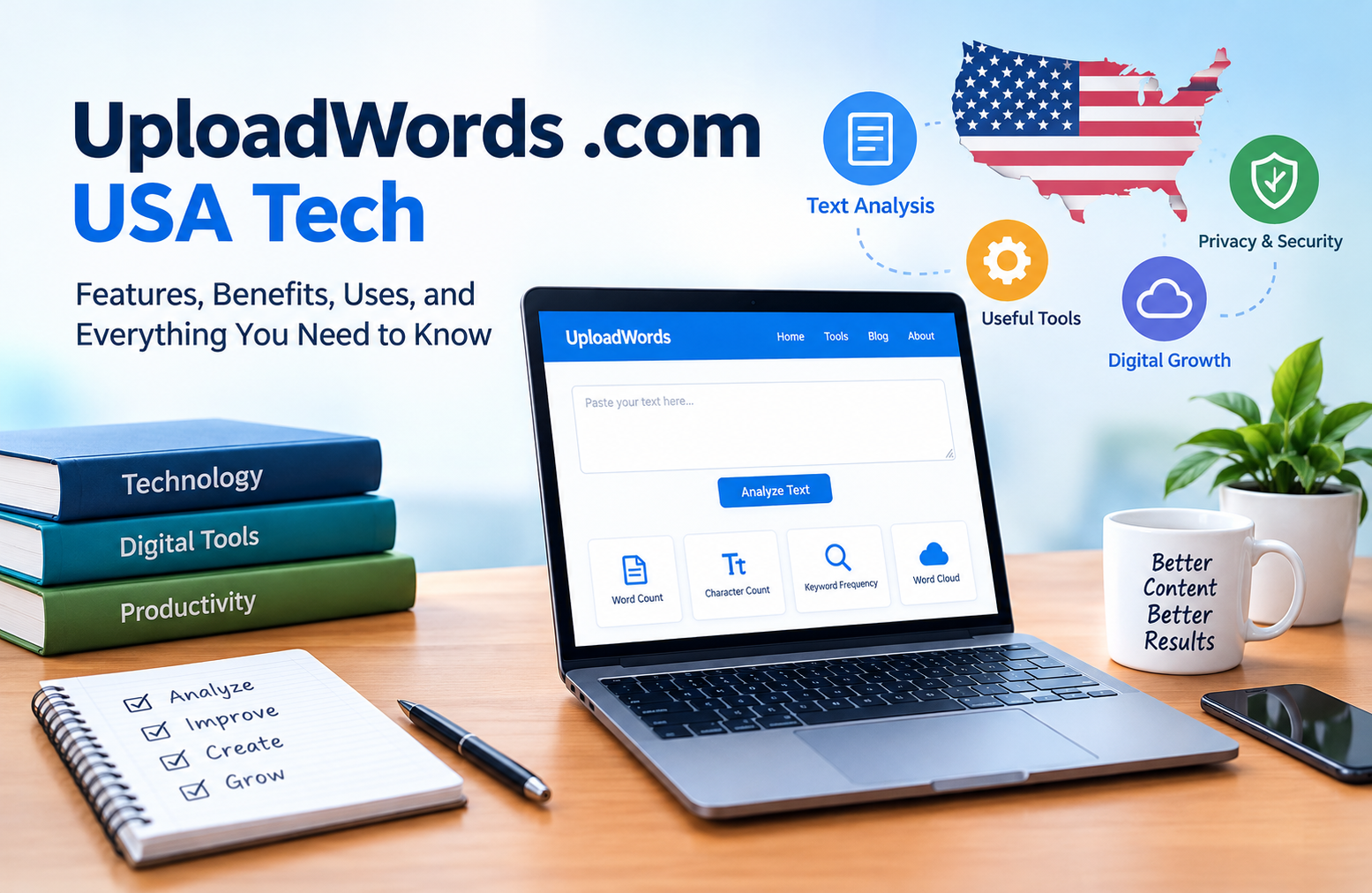
The name UploadWords is associated in indexed online information with text-analysis features such as word counting, character counting, keyword-frequency analysis, and word-cloud generation. These are practical tools for people who regularly work with written material.
Other search results use similar wording to discuss broader technology topics, including online productivity, artificial intelligence, content creation, and document workflows. Because several domains and descriptions appear in search results, readers should not assume that every page using the name represents the same organization or product.
Understanding the Website’s Possible Purpose
A useful starting point is to separate three possible interpretations of the search.
First, it may refer to a text-analysis tool. Such a tool examines text supplied by a user and produces basic statistics. A writer might use it to check an article’s length, identify repeated words, or create a word cloud.
Second, it may refer to technology information. Some websites publish accessible guides about digital tools, software, online services, artificial intelligence, and business technology. Readers use these resources to understand unfamiliar concepts without needing advanced technical knowledge.
Third, it may reflect a search for a specific company or service. Someone looking for a United States-based platform might want to verify its ownership, location, privacy practices, or business credentials.
These interpretations should not be treated as interchangeable. A website that publishes technology articles is not necessarily a software provider, and a text-analysis utility is not automatically a cloud-storage service.
The most reliable approach is to identify the exact domain, inspect its current pages, and verify any claims that matter to your intended use.
Does the USA Reference Confirm American Ownership?
No. The presence of the word “USA” in a search query does not prove that a service is American-owned or operated.
A website may serve American users while being registered, managed, or hosted elsewhere. Similarly, a domain ending in .com is available to organizations and individuals around the world.
If location matters to your decision, investigate the following details:
- Business identity: Look for a company name, registered business address, and identifiable operator.
- Contact information: Check whether the website provides a working contact method and meaningful support details.
- Privacy documentation: Review the policy explaining how submitted information is collected, processed, stored, and shared.
- Service terms: Determine what rights the operator claims over uploaded material and whether any restrictions apply.
- Hosting and jurisdiction: Look for credible evidence about where data is processed and which legal obligations apply.
These checks are especially important for businesses, educators, publishers, and organizations that handle private or commercially valuable information.
How UploadWords Technology May Fit Into Everyday Digital Work
Modern digital work depends on a wide range of online services. Some manage files, others support collaboration, and some perform small but useful tasks that would otherwise require manual effort.
Text-analysis tools belong to this last category. They focus on the structure and frequency of words rather than trying to replace an entire writing or publishing workflow.
For example, a blogger preparing a long article may need to confirm the word count, check whether a phrase appears too often, and understand which terms dominate the draft. A student may need to meet an assignment’s length requirement. A marketing professional may want to compare the vocabulary used across several pieces of campaign copy.
A suitable text-analysis utility can make these checks quicker.
However, the benefits depend on the features that are actually available on the particular website. Readers should verify current functionality rather than assume every UploadWords-related page provides identical tools.
Word Counting and Character Counting
Word and character counting are among the simplest forms of text analysis.
A word counter estimates how many words appear in a document, while a character counter measures the number of characters. Depending on the tool, character totals may include spaces or exclude them.
These measurements are useful in several situations:
- Checking whether an assignment meets a minimum or maximum word count.
- Preparing blog articles with editorial length requirements.
- Writing social media posts with character limits.
- Reviewing product descriptions and advertising copy.
- Preparing summaries, reports, and short professional biographies.
- Comparing the length of different versions of the same document.
Consider a writer preparing a 1,500-word article. A word counter can quickly reveal whether the draft is close to its intended length. It can also help identify sections that need expansion or trimming.
Nevertheless, a target word count should never become the only measure of quality. A concise article that answers a question accurately may be more useful than a much longer article filled with repetition.
Character counts also require care. Different platforms may count line breaks, spaces, emoji, and certain Unicode characters differently. If an exact limit matters, check the final text in the destination platform as well.
Keyword Frequency and Text Patterns
Keyword-frequency analysis identifies terms that appear repeatedly in a document.
For a content editor, this can be a useful diagnostic step. Repetition may be necessary when a document discusses a specific subject, but excessive repetition can make the writing awkward or difficult to read.
A frequency report can help identify:
- Words that appear unusually often.
- Important concepts that dominate a document.
- Repeated phrases that could be simplified.
- Vocabulary differences between two drafts.
- Terms that may deserve closer editorial review.
For example, suppose a technology article repeatedly uses the words “digital,” “technology,” and “online.” The frequency report may prompt the writer to examine whether those words are genuinely needed in every sentence.
The correct response is not to replace every repeated word with a synonym. Repetition can support clarity when a technical term needs to remain consistent. The goal is to identify unnecessary repetition and improve the natural flow of the text.
Keyword frequency also cannot establish whether an article is factually correct, original, persuasive, or useful to readers. Those judgments require a more complete review.
Word Clouds and Visual Text Analysis
A word cloud presents selected words visually, often making more frequent terms appear larger than less frequent ones.
This format can provide a quick overview of a document’s vocabulary. A teacher might use it to introduce a reading passage, while a researcher could use one to explore recurring terms in a collection of notes.
Businesses may also find word clouds useful when brainstorming content themes or reviewing non-sensitive feedback.
However, visual prominence should not be confused with importance. A frequent word may be central to the topic, or it may simply occur repeatedly because of the document’s writing style. A word cloud also does not explain relationships between concepts or show how a word is used in context.
For that reason, visual text analysis works best as an initial exploration method rather than a substitute for reading and interpretation.
Main Benefits of UploadWords-Related Text Tools
The main appeal of a lightweight text utility is convenience. It can provide a quick measurement or overview without requiring a complicated editing process.
The exact benefits depend on the specific service and its verified features, but several advantages apply to text-analysis tools generally.
1. Faster Routine Checks
Manually counting words or searching a long document for repeated terms takes time. Automated analysis can complete these basic tasks much more quickly.
This is particularly useful for people who prepare multiple articles, assignments, reports, or product descriptions every week.
Time saved on repetitive checks can then be used for more valuable work, such as verifying information, improving explanations, and organizing content.
2. A Lower Learning Curve
Simple online utilities are often easier to use than full-featured editing applications.
A typical text-analysis workflow involves supplying text, running an analysis, and reviewing the results. Users may not need advanced software knowledge to understand basic counts and frequency lists.
This accessibility can benefit students, small businesses, independent writers, and people who rarely use specialist publishing software.
Still, ease of use should not eliminate the need to read the site’s instructions and privacy policy.
3. Support for Content Planning
Writers can use frequency data to understand the vocabulary of an existing draft before making revisions.
For example, an editor might discover that a section relies heavily on a single expression. The editor can then decide whether to simplify the language, restructure the passage, or retain the term because it is essential to the topic.
The tool provides evidence about the text’s surface patterns. The writer remains responsible for deciding what those patterns mean.
4. More Consistent Editorial Reviews
When a publishing team follows the same review process for every article, basic text statistics can make routine checks more consistent.
A team could use a word-count threshold, a list of editorial requirements, and a manual review checklist before publication.
However, a frequency tool cannot enforce an entire editorial policy by itself. It cannot reliably determine whether sources are trustworthy, whether an argument is balanced, or whether a reader’s question has been fully answered.
5. Useful Support for Beginners
People learning to write, edit, or publish online can benefit from seeing objective information about their work.
A word count makes length visible. A frequency list makes repeated vocabulary easier to notice. A word cloud provides a quick visual representation of the text.
These features can encourage better editing habits when used alongside feedback, reading, and careful revision.
Who Can Benefit From Text-Analysis Technology?
Different users have different reasons for examining text. Understanding the intended audience helps determine whether a simple tool is sufficient or whether a more advanced application is necessary.
Students and Academic Writers
Students often work under word limits and formatting rules. A text-analysis utility can help them check the length of essays, summaries, presentations, and reports.
It can also support vocabulary exercises or provide a basic overview of repeated terms in a draft.
For academic work, however, the tool should be only one part of the writing process. Students still need to evaluate evidence, cite sources correctly, organize arguments, and follow their institution’s rules about permitted software and artificial intelligence.
They should also avoid uploading unpublished research, personal records, examination materials, or confidential assignments to an unfamiliar service without authorization.
Bloggers and Website Owners
Bloggers can use text statistics to check article length and review recurring terminology before publication.
A practical editorial process might include these steps:
- Draft the article around a clear reader question.
- Check the word count against the intended scope.
- Review repeated words and phrases.
- Verify important claims against reliable sources.
- Edit for clarity, structure, and usefulness.
- Check links, headings, and formatting before publishing.
This approach prevents a common mistake: treating a text-analysis report as proof that a page is ready to publish.
Search visibility depends on many factors, including relevance, content quality, accessibility, and how well a page meets the reader’s needs. Word counts and keyword frequencies cannot guarantee rankings.
Digital Marketers
Marketing professionals often prepare landing pages, advertisements, email campaigns, product descriptions, and social media copy.
Character counting can help when a destination platform imposes a strict limit. Frequency analysis can also identify repeated language in promotional material.
For example, a business may discover that several product descriptions use the same generic phrases. An editor can then make each description more specific by explaining the product’s actual features and intended audience.
Marketing teams should not use keyword-frequency tools to justify repetitive copy. Clear benefits, accurate claims, and a consistent brand voice are more important than forcing a phrase into every paragraph.
Teachers and Trainers
Educators may use text analysis to demonstrate how vocabulary, repetition, and document length affect communication.
A word cloud can serve as a starting point for discussion. Students can compare the visual output with the original text and consider whether the most prominent words genuinely represent the central message.
Teachers can also use frequency lists to develop vocabulary activities or compare drafts during an editing exercise.
These applications are most effective when the teacher explains the limitations of automated analysis and encourages students to interpret results critically.
Researchers and Business Teams
Researchers may use basic text statistics when exploring interview notes, open-ended survey responses, or collections of documents.
Business teams can also examine non-sensitive feedback to identify frequently mentioned topics.
Yet frequency analysis is not a complete research method. It may miss sarcasm, context, relationships between ideas, and differences in meaning. A rigorous study may require qualitative coding, statistical analysis, or specialist software.
Sensitive data needs additional protection. Research participants’ information, employee records, customer complaints, and internal company documents should not be pasted into an unfamiliar website without appropriate permission and security review.
How to Use UploadWords-Related Tools Effectively
A useful workflow starts with a clear goal. Instead of analyzing text simply because a tool is available, decide what question the analysis should answer.
For instance, are you checking a strict word limit, looking for repeated language, or examining the vocabulary of a document? The answer determines which output matters.
Step 1: Confirm the Exact Website
Before submitting text, check the domain carefully.
Search results may contain similar names, alternative domains, review articles, and pages that use related keywords. A familiar name or professional-looking design is not sufficient proof of a site’s identity.
Confirm that you are visiting the intended service and that the features described on the page match your needs.
If you cannot establish who operates the service, avoid giving it confidential information.
Step 2: Read the Tool’s Instructions
Check whether the service accepts pasted text, uploaded files, or both.
If file uploads are supported, confirm the accepted formats and maximum file size. Do not assume that a platform accepts Word documents, PDFs, or spreadsheets simply because its name includes the word “upload.”
Also check whether the results include word counts, character counts, keyword statistics, word clouds, or other features. Available functionality may change over time.
Step 3: Prepare the Text
Remove material that is not necessary for the task.
For example, if you only need the word count of an article, there may be no reason to include private correspondence, customer details, internal comments, or personal information.
Keep a separate copy of your original document so you can compare changes and recover the text if something goes wrong.
For sensitive material, use an approved local application or an organization-authorized service rather than an unfamiliar online tool.
Step 4: Run the Analysis
Supply the text using the method supported by the website.
Review the output and make sure it answers your original question. If you are checking an assignment length, the word count is the main result. If you are examining repeated vocabulary, the frequency list may be more useful.
Do not assume that every statistic is calculated according to the rules of your school, publisher, or destination platform.
Step 5: Interpret the Results
Statistics are useful only when interpreted correctly.
If a term appears frequently, read the relevant passages before deciding whether to change it. The word may be essential to the explanation.
If the word count is too high, look for repetition, unnecessary introductions, and sections that do not answer the reader’s question. Avoid deleting essential context simply to reach a shorter target.
If the document is too short, add useful explanations, examples, or evidence rather than repeating existing points.
Step 6: Complete a Human Review
Before publishing or submitting the document, check the things a simple text analyzer cannot establish.
Ask yourself:
- Is the information accurate and current?
- Does the document answer the intended question?
- Are the examples relevant and understandable?
- Are important claims supported by credible evidence?
- Is the structure easy to follow?
- Does the writing sound natural?
- Have private details been removed where appropriate?
This final review is what turns basic text statistics into a useful part of a broader workflow.
Privacy and Security Considerations
Privacy deserves particular attention whenever an online tool accepts text or files.
A document may contain unpublished business plans, personal information, academic research, customer details, or material protected by a contract. Even when a tool appears simple, users should understand what happens to the information they provide.
The presence of HTTPS can help protect data in transit, but it does not independently prove that a website stores information securely, deletes it promptly, or avoids sharing it with third parties.
Similarly, a statement that a service is privacy-focused should be treated as a claim to evaluate rather than conclusive evidence.
What to Check in a Privacy Policy
Before using an unfamiliar platform, look for clear answers to these questions:
What information is collected? The service may collect submitted text, uploaded files, account information, usage data, or technical details.
Why is the information processed? Determine whether the stated purpose is limited to providing the requested service or includes other uses.
How long is information retained? A transparent policy should explain retention practices where applicable and describe the available deletion process.
Is information shared with other organizations? Check for disclosures involving service providers, analytics companies, advertising partners, or other third parties.
Can users request deletion? Find out whether a deletion process exists and what limitations apply.
Who can access submitted material? The policy should help users understand the service’s handling of uploaded information and any relevant access conditions.
If these details are missing or unclear, do not submit material that would create a meaningful privacy or business risk.
Protecting Sensitive Documents
A sensible rule is to share only the information necessary for the task.
If you need to count words in a report, use a version that excludes confidential appendices, customer identifiers, and internal financial details.
If a document contains personal data, research records, legal material, or commercially sensitive information, use a tool approved for that purpose. For organizational work, follow your employer’s data-handling policies.
Readers should also be cautious about browser extensions, unexpected downloads, and requests for unnecessary permissions. A basic text-analysis task should not require access to unrelated personal accounts.
How to Evaluate Trustworthy Technology Claims
When a website describes itself as secure, American-hosted, artificial-intelligence-powered, or privacy-first, look for specific evidence.
A meaningful claim should explain what the service does and how the relevant protection or feature works. Vague marketing language does not establish technical performance.
For broader consumer guidance on recognizing online risks and protecting personal information, readers can consult the Federal Trade Commission’s online privacy and security resources.
That resource is useful for understanding general online safety. It should not be interpreted as an endorsement, certification, or independent review of UploadWords itself.
Limitations of UploadWords and Similar Online Tools
A simple utility can be helpful without being suitable for every task. Understanding its limitations helps users avoid unrealistic expectations.
Text Statistics Do Not Measure Writing Quality
A document can meet its word-count target and still be unclear, inaccurate, repetitive, or poorly organized.
Likewise, a short document can communicate a complex idea effectively when its audience and purpose are well defined.
Word counts should be treated as constraints or measurements, not scores of writing quality.
Keyword Frequency Does Not Guarantee SEO Success
Search optimization involves understanding what people want to know and providing relevant, reliable answers.
A frequency report can reveal repeated terms, but it cannot determine whether a page satisfies search intent or offers a better answer than competing content.
Writers should avoid inserting keywords merely to increase their count. The wording should remain natural, and the article should cover the subject in a way that benefits readers.
A Word Cloud Cannot Explain Meaning
Word clouds provide a simplified view of vocabulary. They do not reliably explain the author’s argument, distinguish every technical meaning, or identify relationships between words.
A frequently mentioned term may be a central concept, a recurring example, or an unnecessary expression. Context determines which interpretation is appropriate.
Accuracy Depends on the Tool’s Implementation
Different tools may count contractions, hyphenated expressions, numbers, symbols, emoji, and non-English words differently.
For routine checks, small differences may not matter. For a strict academic or publishing requirement, the counting method should match the relevant rules.
Users should compare results with the destination platform when precision is important.
Website Features Can Change
Online services can add, remove, or modify features. A description published months ago may not reflect the current website.
The same caution applies to pricing, file-format support, privacy practices, and availability. Confirm current information directly before relying on a specific feature.
The Website’s Identity May Be Unclear
One of the main challenges associated with the search phrase is that indexed pages do not present a single, fully consistent description of every similarly named service.
Some results describe text-analysis functionality, while others discuss technology publishing or different service models. The name alone is not enough to establish a shared operator or technical relationship.
This uncertainty is a reason to verify the exact domain, not a reason to assume that the service is unsafe or that every description is incorrect.
UploadWords .com USA Tech and the Wider Technology Landscape
The interest in simple online tools reflects a broader shift in how people approach everyday digital work. Users increasingly expect common tasks to be accessible through a browser without requiring extensive setup.
Text analysis is one example of this trend. Other examples include online document conversion, collaborative editing, file compression, cloud-based productivity applications, and automated writing assistance.
These services can reduce friction, but their value depends on how well they solve a real problem.
Browser-Based Tools and Accessibility
Browser-based services can be convenient because users may access them from different devices without installing a dedicated application.
For students and small businesses, this can reduce setup requirements and make routine tasks easier to complete.
However, browser access does not automatically mean that a service works equally well on every device. Mobile usability, accessibility, file compatibility, and connection requirements still matter.
People should test the actual workflow they intend to use rather than relying solely on broad claims about convenience.
Artificial Intelligence and Text Analysis
Artificial intelligence has expanded the range of tools available to writers and businesses. Some applications can summarize documents, suggest edits, classify text, or generate new material.
Basic text analysis and generative AI perform different functions.
A word counter measures length. A frequency tool identifies repeated terms. A generative AI system may produce or transform text based on a prompt.
A service may combine these features, but their presence should be verified rather than assumed.
Even when AI features are available, users remain responsible for checking factual claims, protecting confidential information, and ensuring that the output meets their needs.
Technology Should Support Human Judgment
Automation is most useful when it handles repetitive work while leaving important decisions to people.
A frequency report can help an editor find repeated phrases. It cannot reliably decide whether removing them will improve the explanation.
A word counter can establish length. It cannot determine whether a document has sufficient evidence or whether its conclusion follows from the information presented.
The best digital workflow combines automated checks with informed human review.
For this reason, people evaluating uploadwords .com usa tech should focus on the practical task they need to complete, the features the actual website provides, and the safeguards surrounding their information.
How to Decide Whether UploadWords Is Right for You
The right choice depends on your goal, the sensitivity of your material, and the level of functionality you require.
For a simple word-count task, a lightweight text utility may be sufficient. For complex editing, collaborative publishing, document management, or research, a more specialized application may be necessary.
Use the following questions to make a practical decision.
Identify Your Primary Need
Start by naming the problem.
If you need a word count, choose a tool that reports the relevant counting method. If you want to identify repeated terms, look for a frequency report. If you need a document-management system, verify that the service actually supports storage, access control, version history, and the file operations you require.
Do not select a service simply because its name sounds relevant.
Evaluate Ease of Use
A tool should make the intended task easier rather than introduce unnecessary complexity.
Check whether the interface is understandable, whether the results are easy to interpret, and whether the service works on your device.
If the workflow is unreliable or confusing, another established tool may be more appropriate.
Review Privacy Before Uploading
Determine whether your content is public, personal, confidential, or commercially sensitive.
Public draft material may carry a relatively low risk, while customer records or confidential documents require much greater care.
Choose a service whose data practices are appropriate for the material you intend to process.
Consider Accuracy and Compatibility
Check whether the output matches your requirements.
For example, if a platform imposes a strict character limit, verify the final text in that platform. If a school uses a particular word-count rule, follow that rule rather than relying on an unspecified counting method.
Compare Alternatives When Necessary
You do not need a single tool for every writing task.
A basic counter may handle length checks, a dedicated editor may improve grammar and structure, and an approved research application may support more complex analysis.
The goal is not to collect as many tools as possible. It is to choose the simplest reliable option that meets the actual requirement.
Common Mistakes to Avoid
People can get less value from technology when they misunderstand what a tool measures or trust claims without verification.
Several mistakes are particularly easy to avoid.
Assuming the Name Explains the Service
The word “UploadWords” may suggest file uploads, text editing, or content publishing. A name is not a reliable feature list.
Read the current service description and confirm what it actually supports.
Treating Search Results as Official Documentation
A third-party article may summarize a platform accurately, partially, or incorrectly. Search snippets can also omit qualifications.
When a feature, price, ownership detail, or privacy promise matters, look for a current first-party explanation and supporting evidence.
Uploading Sensitive Information Without Checking
Convenience is not a substitute for data protection. Do not submit private material to an unfamiliar service merely because it appears free or does not require registration.
Check the relevant terms and privacy practices first.
Over-Editing to Improve Keyword Counts
Repeated terms are not automatically mistakes. Replacing every repeated word can make an article harder to understand or introduce inaccurate synonyms.
Edit for clarity, not for an arbitrary frequency target.
Expecting One Tool to Replace the Entire Workflow
A text analyzer cannot independently verify facts, evaluate source quality, guarantee originality, or ensure that an article satisfies its audience.
Use it for the task it is designed to perform, then complete the remaining editorial checks.
Frequently Asked Questions
1. What is UploadWords .com USA Tech?
The phrase is a search query used to find information about UploadWords and its possible technology-related services. Search results associate the name with text analysis and technology content, but the exact website and its current features should be verified.
2. Is UploadWords a text-analysis tool?
Indexed information associates the UploadWords name with features such as word counting, character counting, keyword-frequency analysis, and word-cloud generation. Confirm these features on the specific website you intend to use.
3. Is UploadWords based in the United States?
The search phrase does not establish American ownership, headquarters, or hosting. Verify the operator’s identity and location using credible business information and the website’s own documentation.
4. Can text-analysis tools help with SEO?
Yes. They can help writers check article length and identify repeated vocabulary. However, they cannot guarantee search rankings or replace useful content, factual accuracy, natural writing, and a clear understanding of search intent.
5. Is it safe to upload documents to UploadWords?
Safety depends on the specific service and how it handles submitted information. Review its privacy policy, retention practices, and terms before uploading anything. Avoid submitting confidential or sensitive documents unless the service is approved for that purpose.
6. Does UploadWords replace a professional writing or editing tool?
Not necessarily. Basic text-analysis features can support routine checks, but they do not replace comprehensive editing, fact-checking, plagiarism assessment, or specialized document-management software. Choose tools according to the task you need to complete.
Conclusion
Understanding uploadwords .com usa tech begins with separating the search phrase from verified information about the website behind it. Current search results associate the UploadWords name with text-analysis utilities and technology-related content, but descriptions of similarly named services are not always consistent. Readers should therefore confirm the exact domain, operator, available features, and privacy practices before relying on any specific claim.
Text-analysis tools can provide practical help with word counts, character counts, keyword frequency, and vocabulary visualization. These features may benefit students, bloggers, marketers, educators, and researchers who need a quick overview of written material. Their greatest value comes from reducing repetitive work and helping users identify areas that deserve closer attention.
At the same time, automated statistics have clear limits. They do not prove that writing is accurate, original, well organized, or useful to its intended audience. Nor does a technology-related name establish where a service is based or how securely it handles data.
A careful user evaluates each tool according to its real capabilities, the task at hand, and the sensitivity of the information involved. By combining reliable technology with human judgment, readers can make better decisions about online services and build more effective digital workflows.