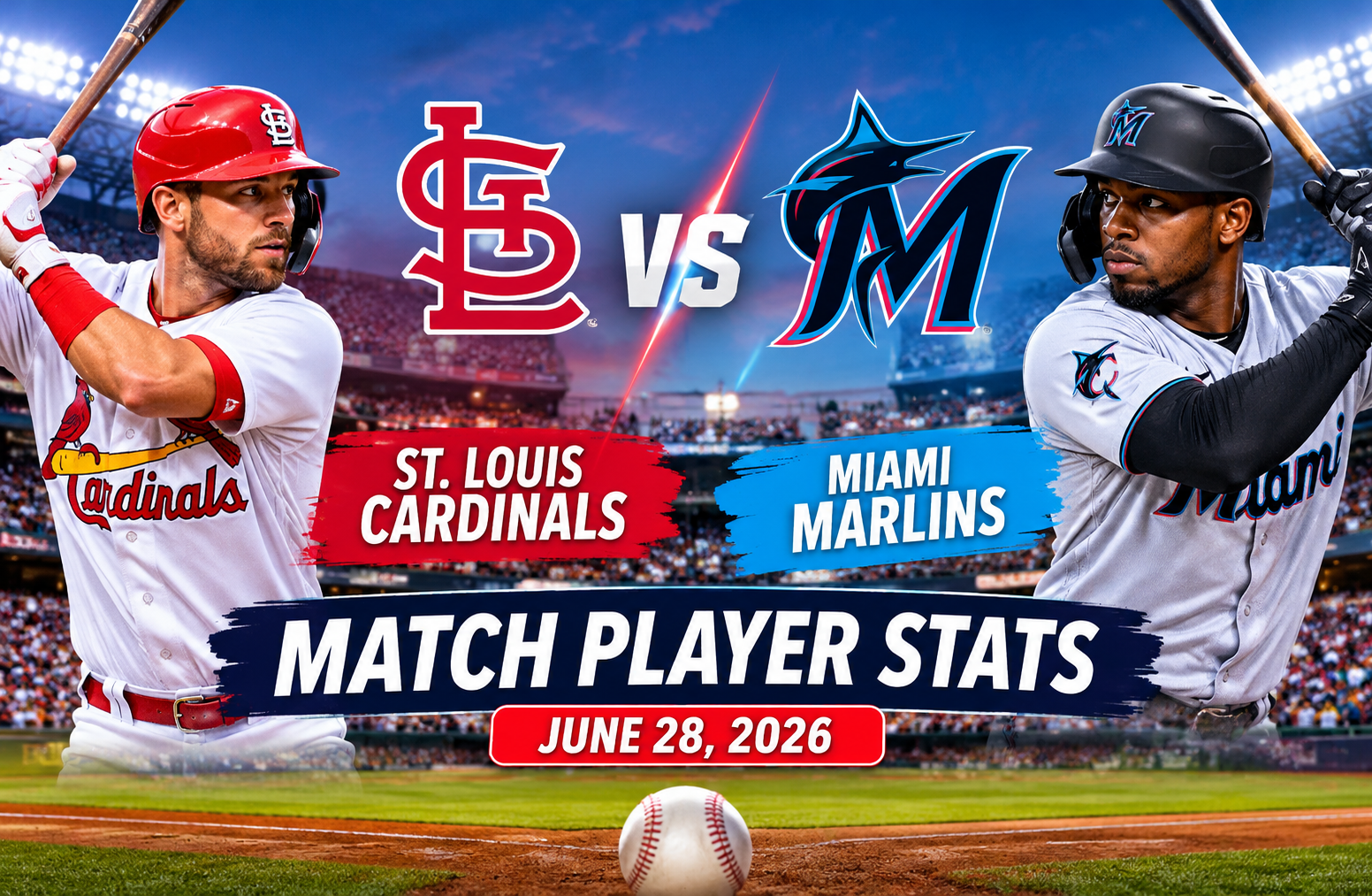
St. Louis Cardinals vs Miami Marlins Match Player Stats
The st. louis cardinals vs miami marlins match player stats from June 28, 2026, tell the story of a closely contested game decided by one powerful swing and an effective pitching performance. The St. Louis Cardinals defeated the Miami Marlins 2-1 at Busch Stadium, using a second-inning home run and five innings of strong starting pitching to secure the victory. Although Miami created several opportunities to respond, the Cardinals’ bullpen protected the narrow lead through the final out.
The matchup featured important contributions from Bryan Torres, JJ Wetherholt, Kyle Leahy, Graham Pauley, and Tyler Phillips. Torres delivered the decisive offensive moment with a two-run home run. Leahy limited Miami to one earned run, while Riley O’Brien completed the game with his 20th save of the season.
Despite losing the final game, Miami won the three-game series 2-1. The Marlins had previously defeated St. Louis 4-0 and 5-1. Therefore, the Cardinals’ final victory prevented a series sweep rather than changing the overall series winner.
This game provides an interesting example of how a small offensive advantage can become decisive when supported by disciplined pitching. St. Louis finished with six hits, while Miami recorded four. Both teams avoided defensive errors, making the difference in the final score primarily an outcome of timely hitting and run prevention.
St. Louis Cardinals vs Miami Marlins Match Player Stats: Complete Game Overview
The Cardinals entered the contest looking to finish their home series positively. Miami, meanwhile, wanted to complete a three-game sweep after winning the opening two matchups.
The final result was a 2-1 Cardinals victory. Both runs for St. Louis came from one swing in the second inning. Miami responded in the fifth but could not produce another run during the remaining four innings.
Match Information
| Match Detail | Information |
| Matchup | St. Louis Cardinals vs Miami Marlins |
| Date | June 28, 2026 |
| Competition | Major League Baseball |
| Venue | Busch Stadium |
| Location | St. Louis, Missouri |
| Attendance | 37,779 |
| Game Duration | 2 hours, 16 minutes |
| Final Score | Cardinals 2, Marlins 1 |
| Cardinals Hits | 6 |
| Marlins Hits | 4 |
| Cardinals Errors | 0 |
| Marlins Errors | 0 |
| Winning Pitcher | Kyle Leahy |
| Losing Pitcher | Tyler Phillips |
| Winning Save | Riley O’Brien |
The numbers show how closely matched the teams were in several areas. Miami collected four hits and scored once, while St. Louis produced six hits and scored twice.
The Cardinals also benefited from a strong relief performance. Their bullpen did not allow another run after Leahy left the game.
Final Score by Inning
| Team | 1 | 2 | 3 | 4 | 5 | 6 | 7 | 8 | 9 | R | H | E |
| Miami Marlins | 0 | 0 | 0 | 0 | 1 | 0 | 0 | 0 | 0 | 1 | 4 | 0 |
| St. Louis Cardinals | 0 | 2 | 0 | 0 | 0 | 0 | 0 | 0 | X | 2 | 6 | 0 |
St. Louis scored both runs in the second inning. Miami answered three innings later, but the Cardinals maintained their one-run advantage.
The final inning ended without a Miami comeback. O’Brien recorded a scoreless ninth inning to secure the save.
How the Cardinals Secured Their 2-1 Victory
The game developed around two important offensive moments. The first gave St. Louis its early advantage, while the second helped Miami return within one run.
Second Inning: Bryan Torres Delivers the Decisive Home Run
The Cardinals created their biggest scoring opportunity in the bottom of the second inning.
Masyn Winn reached base before Bryan Torres came to the plate. Torres connected with a pitch from Tyler Phillips and sent the ball over the fence for a two-run home run.
The home run brought Winn home and gave St. Louis a 2-0 advantage.
This was the most important offensive play of the afternoon. It accounted for both Cardinals runs and established the lead that the pitching staff protected for the remainder of the contest.
Torres finished with one hit, one home run, and two RBIs in three at-bats. His contribution was especially valuable because the Cardinals did not score again.
The timing also placed additional pressure on Phillips. Although the Miami starter continued pitching effectively after the home run, the damage had already determined the eventual difference between the teams.
Fifth Inning: Graham Pauley Gets Miami on the Scoreboard
Miami finally responded in the top of the fifth inning.
Owen Caissie reached base and created an opportunity for the Marlins to reduce the deficit. Graham Pauley followed with a double that brought Caissie home.
The play changed the score to 2-1.
Pauley’s hit gave Miami renewed hope, especially because the Cardinals had not added to their second-inning lead. However, the Marlins could not convert that momentum into additional runs.
The fifth inning remained Miami’s only scoring frame.
Pauley finished with one hit and one RBI. Caissie also contributed offensively with a hit and a run scored.
Ninth Inning: Riley O’Brien Closes the Game
The Cardinals entered the ninth inning protecting a one-run lead.
Riley O’Brien took responsibility for the final inning and delivered a scoreless appearance. He allowed no hits and recorded one strikeout.
His performance secured his 20th save of the season.
Closing a game with such a narrow advantage requires concentration and execution. One mistake can completely change the result. O’Brien avoided that situation and prevented Miami from extending the contest.
His contribution completed a pitching performance that began with Leahy and continued through several effective relief appearances.
St. Louis Cardinals Batting Stats and Player Performance
The Cardinals recorded six hits and two runs against Miami. Their offense was not consistently productive throughout the game, but Torres delivered when the team needed a major contribution.
JJ Wetherholt also provided useful support with two hits. Masyn Winn contributed a hit and scored the opening run.
Cardinals Batting Box Score
| Player | AB | R | H | RBI | HR | BB | SO |
| JJ Wetherholt | 4 | 0 | 2 | 0 | 0 | 0 | 2 |
| Iván Herrera | 3 | 0 | 0 | 0 | 0 | 0 | 0 |
| Alec Burleson | 3 | 0 | 0 | 0 | 0 | 0 | 0 |
| Lars Nootbaar | 3 | 0 | 0 | 0 | 0 | 0 | 0 |
| Masyn Winn | 3 | 1 | 1 | 0 | 0 | 0 | 0 |
| Bryan Torres | 3 | 1 | 1 | 2 | 1 | 0 | 0 |
| Brendan Jordan | 3 | 0 | 0 | 0 | 0 | 0 | 0 |
| Nathan Church | 3 | 0 | 1 | 0 | 0 | 0 | 0 |
| Pedro Pagés | 3 | 0 | 1 | 0 | 0 | 0 | 0 |
| Team Total | 28 | 2 | 6 | 2 | 1 | 0 | 2 |
AB means at-bats, R means runs, H means hits, RBI means runs batted in, HR means home runs, BB means walks, and SO means strikeouts.
Bryan Torres: The Offensive Difference-Maker
Bryan Torres was the most influential Cardinals hitter in this matchup.
His final batting line included:
- At-bats: 3
- Hits: 1
- Runs: 1
- RBIs: 2
- Home runs: 1
- Strikeouts: 0
His home run provided the entire offensive advantage for St. Louis.
The importance of his performance becomes clearer when considering the final score. The Cardinals produced only two runs across nine innings. Torres accounted for both, making his contribution directly responsible for the winning margin.
He also avoided a strikeout in his three at-bats. His ability to make the most of a scoring opportunity proved more valuable than collecting several hits without producing runs.
JJ Wetherholt: Two Important Hits
JJ Wetherholt provided the Cardinals with their most productive multi-hit performance.
He finished with two hits in four at-bats. Although he did not score or drive in a run, his ability to reach base helped maintain offensive pressure.
Wetherholt also recorded a stolen base during the contest. That additional contribution demonstrated his ability to create scoring opportunities beyond traditional hitting statistics.
His performance was a useful supporting element in a game where St. Louis needed every offensive opportunity.
Masyn Winn: Scoring the Opening Run
Masyn Winn recorded one hit in three at-bats and scored once.
His run came on Torres’ second-inning home run. Reaching base before that home run was important because it allowed Torres to produce two RBIs rather than one.
Winn’s contribution therefore played a direct role in the game’s decisive scoring sequence.
Nathan Church and Pedro Pagés
Nathan Church and Pedro Pagés each collected one hit.
Neither player recorded an RBI, but their hits contributed to the Cardinals’ six-hit total.
Church also played an important defensive role. The Cardinals completed a double play involving Winn and Alec Burleson, helping prevent Miami from creating additional scoring opportunities.
Pagés handled the catching responsibilities and worked behind the plate during the team’s pitching performance.
Cardinals’ Offensive Assessment
St. Louis did not dominate Miami’s pitching staff throughout the contest.
The team recorded six hits but finished without a walk. Its offensive production depended heavily on one successful scoring sequence.
Three factors explain the result:
- Torres delivered a home run with a runner on base.
- Wetherholt collected two hits and added a stolen base.
- Winn reached base and scored the run that established the winning margin.
The Cardinals did not need a large number of scoring opportunities. They needed one productive inning and enough pitching support to protect it.
Miami Marlins Batting Stats and Player Performance
The Miami Marlins finished with four hits and one run. Their offense showed some promise in the fifth inning, but the team struggled to generate consistent production against the Cardinals’ pitching staff.
Miami also struck out nine times. That total was significantly higher than St. Louis’ two batting strikeouts.
The Marlins reached base through a combination of hits and walks, but they could not turn those opportunities into enough runs.
Marlins Batting Box Score
| Player | AB | R | H | RBI | HR | BB | SO |
| Jakob Marsee | 3 | 0 | 0 | 0 | 0 | 1 | 1 |
| Otto Lopez | 4 | 0 | 0 | 0 | 0 | 0 | 2 |
| Kyle Stowers | 4 | 0 | 0 | 0 | 0 | 0 | 2 |
| Xavier Edwards | 3 | 0 | 1 | 0 | 0 | 1 | 0 |
| Heriberto Hernandez | 4 | 0 | 0 | 0 | 0 | 0 | 2 |
| Griffin Conine | 2 | 0 | 0 | 0 | 0 | 0 | 1 |
| Javier Sanoja | 2 | 0 | 0 | 0 | 0 | 0 | 1 |
| Owen Caissie | 1 | 1 | 1 | 0 | 0 | 1 | 0 |
| Esteury Ruiz | 1 | 0 | 0 | 0 | 0 | 0 | 0 |
| Graham Pauley | 2 | 0 | 1 | 1 | 0 | 0 | 0 |
| L. Jiménez | 1 | 0 | 1 | 0 | 0 | 0 | 0 |
| Brian Navarreto | 1 | 0 | 0 | 0 | 0 | 0 | 0 |
| Joe Mack | 1 | 0 | 0 | 0 | 0 | 0 | 0 |
| Team Total | 29 | 1 | 4 | 1 | 0 | 3 | 9 |
Pinch hitters and players who entered during the game are included in the batting totals.
Graham Pauley: Miami’s Only RBI
Graham Pauley delivered the hit responsible for Miami’s only run.
His fifth-inning double brought Owen Caissie home and reduced the Cardinals’ advantage to 2-1.
His individual batting numbers included:
- At-bats: 2
- Hits: 1
- RBIs: 1
- Doubles: 1
- Runs: 0
Pauley’s contribution prevented Miami from being shut out. It also created a more competitive situation for the remainder of the game.
However, the Marlins could not produce another successful scoring play after his double.
Owen Caissie: Reaching Base and Scoring
Owen Caissie recorded one hit and scored Miami’s only run.
His appearance was particularly important because his presence on base allowed Pauley to produce an RBI.
Caissie also drew a walk during the contest. Despite receiving limited official at-bats, he contributed to Miami’s offensive production.
Xavier Edwards: A Base-Running Contribution
Xavier Edwards collected one hit and one walk.
He also stole a base, adding another element to Miami’s offensive effort.
Edwards demonstrated the type of speed that can create pressure even when a team is struggling to collect extra-base hits.
However, Miami could not turn his individual contributions into additional runs.
Luis Jiménez Adds a Hit
Luis Jiménez entered as a pinch hitter and recorded a single.
His hit contributed to Miami’s four-hit total. However, it did not lead to another scoring opportunity.
His appearance represented one of the Marlins’ few successful offensive contributions during the later innings.
Why Miami’s Offense Struggled
The Marlins’ offensive performance was limited by several factors.
First, the team collected only four hits across nine innings. That made it difficult to establish sustained pressure against the Cardinals.
Second, Miami recorded nine strikeouts. Several important hitters failed to put the ball in play during their opportunities.
Third, the Marlins scored only one run despite reaching base through three walks and four hits.
The team’s overall performance was not completely unsuccessful. Miami avoided defensive errors and received a lengthy outing from its starting pitcher. However, its offense could not provide enough support to overcome the second-inning home run.
Pitching Comparison: Cardinals vs Marlins
Pitching was one of the most important elements of this matchup.
Both starting pitchers completed at least five innings, but their results differed in terms of run prevention and strikeouts.
Kyle Leahy earned the victory after allowing one earned run in five innings. Tyler Phillips pitched longer but surrendered the two runs that ultimately decided the contest.
The Cardinals’ bullpen then protected the lead through four scoreless innings.
Cardinals Pitching Stats
| Pitcher | IP | H | R | ER | BB | SO |
| Kyle Leahy | 5.0 | 2 | 1 | 1 | 3 | 5 |
| JoJo Romero | 1.1 | 1 | 0 | 0 | 0 | 1 |
| Ryne Stanek | 0.2 | 1 | 0 | 0 | 0 | 0 |
| George Soriano | 1.0 | 0 | 0 | 0 | 0 | 2 |
| Riley O’Brien | 1.0 | 0 | 0 | 0 | 0 | 1 |
| Team Total | 9.0 | 4 | 1 | 1 | 3 | 9 |
Miami Marlins Pitching Stats
| Pitcher | IP | H | R | ER | BB | SO |
| Tyler Phillips | 7.1 | 6 | 2 | 2 | 0 | 1 |
| Caleb Gibson | 0.2 | 0 | 0 | 0 | 0 | 1 |
| Team Total | 8.0 | 6 | 2 | 2 | 0 | 2 |
IP means innings pitched, H means hits allowed, R means runs allowed, ER means earned runs, BB means walks, and SO means strikeouts.
Kyle Leahy: A Winning Starting Performance
Kyle Leahy delivered five innings of effective pitching for St. Louis.
His final numbers were:
- Innings pitched: 5.0
- Hits allowed: 2
- Runs allowed: 1
- Earned runs: 1
- Walks: 3
- Strikeouts: 5
Leahy limited Miami to two hits during his appearance. Although he issued three walks, he prevented the Marlins from converting those opportunities into a larger scoring advantage.
His five strikeouts also helped control Miami’s lineup.
The only run charged to Leahy came during the fifth inning, when Pauley’s double brought Caissie home.
Leahy left the game with St. Louis still ahead. The bullpen maintained that advantage, allowing him to receive the winning decision.
Tyler Phillips: A Long Outing Despite the Loss
Tyler Phillips pitched 7.1 innings for Miami.
His final pitching line included six hits, two earned runs, no walks, and one strikeout.
Phillips deserves recognition for his ability to remain in the game for more than seven innings. He did not issue a walk and limited the Cardinals to six hits.
However, the second-inning home run proved costly.
Both Cardinals runs were charged to Phillips. Because Miami scored only once, that single offensive sequence became the difference between victory and defeat.
His performance shows why pitching duration and game results do not always tell the same story. A starter can provide substantial innings and still receive a loss when a small number of mistakes become decisive.
JoJo Romero Supports the Bullpen
JoJo Romero pitched 1.1 innings and allowed one hit without surrendering a run.
He recorded one strikeout and did not issue a walk.
His appearance helped bridge the game between Leahy and the remaining relievers.
Romero’s contribution was particularly important because the Cardinals had only a one-run advantage to protect.
Ryne Stanek and George Soriano Maintain Control
Ryne Stanek recorded two outs and allowed one hit.
He did not allow a run or issue a walk. His short appearance helped St. Louis move closer to the final innings.
George Soriano followed with a scoreless inning. He allowed no hits and recorded two strikeouts.
Soriano’s performance was particularly effective because Miami could not put a runner on base during his inning.
Riley O’Brien Secures His 20th Save
Riley O’Brien completed the Cardinals’ pitching effort.
He pitched one inning, allowed no hits, and recorded one strikeout.
The appearance earned him his 20th save of the season.
O’Brien’s ability to finish the contest was important because Miami needed only one additional run to tie the score.
His scoreless inning protected the Cardinals’ narrow advantage and completed the 2-1 victory.
Head-to-Head Statistical Comparison
The team statistics highlight the main reasons St. Louis won the contest.
Miami produced fewer hits and struck out more frequently. The Cardinals, meanwhile, received the more effective overall pitching performance.
Team Statistics Comparison
| Statistical Category | Cardinals | Marlins |
| Runs | 2 | 1 |
| Hits | 6 | 4 |
| Home Runs | 1 | 0 |
| RBIs | 2 | 1 |
| Doubles | 0 | 2 |
| Walks | 0 | 3 |
| Strikeouts by Batters | 2 | 9 |
| Stolen Bases | 1 | 1 |
| Errors | 0 | 0 |
| Left on Base | 2 | 5 |
| Runs Allowed | 1 | 2 |
| Pitching Strikeouts | 9 | 2 |
The comparison reveals several important differences.
St. Louis Had the More Productive Offense
The Cardinals collected six hits compared with Miami’s four.
More importantly, St. Louis produced a home run with a runner on base. That one play generated both of its runs.
Miami recorded two doubles but could not produce a home run. Its extra-base hits created opportunities, but only one resulted in a run.
Miami Reached Base More Frequently Through Walks
The Marlins drew three walks, while St. Louis did not receive any.
This statistic shows that Miami had opportunities to place additional runners on base.
However, reaching base does not automatically produce runs. The Marlins struggled to move those runners around and finish scoring sequences.
The Cardinals Had a Clear Strikeout Advantage
St. Louis pitchers recorded nine strikeouts against Miami.
The Marlins’ pitchers recorded only two strikeouts against Cardinals hitters.
This difference reflects how effectively the Cardinals’ pitching staff challenged the Miami lineup.
Miami Left More Runners on Base
The Marlins left five runners on base, compared with two for St. Louis.
This was another important difference.
Miami had more opportunities to extend innings but could not consistently turn those situations into runs.
Key Matchups That Influenced the Result
Individual player matchups helped shape the outcome.
The most important was the confrontation between Bryan Torres and Tyler Phillips in the second inning.
Torres won that matchup by hitting a two-run home run. The play placed St. Louis ahead and created the margin that Miami could not overcome.
Another important matchup involved Kyle Leahy against Miami’s middle-order hitters. Leahy allowed only two hits in five innings and limited the damage despite issuing three walks.
The bullpen then faced the challenge of protecting the advantage against a team that needed only one run to tie.
Bryan Torres vs Tyler Phillips
This was the decisive offensive matchup.
Phillips generally limited the Cardinals’ offense, but Torres capitalized on a scoring opportunity.
The home run changed the scoreboard immediately and established the winning margin.
Kyle Leahy vs Miami’s Batting Lineup
Leahy’s five strikeouts helped reduce Miami’s offensive momentum.
Although the Marlins scored once during his appearance, they could not produce a second run.
His ability to limit hits was a major part of the Cardinals’ early control.
Riley O’Brien vs Miami’s Final-Inning Offense
O’Brien faced the responsibility of closing a one-run game.
He delivered a hitless ninth inning and recorded a strikeout.
His performance ensured that the Marlins did not get another opportunity to tie the contest.
Important Statistical Lessons From the Game
The matchup provides several useful insights into baseball performance.
A final score does not always reflect which team had the longer offensive stretches or the more impressive individual pitching workload.
In this contest, several statistical details explain the result more clearly than the scoreboard alone.
One Home Run Can Decide a Low-Scoring Game
The Cardinals scored both of their runs through one home run.
Torres’ second-inning contribution accounted for the entire difference between the teams.
This demonstrates the importance of hitting with runners on base.
A single successful swing can have more influence on the final result than several hits that do not produce runs.
Pitching Efficiency Requires More Than Strikeouts
Leahy recorded five strikeouts but also issued three walks.
His performance was successful because he limited Miami to two hits and only one earned run.
Strikeouts are valuable, but pitchers must also control walks, contact, and scoring opportunities.
The Cardinals’ relief pitchers continued that approach by allowing no additional runs.
Long Starting Outings Do Not Guarantee Wins
Phillips pitched 7.1 innings, considerably longer than Leahy.
However, he received the losing decision because he allowed the two runs that determined the result.
This is an important distinction when evaluating pitcher performance.
Innings pitched measure workload, while the win-loss decision reflects the game’s result under official scoring rules.
Defensive Reliability Matters in Close Games
Neither team committed an error.
Both defenses completed a double play, helping reduce the number of potential scoring opportunities.
The Cardinals’ defensive execution was especially useful while protecting a one-run lead.
Series Context: Why the Final Game Still Mattered
Although St. Louis won the final matchup, Miami won the three-game series.
The Marlins entered the contest with victories of 4-0 and 5-1.
The Cardinals’ 2-1 win prevented a sweep and gave them a positive result in the final meeting.
Results From the Three-Game Series
| Game | Result | Winner |
| First Game | Marlins 4-0 Cardinals | Miami Marlins |
| Second Game | Marlins 5-1 Cardinals | Miami Marlins |
| Third Game | Cardinals 2-1 Marlins | St. Louis Cardinals |
| Series Result | Marlins won 2-1 | Miami Marlins |
The series demonstrates how individual game outcomes and overall series results can differ.
St. Louis finished with a victory, but Miami had already secured the series by winning the first two contests.
For the Cardinals, the final result offered a better ending to the series. For Miami, the earlier victories remained enough to secure the overall advantage.
What the Match Player Stats Reveal About Both Teams
The individual performances offer a clearer understanding of each team’s strengths and weaknesses during this game.
St. Louis demonstrated the value of timely power hitting and effective bullpen management.
Miami showed that it could generate extra-base hits and reach base through walks, but it struggled to convert those opportunities into runs.
What Worked for the Cardinals?
The Cardinals benefited from three major factors:
- Power hitting: Torres produced a two-run home run that established the winning advantage.
- Starting pitching: Leahy limited Miami to one run over five innings.
- Bullpen execution: Four relief pitchers combined to complete four scoreless innings.
The team also avoided defensive errors, helping protect its narrow advantage.
What Could Miami Have Done Better?
Miami’s biggest challenge was its inability to produce consistent offensive pressure.
The team recorded four hits and nine strikeouts. Its three walks created opportunities, but it left five runners on base.
The Marlins could have benefited from more contact in important situations.
They also needed additional production after Pauley’s fifth-inning double.
Their starting pitching was not entirely ineffective. Phillips completed more than seven innings without issuing a walk. However, the two-run home run became too costly in a game with limited scoring.
Which Players Had the Biggest Impact?
Bryan Torres was the most influential offensive player because he drove in both Cardinals runs.
Kyle Leahy was the most important starting pitcher for St. Louis, while Riley O’Brien completed the victory with a save.
For Miami, Graham Pauley produced the only RBI. Owen Caissie scored the team’s only run, and Tyler Phillips provided a lengthy starting appearance despite receiving the loss.
These performances explain why the final score remained close.
Frequently Asked Questions
1. Who won the St. Louis Cardinals vs Miami Marlins game on June 28, 2026?
The St. Louis Cardinals defeated the Miami Marlins 2-1 at Busch Stadium. Bryan Torres’ two-run home run provided the winning margin.
2. Which Cardinals player hit a home run?
Bryan Torres hit a two-run home run in the second inning. His home run scored Masyn Winn and gave St. Louis a 2-0 lead.
3. How many hits did each team record?
The Cardinals recorded six hits, while the Marlins finished with four hits. St. Louis also scored twice compared with Miami’s single run.
4. Who was the winning pitcher?
Kyle Leahy earned the winning decision. He pitched five innings, allowed two hits and one earned run, issued three walks, and recorded five strikeouts.
5. Why did Tyler Phillips receive the loss?
Tyler Phillips received the losing decision after allowing two earned runs over 7.1 innings. Both runs came from Bryan Torres’ second-inning home run.
6. Who recorded the save for the Cardinals?
Riley O’Brien recorded his 20th save of the season. He pitched a scoreless ninth inning, allowed no hits, and recorded one strikeout.
Conclusion
The June 28, 2026, matchup between the St. Louis Cardinals and Miami Marlins ended with a 2-1 victory for St. Louis. Bryan Torres delivered the decisive moment with a two-run home run in the second inning. Graham Pauley later brought Miami within one run, but the Marlins could not complete the comeback.
The Cardinals finished with six hits, compared with Miami’s four. Kyle Leahy earned the win after allowing one run in five innings. The bullpen maintained the advantage, with Riley O’Brien securing his 20th save.
Tyler Phillips also delivered a lengthy outing, pitching 7.1 innings despite receiving the loss. However, his second-inning mistake proved decisive in a low-scoring contest.
Although St. Louis won the final game, Miami secured the three-game series by winning the opening two matchups. The result highlighted the importance of timely hitting, effective pitching changes, and defensive execution.