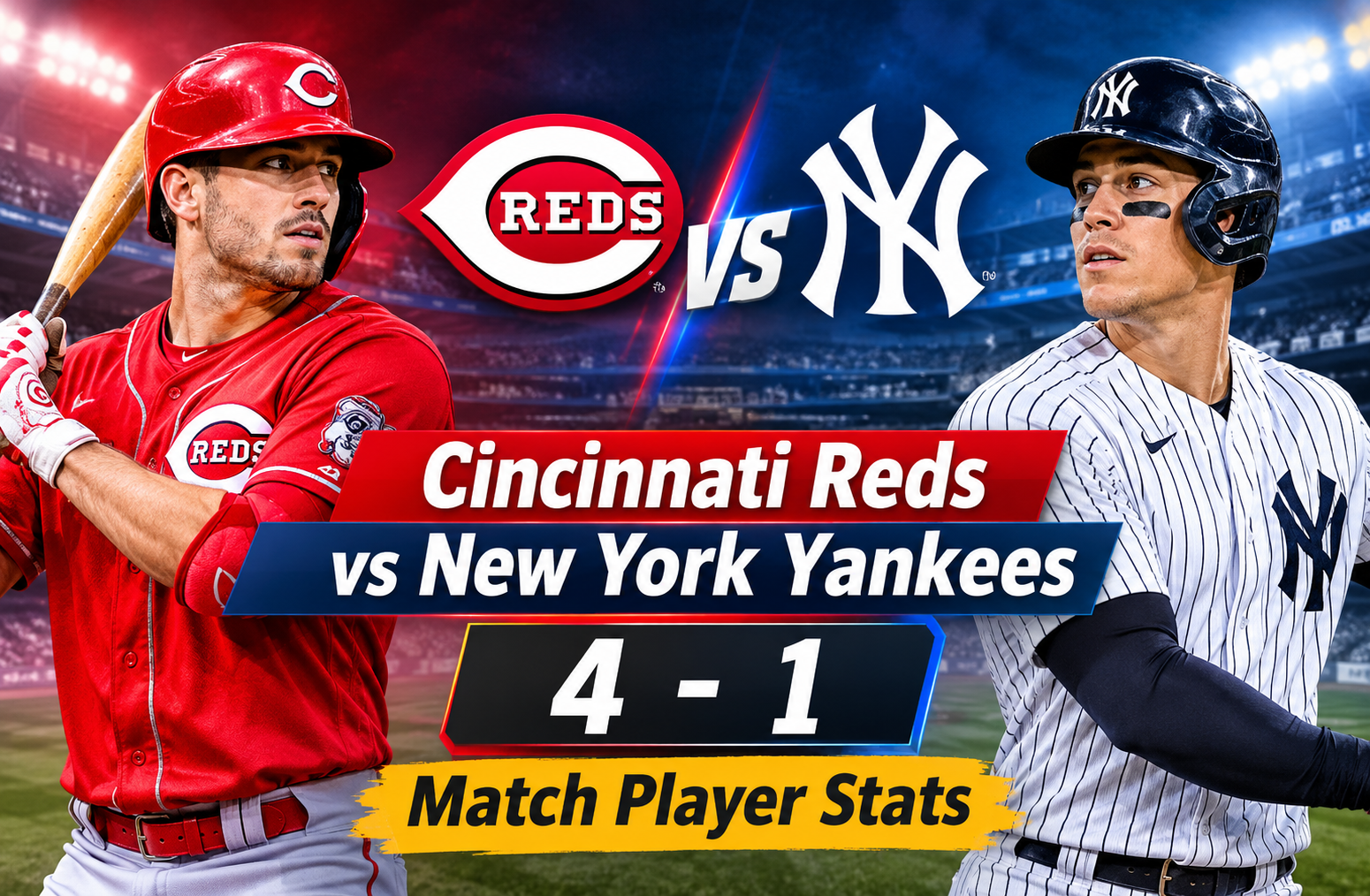
Cincinnati Reds vs New York Yankees Match Player Stats
The cincinnati reds vs new york yankees match player stats from June 21, 2026, reveal how Cincinnati secured a 4-1 victory over New York at Yankee Stadium. The Reds combined timely hitting, effective starting pitching, and a reliable bullpen to win the series finale. Tyler Stephenson delivered the biggest offensive moment with a three-run home run in the fourth inning. Chase Burns controlled the Yankees’ lineup over five innings, while Tony Santillan completed the game with two scoreless innings. Despite recording seven hits, the Yankees struggled to turn their offensive opportunities into runs. Their defensive mistakes also made the difference in a closely contested matchup.
The result gave Cincinnati a 2-1 victory in the three-game series. Both teams finished with seven hits, but the Reds produced four runs while limiting New York to one. The difference came from Cincinnati’s ability to capitalize on important scoring opportunities and maintain control during the final innings.
This game also offered several individual performances worth examining. Stephenson’s power hitting, Burns’ seven strikeouts, and Santillan’s late-inning work shaped the final result. On the other side, Ben Rice provided New York’s only run with a solo home run in the third inning.
This breakdown examines the final score, individual batting performances, pitching statistics, team comparisons, important moments, and the factors that influenced the outcome.
Cincinnati Reds vs New York Yankees Match Player Stats: Game Overview
MLB REGULAR-SEASON GAME | JUNE 21, 2026
2025 MLB Draft News, Dates, Tracker and Prospects | MLB.com
Cincinnati Reds
4
Winner
FINAL
June 21, 2026
4-1
New York Yankees Scores, Stats and Highlights – ESPN
New York Yankees
1
Home
Venue
Yankee Stadium
Location
Bronx, New York
Attendance
46,046
Game duration
2 hours, 56 minutes
Series result
Reds won 2-1
Game format
Nine innings
The Cincinnati Reds entered the matchup looking to finish the series with a winning result. New York wanted to protect its home advantage and secure the final game.
Cincinnati achieved its objective through a combination of offensive execution and pitching discipline.
The Reds collected seven hits and scored four runs. Their biggest offensive contribution came from Stephenson, whose home run changed the direction of the game.
New York also collected seven hits. However, the Yankees scored only once, despite reaching base through hits and walks.
Final Score by Inning
| Inning | Reds | Yankees |
| First | 0 | 0 |
| Second | 0 | 0 |
| Third | 0 | 1 |
| Fourth | 3 | 0 |
| Fifth | 0 | 0 |
| Sixth | 0 | 0 |
| Seventh | 0 | 0 |
| Eighth | 0 | 0 |
| Ninth | 1 | 0 |
| Total | 4 | 1 |
The scoring pattern explains why Cincinnati controlled the game.
New York initially took the lead in the third inning. However, the Reds responded immediately with three runs in the fourth.
Cincinnati then maintained its advantage through the middle innings. An additional run in the ninth provided insurance and established the final 4-1 score.
Complete Team Statistics: Cincinnati Reds vs New York Yankees
The overall team numbers show that this was not a game dominated by one team in every category. Both lineups produced the same number of hits, but Cincinnati was more effective when opportunities appeared.
| Team Statistic | Cincinnati Reds | New York Yankees |
| Runs | 4 | 1 |
| Hits | 7 | 7 |
| Errors | 0 | 3 |
| Home Runs | 1 | 1 |
| Runs Batted In | 4 | 1 |
| Batting Strikeouts | 6 | 10 |
| Batting Walks | 3 | 4 |
What the Team Numbers Reveal
- Equal hits did not produce equal results
Both teams finished with seven hits. However, Cincinnati converted its offensive opportunities into four runs.
The Yankees managed only one run from their seven hits. This difference highlights the importance of hitting with runners in scoring position.
A team can collect several hits without creating enough scoring opportunities. Cincinnati avoided that problem during its most important offensive sequence.
- Home runs created the biggest scoring difference
Both teams recorded one home run.
Ben Rice hit a solo home run for New York in the third inning. Stephenson answered with a three-run homer in the fourth.
Although the teams finished with identical home run totals, Cincinnati received substantially more production from its long ball.
- New York struggled with strikeouts
The Yankees struck out 10 times, compared with six strikeouts by Cincinnati hitters.
This difference reflects the effectiveness of the Reds’ pitching staff. Burns recorded seven strikeouts himself, giving Cincinnati a strong foundation during the opening five innings.
- Defensive mistakes created additional pressure
The Yankees were charged with three errors in the supplied game statistics, while Cincinnati finished without an error.
Defensive mistakes can extend innings and create additional opportunities for opposing hitters. Cincinnati benefited from New York’s defensive problems while maintaining a clean defensive performance.
Cincinnati Reds Batting Stats and Individual Performances
Cincinnati’s offense was not built around one player collecting several hits. Instead, different hitters contributed at important moments.
Stephenson provided the decisive home run, while Noelvi Marte contributed two hits and an important RBI double.
The following table presents the Reds’ individual batting numbers.
Cincinnati Reds Batting Box Score
| Player | AB | R | H | RBI | HR |
| Blake Dunn | 4 | 0 | 2 | 0 | 0 |
| JJ Bleday | 3 | 0 | 0 | 0 | 0 |
| Sal Stewart | 4 | 0 | 1 | 0 | 0 |
| Nathaniel Lowe | 3 | 1 | 0 | 0 | 0 |
| Spencer Steer | 4 | 1 | 1 | 0 | 0 |
| Eugenio Suárez | 4 | 0 | 0 | 0 | 0 |
| Noelvi Marte | 4 | 1 | 2 | 1 | 0 |
| Tyler Stephenson | 4 | 1 | 1 | 3 | 1 |
| Edwin Arroyo | 3 | 0 | 0 | 0 | 0 |
| Team Total | 33 | 4 | 7 | 4 | 1 |
AB means at-bats, R means runs, H means hits, RBI means runs batted in, and HR means home runs.
Tyler Stephenson: The Offensive Difference-Maker
Cincinnati Reds v New York Yankees
Tyler Stephenson
Top offensive performer
- At-bats: 4
- Hits: 1
- Runs: 1
- Home runs: 1
- RBIs: 3
Tyler Stephenson delivered the most important offensive performance of the afternoon.
His three-run home run in the fourth inning gave Cincinnati a 3-1 lead. It also changed the momentum after New York had scored the opening run.
The situation made the home run especially important.
Stephenson faced Yankees starting pitcher Elmer Rodríguez with two runners aboard and two outs. Rather than allowing the inning to end without a major scoring contribution, he connected for a home run that brought three runs across the plate.
His performance demonstrated the value of timely hitting.
A batter does not necessarily need multiple hits to become the most influential offensive player. Stephenson finished with only one hit, but that hit produced three runs.
His home run accounted for 75% of Cincinnati’s final four runs.
That makes his contribution particularly important when evaluating the offensive numbers.
Noelvi Marte: Two Hits and an Important Ninth-Inning RBI
San Francisco Giants v Cincinnati Reds
Noelvi Marte
- At-bats: 4
- Hits: 2
- Runs: 1
- RBIs: 1
- Home runs: 0
Noelvi Marte provided another valuable contribution to Cincinnati’s victory.
He finished with two hits, making him one of the Reds’ most productive players at the plate.
His most important contribution arrived in the ninth inning.
Marte hit a ground-rule double against Yankees reliever Camilo Doval. The hit allowed Spencer Steer to score and extended Cincinnati’s advantage to three runs.
This insurance run was important because it reduced the possibility of a late comeback.
Marte’s performance also showed that Cincinnati did not depend entirely on home runs. The Reds created scoring opportunities through extra-base hits and productive offensive sequences.
Blake Dunn: A Useful Contribution at the Plate
Cincinnati Reds v Chicago Cubs
Blake Dunn
- At-bats: 4
- Hits: 2
- Runs: 0
- RBIs: 0
Blake Dunn recorded two hits in four at-bats.
Although he did not score a run or record an RBI, his two hits contributed to Cincinnati’s offensive production.
Getting on base is an important part of building scoring opportunities. A player can help an offense without appearing directly in the RBI column.
Dunn also attempted to advance during the game but was caught stealing. This illustrates how baserunning decisions can affect offensive production.
His batting performance remained one of Cincinnati’s better individual contributions.
Spencer Steer: Supporting the Reds’ Scoring Effort
Cincinnati Reds v Colorado Rockies
Spencer Steer
- At-bats: 4
- Hits: 1
- Runs: 1
- RBIs: 0
Spencer Steer finished with one hit and scored one run.
His contribution became particularly relevant in the ninth inning. He scored on Marte’s ground-rule double, helping Cincinnati increase its lead to 4-1.
Steer also recorded a double during the game.
His performance demonstrates why run scoring and run production are different statistics. A player can score without recording an RBI because another batter drives him home.
Nathaniel Lowe: Reaching Base and Scoring
Nathaniel Lowe recorded three at-bats without collecting a hit.
However, he scored one run for Cincinnati.
This is another example of why batting analysis should consider more than the number of hits.
A player who reaches base through a walk or another method can still contribute to an inning. Lowe’s run was part of Cincinnati’s offensive production.
Other Reds Batting Contributions
Sal Stewart recorded one hit in four at-bats. He contributed to the lineup’s overall offensive activity, although he did not score or drive in a run.
JJ Bleday finished without a hit in three at-bats. Edwin Arroyo also went hitless in three at-bats.
Eugenio Suárez did not record a hit in four at-bats.
These individual results show that Cincinnati’s victory was not the product of every hitter performing equally well. The lineup received its most important production from Stephenson and Marte.
The team’s ability to capitalize on those contributions proved sufficient to win.
New York Yankees Batting Stats and Individual Performances
The Yankees produced seven hits but could not generate enough runs to challenge Cincinnati’s advantage.
Ben Rice provided the team’s only run through a solo home run. Other players recorded hits, but the lineup struggled to produce additional scoring.
New York Yankees Batting Box Score
| Player | AB | R | H | RBI | HR |
| Ben Rice | 3 | 1 | 2 | 1 | 1 |
| Jasson Domínguez | 4 | 0 | 1 | 0 | 0 |
| Cody Bellinger | 3 | 0 | 1 | 0 | 0 |
| Spencer Jones | 2 | 0 | 0 | 0 | 0 |
| Max Schuemann | 2 | 0 | 0 | 0 | 0 |
| Jazz Chisholm Jr. | 4 | 0 | 1 | 0 | 0 |
| José Caballero | 3 | 0 | 1 | 0 | 0 |
| Ryan McMahon | 2 | 0 | 0 | 0 | 0 |
| Amed Rosario | 2 | 0 | 1 | 0 | 0 |
| Austin Wells | 2 | 0 | 0 | 0 | 0 |
| Paul Goldschmidt | 1 | 0 | 0 | 0 | 0 |
| Agustín Sánchez | 1 | 0 | 0 | 0 | 0 |
| Anthony Volpe | 3 | 0 | 0 | 0 | 0 |
| Team Total | 32 | 1 | 7 | 1 | 1 |
AB means at-bats, R means runs, H means hits, RBI means runs batted in, and HR means home runs.
Ben Rice: New York’s Leading Offensive Performer
Cincinnati Reds v New York Yankees
Ben Rice
Yankees top hitter
- At-bats: 3
- Hits: 2
- Runs: 1
- Home runs: 1
- RBIs: 1
- Walks: 1
Ben Rice delivered New York’s most important offensive contribution.
He hit a solo home run against Chase Burns in the third inning. The home run gave the Yankees an early 1-0 advantage.
Rice finished with two hits in three at-bats, one run, one RBI, and one walk.
His performance was particularly notable because he accounted for New York’s only run.
However, the Yankees could not build on his offensive success.
Rice’s home run was followed by Cincinnati’s three-run response in the next inning. That sequence became the turning point of the matchup.
Jasson Domínguez: Reaching Base and Creating Movement
Jasson Domínguez
- At-bats: 4
- Hits: 1
- Runs: 0
- RBIs: 0
- Stolen bases: 2
Jasson Domínguez recorded one hit and stole two bases.
His baserunning was part of an unusual aspect of this game. New York’s runners successfully stole six bases in total.
Domínguez’s speed created movement on the bases, but the Yankees could not turn those opportunities into additional runs.
This distinction is important when assessing offensive performance.
Baserunning can place pressure on pitchers and catchers. However, stolen bases only become valuable when the offense eventually converts them into scoring opportunities.
Cody Bellinger: A Hit and Two Stolen Bases
Cody Bellinger
- At-bats: 3
- Hits: 1
- Runs: 0
- RBIs: 0
- Stolen bases: 2
- Walks: 1
Cody Bellinger finished with one hit and one walk.
He also stole two bases, giving New York another baserunner capable of advancing into scoring position.
However, Bellinger did not score.
His performance reflects the broader problem experienced by the Yankees. They created opportunities through individual offensive actions but struggled to bring runners home.
Jazz Chisholm Jr.: Speed Without Run Production
Boston Red Sox v New York Yankees
Jazz Chisholm Jr.
- At-bats: 4
- Hits: 1
- Runs: 0
- RBIs: 0
- Stolen bases: 2
Jazz Chisholm Jr. recorded one hit and stole two bases.
Like Domínguez and Bellinger, he demonstrated the Yankees’ ability to create movement on the bases.
However, none of those three players scored.
The Yankees had six successful stolen bases between these players, but their final run total remained one.
This was one of the most interesting statistical contrasts in the game.
Additional Yankees Batting Contributions
José Caballero recorded one hit in three at-bats. He also drew a walk but was caught stealing.
Amed Rosario added one hit as a pinch hitter and later played third base.
Spencer Jones, Max Schuemann, Ryan McMahon, Austin Wells, Paul Goldschmidt, Agustín Sánchez, and Anthony Volpe did not record hits.
These results demonstrate that New York’s offense had contributions from several players but lacked the necessary production with runners on base.
The Yankees needed another major hit after Rice’s home run. That moment never arrived.
Complete Pitching Stats: Reds vs Yankees
Pitching was one of the most important reasons Cincinnati won the game.
Chase Burns started for the Reds and delivered five innings of one-run baseball. The bullpen then handled the remaining four innings without allowing another run.
New York’s pitching staff allowed four runs across nine innings.
Cincinnati Reds Pitching Box Score
| Pitcher | IP | H | R | ER | BB | SO |
| Chase Burns | 5.0 | 5 | 1 | 1 | 3 | 7 |
| Sam Moll | 1.0 | 1 | 0 | 0 | 1 | 1 |
| Caleb Ferguson | 1.0 | 1 | 0 | 0 | 0 | 1 |
| Tony Santillan | 2.0 | 0 | 0 | 0 | 0 | 1 |
| Total | 9.0 | 7 | 1 | 1 | 4 | 10 |
IP means innings pitched, H means hits allowed, R means runs allowed, ER means earned runs, BB means walks, and SO means strikeouts.
Chase Burns: Starting Pitcher and Winning Performer
Chase Burns Earns First MLB Win, Reds Stay Hot With Victory Over Pirates
Chase Burns
Winning pitcher
- Innings pitched: 5.0
- Hits allowed: 5
- Runs allowed: 1
- Earned runs: 1
- Strikeouts: 7
- Walks: 3
- Decision: 9-1
Chase Burns played a central role in Cincinnati’s victory.
He pitched five innings and allowed five hits and one earned run. He also recorded seven strikeouts and issued three walks.
His most important achievement was preventing New York from building on its early lead.
Burns allowed Rice’s solo home run in the third inning. However, he avoided further damage and kept the Yankees from scoring during the remaining innings of his appearance.
Seven strikeouts in five innings represented a strong performance.
His strikeout total also helped Cincinnati’s pitching staff finish with 10 strikeouts overall.
Another important detail was his ability to limit the damage after allowing baserunners.
The Yankees were active on the bases and successfully stole six bags. Nevertheless, Burns kept their scoring opportunities under control.
He earned his ninth win of the season and improved his record to 9-1.
His performance gave the Reds an important foundation before the bullpen took over.
Sam Moll: A Scoreless Middle-Inning Appearance
Cincinnati Reds v New York Yankees
Sam Moll
- Innings pitched: 1.0
- Hits allowed: 1
- Earned runs: 0
- Walks: 1
- Strikeouts: 1
- Decision: Hold
Sam Moll handled one inning of relief work.
He allowed one hit and one walk but did not surrender a run.
His appearance helped Cincinnati maintain its advantage during the middle portion of the game.
Relief pitchers often face a different challenge from starting pitchers. They enter specific situations and must immediately establish control.
Moll completed his assignment without allowing New York to score.
Caleb Ferguson: Maintaining the Advantage
Cleveland Guardians v Cincinnati Reds – Game Two
Caleb Ferguson
- Innings pitched: 1.0
- Hits allowed: 1
- Earned runs: 0
- Walks: 0
- Strikeouts: 1
- Decision: Hold
Caleb Ferguson pitched one inning and allowed one hit.
He did not issue a walk or surrender a run.
His appearance continued Cincinnati’s strong bullpen performance.
The Yankees were still looking for an opportunity to reduce the deficit. Ferguson prevented them from converting their baserunner into a run.
Tony Santillan: Closing the Game
Cincinnati Reds v New York Yankees
Tony Santillan
Recorded the save
- Innings pitched: 2.0
- Hits allowed: 0
- Runs allowed: 0
- Walks: 0
- Strikeouts: 1
- Saves: 5
Tony Santillan delivered an important closing performance.
He pitched two innings without allowing a hit or a walk.
He also recorded one strikeout and earned his fifth save of the season.
The clean appearance was particularly important because the Yankees needed to score multiple runs to challenge Cincinnati’s lead.
Santillan did not give them that opportunity.
His two scoreless innings completed the Reds’ defensive effort and secured the 4-1 victory.
The performance also demonstrated the value of a bullpen that can protect a lead after the starting pitcher leaves the game.
New York Yankees Pitching Box Score
| Pitcher | IP | H | R | ER | BB | SO |
| Elmer Rodríguez | 4.0 | 4 | 3 | 3 | 2 | 4 |
| Tim Hill | 1.0 | 1 | 0 | 0 | 0 | 0 |
| Paul Blackburn | 1.1 | 0 | 0 | 0 | 0 | 0 |
| Ian Headrick | 1.0 | 0 | 0 | 0 | 0 | 0 |
| Fernando Cruz | 0.2 | 0 | 0 | 0 | 0 | 0 |
| Camilo Doval | 1.0 | 2 | 1 | 1 | 1 | 2 |
| Total | 9.0 | 7 | 4 | 4 | 3 | 6 |
Elmer Rodríguez: Starting Pitcher for New York
Elmer Rodríguez started the game for the Yankees.
He pitched four innings, allowing four hits and three earned runs. He also recorded four strikeouts and issued two walks.
His most difficult moment arrived in the fourth inning.
After New York took a 1-0 lead, Rodríguez faced Cincinnati’s lineup with runners aboard. Stephenson then hit the three-run home run that gave the Reds a two-run advantage.
Rodríguez was charged with the loss, bringing his record to 0-2.
His final pitching line illustrates how one difficult inning can influence an entire game.
He recorded four strikeouts, but the three-run home run proved too costly.
Tim Hill: One Inning of Relief
Tim Hill pitched one inning for New York.
He allowed one hit but did not surrender a run.
His appearance helped prevent Cincinnati from extending its lead immediately after the fourth-inning home run.
Paul Blackburn: Scoreless Relief Work
Paul Blackburn pitched 1.1 innings without allowing a hit or run.
He did not issue a walk or record a strikeout.
His performance helped New York keep the deficit at two runs during the middle innings.
Ian Headrick and Fernando Cruz
Ian Headrick pitched one scoreless inning, while Fernando Cruz recorded two outs without allowing a hit or run.
Both relievers contributed to keeping Cincinnati’s offense quiet after the fourth inning.
However, their efforts could not erase the earlier damage.
Camilo Doval: Ninth-Inning Insurance Run
Camilo Doval pitched the ninth inning for New York.
He allowed two hits, one earned run, and one walk while recording two strikeouts.
Marte’s RBI double extended Cincinnati’s lead during this appearance.
The run made the final score 4-1 and gave the Reds additional protection.
Key Moments That Decided the Game
The final result was shaped by a small number of important moments.
Although both teams collected seven hits, Cincinnati delivered its biggest offensive contribution at exactly the right time.
Third Inning: Ben Rice Gives New York the Lead
The Yankees opened the scoring in the third inning.
Ben Rice connected for a solo home run against Chase Burns.
The home run gave New York a 1-0 advantage and provided an early boost to the home crowd.
Rice’s contribution was especially important because the Yankees were looking to establish offensive momentum.
However, Cincinnati’s response came quickly.
Fourth Inning: Tyler Stephenson Changes the Score
The fourth inning became the defining moment of the game.
Cincinnati had an opportunity to respond to New York’s early lead.
Tyler Stephenson delivered a three-run home run against Elmer Rodríguez.
The hit brought three runs across the plate and changed the score from 1-0 in New York’s favor to 3-1 for Cincinnati.
This was the game’s biggest offensive swing.
Instead of allowing the Yankees to control the contest, Cincinnati took a two-run advantage.
Stephenson’s home run also established the Reds’ offensive approach for the remainder of the afternoon. They did not need to chase additional runs aggressively because their pitchers continued protecting the lead.
Fifth Through Eighth Innings: Pitching Takes Control
The middle innings were largely defined by the pitching staffs.
Neither offense managed to score between the fifth and eighth innings.
Cincinnati’s bullpen maintained the advantage after Burns completed his five-inning appearance.
New York’s relievers also limited additional damage.
However, the Yankees could not find another scoring opportunity against Cincinnati’s pitchers.
This period demonstrated the importance of maintaining concentration after a major offensive moment.
Cincinnati protected its lead rather than allowing New York to regain momentum.
Ninth Inning: Noelvi Marte Adds an Insurance Run
Cincinnati added its final run in the ninth inning.
Noelvi Marte hit a ground-rule double against Camilo Doval.
Spencer Steer scored on the play, extending the Reds’ lead to 4-1.
This run provided additional protection before Santillan entered to close the game.
Final Out: Santillan Secures the Victory
Tony Santillan completed the game with two scoreless innings.
He did not allow a hit or walk during his appearance.
The Yankees were unable to produce a late comeback.
Santillan’s performance secured the final result and completed Cincinnati’s series victory.
Baserunning Analysis: Six Stolen Bases by the Yankees
One of the most unusual statistical details from this matchup was New York’s baserunning activity.
The Yankees recorded six stolen bases, but they still finished with only one run.
Three players accounted for those stolen bases:
| Yankees Player | Stolen Bases |
| Jasson Domínguez | 2 |
| Cody Bellinger | 2 |
| Jazz Chisholm Jr. | 2 |
| Total | 6 |
This performance showed that New York could create pressure through speed.
However, successful stolen bases do not automatically produce runs.
A runner must eventually reach home plate, and the offense needs a productive hit, sacrifice, or another scoring opportunity.
In this game, the Yankees struggled to complete that process.
Their six stolen bases demonstrated aggressive baserunning, but Cincinnati’s pitchers prevented those advances from becoming additional runs.
The Reds also recorded a caught stealing involving Blake Dunn. José Caballero was caught stealing for New York.
Why the Yankees’ Baserunning Did Not Change the Result
There were three important factors:
- Limited run production: New York collected seven hits but scored only once.
- Strong relief pitching: Cincinnati’s bullpen did not allow a run after Burns left the game.
- Missed scoring opportunities: The Yankees could advance runners but could not consistently bring them home.
The difference between reaching scoring position and actually scoring became a major theme of the contest.
Head-to-Head Statistical Comparison
Comparing the most important individual performances helps explain why Cincinnati won.
| Performance Category | Reds | Yankees |
| Best home run hitter | Tyler Stephenson | Ben Rice |
| Home runs | 1 | 1 |
| Highest RBI total | Stephenson (3) | Rice (1) |
| Leading multi-hit batter | Marte and Dunn (2) | Rice (2) |
| Starting pitcher strikeouts | Chase Burns (7) | Elmer Rodríguez (4) |
| Best relief performance | Tony Santillan | Paul Blackburn |
| Bullpen runs allowed | 0 | 1 |
| Team hits | 7 | 7 |
| Team runs | 4 | 1 |
Offensive Comparison
Cincinnati’s advantage came from producing more runs with the same number of hits.
Stephenson’s three-run home run was the most important offensive play.
Marte also added two hits and an RBI, giving Cincinnati another productive contributor.
New York received a strong performance from Rice, but its remaining hitters could not produce enough runs.
Starting Pitcher Comparison
Chase Burns outperformed Elmer Rodríguez in several important categories.
| Pitching Category | Chase Burns | Elmer Rodríguez |
| Innings | 5.0 | 4.0 |
| Hits Allowed | 5 | 4 |
| Runs Allowed | 1 | 3 |
| Earned Runs | 1 | 3 |
| Strikeouts | 7 | 4 |
| Walks | 3 | 2 |
| Game Decision | Win | Loss |
Rodríguez allowed fewer hits, but Burns limited the damage more effectively.
The biggest difference was the fourth inning.
Rodríguez surrendered Stephenson’s three-run home run, while Burns avoided another scoring sequence after allowing Rice’s solo shot.
This comparison demonstrates why pitching effectiveness cannot be evaluated through hits allowed alone.
The timing of those hits and the number of runners who score are equally important.
Bullpen Comparison
Cincinnati’s bullpen delivered four scoreless innings.
Sam Moll, Caleb Ferguson, and Tony Santillan combined to protect the lead.
Santillan was especially effective, allowing no hits or walks across two innings.
New York’s bullpen also recorded several scoreless appearances. However, Doval allowed Cincinnati’s fourth run in the ninth.
The Reds therefore received the stronger overall bullpen result.
Why Cincinnati Won Despite Recording the Same Number of Hits
The final 4-1 result might appear straightforward, but the underlying statistics provide a more interesting explanation.
Both teams recorded seven hits.
Both teams hit one home run.
New York even recorded six stolen bases.
Yet Cincinnati won by three runs.
Several factors explain this difference.
1. Better Timing at the Plate
Cincinnati received three RBIs from one swing.
Stephenson’s fourth-inning home run arrived with two runners aboard and two outs.
This made the hit especially valuable because it converted an important scoring opportunity into three runs.
The Yankees did not produce a similar offensive moment after Rice’s home run.
2. Stronger Starting Pitching
Burns allowed one earned run over five innings.
He also struck out seven batters.
Although New York managed five hits against him, it could not consistently turn those hits into runs.
His ability to limit damage gave Cincinnati an opportunity to maintain control.
3. Effective Bullpen Management
The Reds’ bullpen completed four innings without allowing a run.
This was essential because the Yankees needed additional scoring to get back into the game.
Santillan’s two perfect innings in terms of hits and walks were particularly valuable.
4. Defensive Reliability
Cincinnati recorded no errors in the supplied team statistics.
New York’s defensive errors added pressure and reflected a less reliable defensive performance.
The Reds avoided giving the Yankees additional opportunities through their own defensive mistakes.
5. Productive Ninth-Inning Hitting
Marte’s ninth-inning double increased Cincinnati’s advantage.
The extra run was not responsible for the original lead, but it made the final innings more comfortable for the Reds.
It also ensured that Santillan entered with a three-run cushion.
Important Baseball Statistics Explained
Readers who follow individual box scores can better understand this game by knowing what the main statistics represent.
At-Bats (AB)
At-bats measure a player’s official batting opportunities.
Certain plate appearances, including walks and sacrifice flies, are not counted as at-bats.
For example, Stephenson finished with four at-bats and one hit.
Hits (H)
A hit is credited when a batter reaches base safely through a fair ball without an error or fielder’s choice preventing the hit from being awarded.
Both Cincinnati and New York recorded seven hits.
Runs (R)
Runs measure how many times a player successfully reaches home plate.
Cincinnati scored four runs, while New York scored one.
Runs Batted In (RBI)
An RBI is credited when a batter’s plate appearance results in a run scoring under the official scoring rules.
Stephenson recorded three RBIs through his fourth-inning home run.
Rice recorded New York’s only RBI.
Home Runs (HR)
A home run allows the batter to score without being put out, provided the play is completed legally.
Stephenson hit a three-run home run, while Rice hit a solo home run.
Earned Runs (ER)
Earned runs are runs charged to a pitcher that score without the assistance of defensive errors or passed balls under the scoring rules.
Burns allowed one earned run.
Rodríguez allowed three earned runs.
Walks (BB)
A walk occurs when a batter receives four balls and is awarded first base.
The Reds’ hitters drew three walks, compared with four for the Yankees.
Strikeouts (SO)
A strikeout occurs when a batter is retired after receiving three strikes, subject to the applicable baseball rules.
Cincinnati’s pitchers recorded 10 strikeouts overall.
New York’s pitching staff recorded six.
Innings Pitched (IP)
Innings pitched measure how many outs a pitcher records.
A pitcher who records three outs has completed one inning.
Burns completed five innings, while Santillan completed two.
WHIP
WHIP measures walks and hits allowed per inning pitched.
The calculation is:
WHIP=Hits+WalksInnings Pitched
This statistic provides a quick indication of how frequently a pitcher allows baserunners through hits and walks.
It does not include every possible way a batter can reach base.
ERA
Earned Run Average measures the number of earned runs a pitcher allows per nine innings.
The formula is:
ERA=Earned Runs9Innings Pitched
Burns’ performance in this game was particularly effective because he allowed just one earned run over five innings.
These statistics provide different perspectives on player performance. No single number explains every aspect of a baseball game.
Historical and Series Context
The June 21 matchup was the final game of a three-game series between Cincinnati and New York.
The Reds won the series 2-1.
Winning the final game was important because it allowed Cincinnati to finish the series with an overall advantage.
The Yankees had home-field support, with 46,046 people attending the game.
However, home advantage could not overcome Cincinnati’s more productive offensive performance.
The game also featured a notable individual achievement for Burns.
His 9-1 record reflected another successful decision during his season. The associated game report noted that he had won eight consecutive decisions.
That run of success made his performance against New York particularly interesting.
The matchup also featured an unusual combination of offensive and defensive statistics.
The Yankees stole six bases, but their inability to generate additional runs prevented those efforts from changing the result.
For Cincinnati, the game demonstrated the value of combining timely power hitting with effective relief pitching.
What the Match Statistics Tell Baseball Fans
There are several useful lessons to take from this matchup.
First, total hits do not determine the winner.
Both teams recorded seven hits, but Cincinnati converted its opportunities more effectively.
Second, a single home run can change an entire game.
Stephenson’s three-run homer transformed a 1-0 deficit into a 3-1 lead.
Third, starting pitchers must limit damage.
Burns allowed five hits but surrendered only one run. Rodríguez allowed fewer hits but gave up three runs.
Fourth, bullpen depth matters.
Cincinnati’s relievers protected the lead across four innings without allowing a run.
Finally, baserunning needs offensive support.
New York’s six stolen bases were impressive, but they did not translate into additional runs.
These observations are useful when evaluating future matchups. Looking beyond the final score provides a clearer understanding of why a team won or lost.
Frequently Asked Questions (FAQs)
1. What was the final score of the Cincinnati Reds vs New York Yankees game on June 21, 2026?
The Cincinnati Reds defeated the New York Yankees 4-1 at Yankee Stadium. Cincinnati scored four runs on seven hits, while New York scored one run on seven hits.
2. Who was the best player in the Reds vs Yankees matchup?
Tyler Stephenson was Cincinnati’s most influential offensive player. He hit a three-run home run in the fourth inning and finished with one hit, one run, and three RBIs.
3. How many home runs did the Reds and Yankees hit?
Both teams hit one home run. Tyler Stephenson hit a three-run homer for Cincinnati, while Ben Rice hit a solo home run for New York.
4. Who was the winning pitcher in the June 21, 2026 game?
Chase Burns earned the win for Cincinnati. He pitched five innings, allowed five hits and one earned run, and recorded seven strikeouts. His season record improved to 9-1.
5. Who recorded the save for the Cincinnati Reds?
Tony Santillan recorded his fifth save of the season. He pitched two scoreless innings, allowed no hits or walks, and struck out one batter.
6. How many hits did each team record?
Both teams recorded seven hits. However, Cincinnati converted its opportunities into four runs, while New York managed only one.
Conclusion
The Cincinnati Reds defeated the New York Yankees 4-1 on June 21, 2026, through timely hitting and effective pitching.
Tyler Stephenson delivered the game’s biggest offensive moment with a three-run home run in the fourth inning. Noelvi Marte added an important RBI double in the ninth, while Ben Rice provided New York’s only run through a solo home run.
Chase Burns earned the victory after allowing one earned run over five innings. Cincinnati’s bullpen continued the strong performance, with Tony Santillan securing the save after two scoreless innings.
The most interesting aspect of the matchup was the difference between the teams’ offensive results. Both collected seven hits, but Cincinnati produced three more runs. New York also recorded six stolen bases without generating additional scoring.
The cincinnati reds vs new york yankees match player stats demonstrate how timely hitting, pitching efficiency, defensive execution, and bullpen performance can determine a baseball game’s outcome.
Cincinnati’s 4-1 victory also secured a 2-1 series win, making the June 21 performance an important result in the three-game meeting.
For the official game highlights and individual play-by-play details, readers can explore the MLB official game recap.