Oklahoma City Thunder vs Charlotte Hornets Match Player Stats
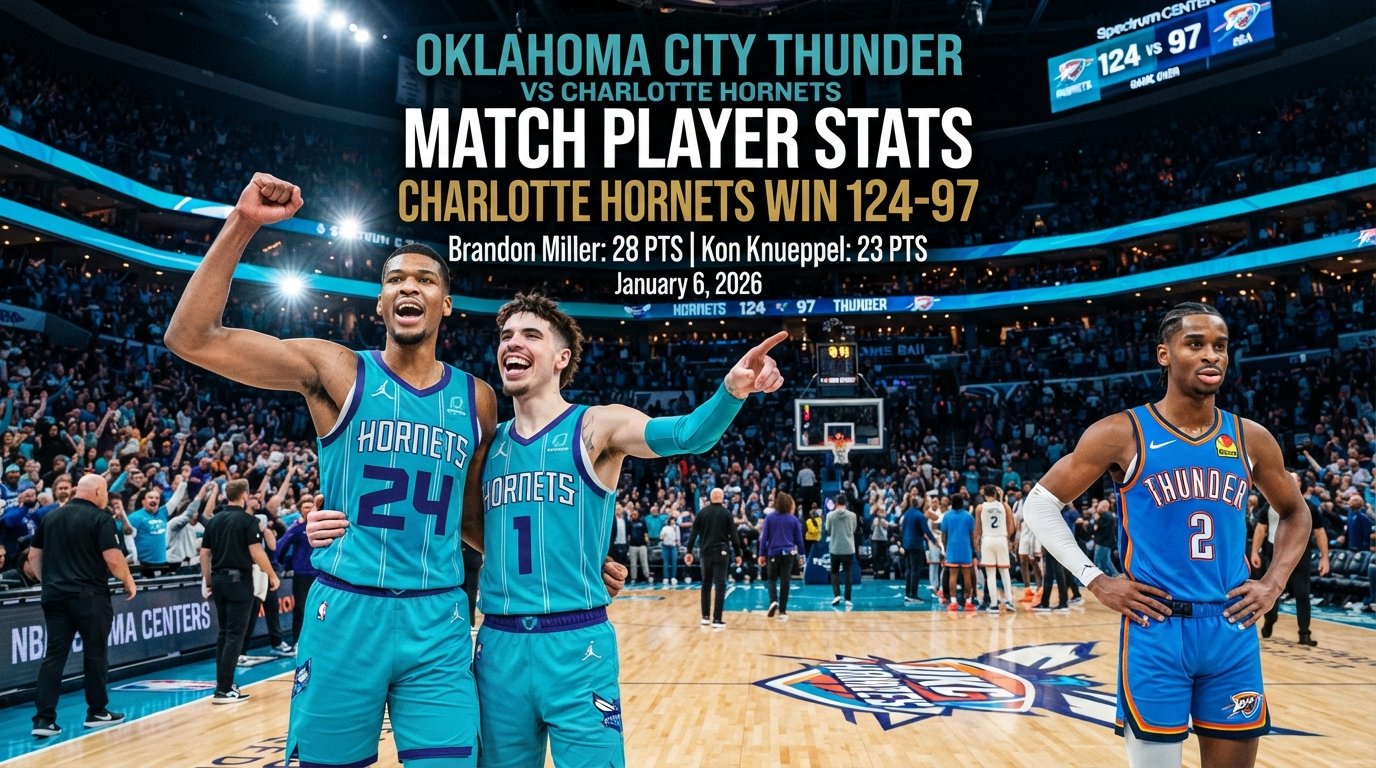
The oklahoma city thunder vs charlotte hornets match player stats from January 6, 2026, tell the story of a surprising road victory at Paycom Center. The Charlotte Hornets defeated the Oklahoma City Thunder 124-97, securing an impressive 27-point win through outstanding perimeter shooting, dominant rebounding, and contributions from several players. Brandon Miller led Charlotte with 28 points, while Kon Knueppel added 23 points. Shai Gilgeous-Alexander was Oklahoma City’s leading scorer with 21 points, but his shooting struggles reflected the Thunder’s wider offensive problems. Although Oklahoma City created defensive pressure and committed fewer turnovers, Charlotte’s superior shooting efficiency proved too difficult to overcome.
The result was particularly interesting because the teams had already met earlier in the 2025-26 season. Oklahoma City won that November 16 meeting 109-96, but Charlotte responded with a convincing performance in January to level the season series at one victory apiece. The January matchup offered a useful example of how three-point accuracy, rebounding, and scoring depth can influence the outcome even when one team creates more steals and protects possession more effectively.
Match Overview: Charlotte Hornets vs Oklahoma City Thunder
The January 6 contest brought together two teams with different offensive approaches. Oklahoma City entered the matchup with a talented scoring group led by Shai Gilgeous-Alexander, while Charlotte relied on perimeter production and balanced contributions from its rotation.
Charlotte established its advantage after a competitive opening quarter. Both teams scored 33 points in the first period, suggesting that the game could develop into a close contest. However, the Hornets changed the direction of the matchup in the second quarter by scoring 34 points while limiting the Thunder to just 17.
That 17-point second-quarter difference became the foundation of Charlotte’s victory.
The Hornets continued their offensive production in the third period, adding another 32 points. Oklahoma City struggled to respond consistently, and the growing deficit made the fourth quarter difficult. Although the Thunder scored one more point than Charlotte in the final period, the comeback opportunity had largely disappeared.
Game Information
| Detail | Result |
| Matchup | Charlotte Hornets vs Oklahoma City Thunder |
| Date | January 6, 2026 |
| Venue | Paycom Center |
| Location | Oklahoma City, Oklahoma |
| Attendance | 18,203 |
| Final score | Charlotte 124, Oklahoma City 97 |
| Winning team | Charlotte Hornets |
| Winning margin | 27 points |
| Season series | Tied 1-1 |
The official NBA game listing identifies the contest as January 5 on its local schedule, while its game information records a January 6 start at 1:00 AM. This explains the difference in date labels across basketball databases. The official NBA box score and game statistics provide the primary reference for the matchup.
Quarter-by-Quarter Scoring Breakdown
The scoring pattern explains why Charlotte won so comfortably. The opening period was competitive, but the Hornets created separation through a powerful second quarter and maintained their advantage after halftime.
| Quarter | Charlotte Hornets | Oklahoma City Thunder |
| First quarter | 33 | 33 |
| Second quarter | 34 | 17 |
| Third quarter | 32 | 21 |
| Fourth quarter | 25 | 26 |
| Final score | 124 | 97 |
First Quarter: Both Teams Start Strong
Charlotte and Oklahoma City scored 33 points each in the opening period. Neither side established a lasting advantage, and the scoring suggested that the matchup would remain competitive.
The Hornets showed that they could create opportunities from the perimeter, while Oklahoma City attempted to use its offensive movement and individual scoring ability to stay close.
The Thunder were not completely outplayed during this period. They matched Charlotte’s scoring output and entered the second quarter on equal terms.
However, an even first quarter did not guarantee an even game. Charlotte eventually found better offensive rhythm and began converting its opportunities at a much higher rate.
Second Quarter: Charlotte Takes Control
The second quarter was the defining stretch of the game.
Charlotte scored 34 points, while Oklahoma City managed only 17. That difference allowed the Hornets to turn a tied contest into a substantial halftime advantage.
Brandon Miller was especially important during the first half. His perimeter scoring placed pressure on Oklahoma City’s defense and made it difficult for the Thunder to concentrate their attention on one offensive threat.
Charlotte also benefited from contributions across its rotation. Kon Knueppel provided additional outside shooting, while the team’s other offensive players helped maintain pressure.
Oklahoma City struggled to produce consistent baskets. Missed field goals and inefficient free-throw shooting limited the Thunder’s ability to respond.
By halftime, Charlotte had established a 67-50 advantage.
Third Quarter: The Hornets Extend Their Lead
Charlotte continued its strong performance after halftime, scoring 32 points in the third quarter.
Oklahoma City managed 21 points, allowing the Hornets to extend their advantage to 28 points entering the final period.
This quarter demonstrated that Charlotte’s second-quarter performance was not simply a temporary scoring run.
The Hornets continued to create quality opportunities and convert three-point attempts. Brandon Miller’s shooting remained a major factor, while Kon Knueppel provided another reliable perimeter option.
One particularly memorable moment came when LaMelo Ball recovered a ball near the sideline and converted a difficult corner attempt. The play demonstrated the kind of individual creativity that helped Charlotte maintain its offensive momentum.
Miller also connected from beyond the arc at the end of the third quarter, pushing Charlotte’s lead to 99-71.
Fourth Quarter: Oklahoma City Shows Limited Improvement
The Thunder scored 26 points in the fourth quarter, compared with Charlotte’s 25.
Although Oklahoma City performed slightly better in the final period, the improvement was not enough to change the result.
Charlotte had already established a comfortable lead, allowing the Hornets to manage the remaining minutes without needing another major scoring run.
The Thunder’s late improvement showed that they could still generate points, but their earlier shooting problems had created too large a deficit.
Charlotte finished with a 124-97 victory.
Oklahoma City Thunder vs Charlotte Hornets Match Player Stats
Individual performances provide a clearer understanding of the result than the final score alone. Charlotte received outstanding production from Brandon Miller and Kon Knueppel, while several other players contributed through rebounding, passing, and scoring.
Oklahoma City had productive performances from Shai Gilgeous-Alexander, Jalen Williams, and Chet Holmgren. However, the team’s overall shooting efficiency prevented those contributions from becoming a serious comeback challenge.
Charlotte Hornets Player Statistics
| Player | Points | Rebounds | Assists | Steals | Blocks |
| Brandon Miller | 28 | 6 | 1 | 2 | 2 |
| Kon Knueppel | 23 | 5 | 5 | 0 | 0 |
| Miles Bridges | 17 | 11 | 4 | 0 | 1 |
| LaMelo Ball | 16 | 2 | 2 | 0 | 0 |
| Moussa Diabate | 9 | 12 | 5 | 0 | 0 |
| PJ Hall | 13 | 5 | Not specified | Not specified | Not specified |
| Collin Sexton | 10 | Not specified | Not specified | Not specified | Not specified |
| Sion James | 5 | 3 | 4 | Not specified | Not specified |
The table presents the supplied player statistics. Unspecified individual categories have not been estimated.
Brandon Miller: Charlotte’s Leading Scorer
28 points
Brandon Miller delivered the most important individual scoring performance for Charlotte.
He finished with 28 points, shooting 8-of-16 from the field and 7-of-10 from three-point range. He also recorded six rebounds, one assist, two steals, and two blocks.
His three-point shooting was particularly impressive. Making seven of ten attempts from beyond the arc represents a 70% conversion rate.
That efficiency gave Charlotte a major advantage because Miller could produce points without requiring an unusually high number of possessions.
His performance also created defensive problems for Oklahoma City. When a player is making outside shots at that rate, defenders must close out more aggressively. That can create additional driving opportunities and open space for teammates.
Miller’s contribution went beyond his scoring total.
- He provided consistent perimeter offense.
- He converted difficult three-point opportunities.
- He contributed defensively with two steals.
- He protected the basket with two blocks.
- He finished with a team-best plus/minus of +33.
The plus/minus figure deserves attention because it shows how strongly Charlotte performed during his playing time.
Miller’s performance was a major reason the Hornets could maintain offensive pressure throughout the contest.
Kon Knueppel: Outstanding Perimeter Support
23 points
Kon Knueppel delivered another excellent shooting performance.
He scored 23 points while making eight of 13 field-goal attempts and five of seven three-point attempts.
His shooting percentages were impressive:
- Field-goal percentage: 61.5%
- Three-point percentage: 71.4%
- Total points: 23
Knueppel also recorded five rebounds and five assists.
His balanced contribution made him valuable in several areas. He was not simply waiting for opportunities to shoot. His passing helped teammates become involved, while his rebounding added support on both ends of the floor.
The combination of Miller and Knueppel created a difficult defensive situation for Oklahoma City.
If the Thunder focused too heavily on Miller, Knueppel could punish them from outside. If they shifted defensive attention toward Knueppel, Miller could find additional shooting opportunities.
This complementary scoring was one of Charlotte’s biggest advantages.
Knueppel also finished with a plus/minus of +15, reflecting his positive contribution during his minutes on the floor.
Miles Bridges: A Powerful Rebounding Performance
Miles Bridges finished with 17 points and 11 rebounds, recording a double-double.
He also contributed four assists.
His rebounding performance was particularly important because Charlotte won the overall rebounding battle by a significant margin.
Bridges gave the Hornets additional physical presence around the basket. His ability to collect defensive rebounds helped Charlotte finish possessions, while his offensive rebounds and positioning created further opportunities.
His 17 points also meant that Oklahoma City could not concentrate its defensive resources entirely on Charlotte’s perimeter scorers.
Bridges’ contribution demonstrated why balanced scoring is valuable in a team-oriented offense.
Even when the attention is focused on outside shooters, a productive forward can punish defensive adjustments through interior scoring and rebounding.
He finished with a plus/minus of +18.
LaMelo Ball: Offensive Creativity and Outside Shooting
LaMelo Ball contributed 16 points, two rebounds, and two assists.
He also made four three-point shots.
Ball’s contribution was important because his shooting added another perimeter threat to Charlotte’s offense.
His ability to create difficult shots gives the Hornets a different offensive dimension from Miller and Knueppel.
Rather than depending entirely on set plays, Charlotte could also benefit from Ball’s individual creativity and ball-handling.
His performance was particularly useful when Oklahoma City attempted to apply pressure and disrupt Charlotte’s offensive rhythm.
Ball’s scoring helped prevent the Thunder from concentrating their defensive attention on the team’s leading scorers.
Moussa Diabate: Rebounding and Interior Support
Moussa Diabate recorded nine points, 12 rebounds, and five assists.
His 12 rebounds were especially valuable.
Charlotte finished with 52 total rebounds, compared with Oklahoma City’s 33. Diabate played an important role in establishing that advantage.
His contribution was not limited to collecting missed shots. Five assists showed that he also helped connect the offense and create opportunities for teammates.
A center who can rebound, pass, and contribute points provides flexibility to the team’s offensive structure.
Diabate’s performance helped Charlotte maintain control around the basket and limited Oklahoma City’s ability to dominate the glass.
He also finished with a plus/minus of +21.
PJ Hall: Valuable Bench Scoring
PJ Hall contributed 13 points and five rebounds.
His scoring was significant because Charlotte received meaningful production beyond its primary offensive options.
Bench scoring often becomes important in games where the starting lineup creates an early advantage but needs support to maintain it.
Hall provided that support.
His 13 points helped Charlotte preserve its offensive production while the team rotated players.
A balanced rotation also makes it harder for an opposing defense to focus on only two or three players.
Collin Sexton: Additional Scoring Support
Collin Sexton added 10 points.
His contribution gave Charlotte another scoring option and helped the Hornets maintain pressure throughout the game.
Although his total was lower than Miller’s or Knueppel’s, the additional production mattered in a matchup where several Charlotte players reached double figures.
Sion James: Supporting the Team Effort
Sion James finished with five points, three rebounds, and four assists.
His four assists were a useful contribution, particularly because Charlotte was able to distribute the ball effectively throughout the game.
James did not need to lead the scoring to provide value. His involvement in ball movement and rebounding helped the Hornets maintain their team structure.
Oklahoma City Thunder Player Statistics
The Thunder had several players produce respectable individual numbers, but the team struggled to convert enough scoring opportunities.
Shai Gilgeous-Alexander led Oklahoma City with 21 points, while Jalen Williams and Chet Holmgren also contributed double-digit scoring.
Oklahoma City Player Performance Table
| Player | Points | Rebounds | Assists | Steals |
| Shai Gilgeous-Alexander | 21 | Not specified | 6 | Not specified |
| Jalen Williams | 16 | 2 | 4 | Not specified |
| Chet Holmgren | 15 | 6 | Not specified | Not specified |
| Aaron Wiggins | 11 | 2 | Not specified | 2 |
| Luguentz Dort | 5 | 4 | Not specified | Not specified |
| Ajay Mitchell | 11 | 3 | 2 | Not specified |
| Kenrich Williams | 8 | 3 | 2 | Not specified |
| Isaiah Joe | 5 | Not specified | Not specified | Not specified |
| Cason Wallace | 2 | Not specified | Not specified | Not specified |
Shai Gilgeous-Alexander: Leading Oklahoma City Scorer
21 points
Shai Gilgeous-Alexander was Oklahoma City’s leading scorer with 21 points and six assists.
However, his shooting efficiency was a major concern.
He made seven of 21 field-goal attempts, producing a field-goal percentage of approximately 33.3%.
For a player who normally carries a significant offensive responsibility, that level of shooting efficiency made it difficult for the Thunder to maintain their usual scoring rhythm.
His six assists showed that he remained involved in creating opportunities for teammates.
Nevertheless, Charlotte’s defense limited his ability to turn those opportunities into efficient scoring possessions.
One notable detail was that Gilgeous-Alexander continued his streak of scoring at least 20 points in consecutive games. The performance therefore included a personal statistical achievement despite the disappointing team result.
The key lesson from his performance is that scoring volume and scoring efficiency are different measures.
A player can reach 20 points while still experiencing a difficult shooting night. His seven successful field goals from 21 attempts illustrate that difference.
Jalen Williams: A Productive Secondary Scorer
Jalen Williams scored 16 points, along with two rebounds and four assists.
He provided an important secondary scoring option behind Gilgeous-Alexander.
His four assists demonstrated that he was involved in creating opportunities rather than focusing only on individual scoring.
However, Oklahoma City needed more efficient production from its supporting players to challenge Charlotte’s growing advantage.
Williams finished with a plus/minus of -23.
That figure reflected the difficulty Oklahoma City experienced while he was on the court.
Chet Holmgren: Interior Scoring and Rebounding
Chet Holmgren finished with 15 points and six rebounds.
His scoring helped Oklahoma City remain competitive during portions of the matchup.
Holmgren’s ability to contribute around the basket and from different areas of the floor provides the Thunder with an important offensive dimension.
However, Charlotte’s overall rebounding advantage reduced Oklahoma City’s opportunities to control the interior.
Holmgren finished with a plus/minus of -25.
His individual production was respectable, but the overall team result demonstrated that one productive frontcourt performance was not enough to overcome Charlotte’s shooting advantage.
Aaron Wiggins: Supporting the Offense
Aaron Wiggins contributed 11 points, two rebounds, and two steals.
His defensive activity was useful, especially considering that Oklahoma City finished with more steals than Charlotte.
However, the Thunder needed greater scoring efficiency from their supporting players.
Wiggins’ contribution was positive in certain areas, but Charlotte’s offensive production remained too strong.
His plus/minus finished at -26.
Ajay Mitchell: Bench Production
Ajay Mitchell scored 11 points, three rebounds, and two assists.
His contribution helped Oklahoma City maintain some offensive production beyond its primary starters.
The Thunder needed this type of support, particularly when Gilgeous-Alexander was struggling to convert field-goal attempts.
Mitchell’s scoring demonstrated that Oklahoma City had additional offensive options, but the team could not combine those individual contributions into a consistent scoring attack.
Kenrich Williams: Versatile Rotation Contribution
Kenrich Williams added eight points, three rebounds, and two assists.
His production provided additional support in the rotation.
Although eight points may not appear especially significant compared with the performances of Miller or Gilgeous-Alexander, contributions from rotation players can influence the overall rhythm of a game.
The problem for Oklahoma City was not simply a lack of individual effort. It was the inability to produce enough efficient possessions across the entire lineup.
Luguentz Dort, Isaiah Joe, and Cason Wallace
Luguentz Dort recorded five points and four rebounds.
Isaiah Joe added five points, while Cason Wallace contributed two.
These players were unable to provide the additional scoring Oklahoma City needed to reduce the deficit.
Their individual totals should be considered within the context of the team’s wider offensive performance rather than treated as the only explanation for the defeat.
Charlotte’s shooting efficiency and rebounding advantage affected the entire matchup.
Team Statistical Comparison: Hornets vs Thunder
The team statistics reveal the biggest reasons behind Charlotte’s victory.
The Hornets were more efficient from the field, converted significantly more three-point attempts, and collected more rebounds.
Oklahoma City performed better in steals and turnovers, but those advantages were not enough to overcome Charlotte’s offensive production.
| Statistical Category | Charlotte | Oklahoma City |
| Total points | 124 | 97 |
| Field goals made | 41 | 34 |
| Field goals attempted | 77 | 93 |
| Field-goal percentage | 53% | 37% |
| Three-pointers made | 19 | 11 |
| Three-pointers attempted | 37 | 39 |
| Three-point percentage | 51% | 28% |
| Free throws made | 23 | 18 |
| Free throws attempted | 25 | 27 |
| Free-throw percentage | 92% | 67% |
| Total rebounds | 52 | 33 |
| Assists | 25 | 18 |
| Turnovers | 21 | 7 |
| Steals | 4 | 14 |
| Blocks | 7 | 5 |
Field-Goal Percentage: Charlotte’s Biggest Advantage
Charlotte made 41 of 77 field-goal attempts, while Oklahoma City converted 34 of 93 attempts.
This produced a significant difference in shooting efficiency.
The Hornets finished with approximately 53% shooting from the field, compared with roughly 37% for the Thunder.
The difference was important because Oklahoma City actually attempted 16 more field goals than Charlotte.
In other words, the Thunder had more shooting opportunities but converted fewer attempts overall.
This is an important distinction when evaluating basketball performance.
A team does not automatically gain an advantage by taking more shots. The quality and conversion rate of those opportunities matter just as much.
Charlotte’s ability to make a higher percentage of its attempts allowed it to score more points without needing as many attempts.
Three-Point Shooting: The Deciding Offensive Factor
Charlotte made 19 three-pointers from 37 attempts.
Oklahoma City made 11 from 39 attempts.
The eight-shot difference in successful three-pointers was one of the most important statistical factors in the result.
Charlotte’s three-point percentage was approximately 51%, while Oklahoma City’s was approximately 28%.
This difference had a direct impact on the scoreboard.
Charlotte’s 19 successful three-pointers produced 57 points from beyond the arc. Oklahoma City’s 11 successful attempts produced 33 points.
That represents a 24-point advantage in three-point scoring.
The importance of this statistic becomes clearer when considering that Charlotte won by 27 points.
Although the entire scoring difference cannot be explained by three-point shooting alone, the Hornets’ perimeter accuracy was a major part of their success.
Brandon Miller and Kon Knueppel were especially important in this area.
Their combined 12 successful three-point shots gave Charlotte a reliable source of offense and forced Oklahoma City to defend the perimeter more aggressively.
Free-Throw Shooting: Another Important Difference
Charlotte converted 23 of 25 free throws, producing a 92% success rate.
Oklahoma City made 18 of 27 attempts, finishing at approximately 67%.
The Hornets therefore scored five more points from the free-throw line despite attempting two fewer shots.
This difference highlights another aspect of Charlotte’s efficiency.
Free throws are often overlooked when discussions focus on three-point shooting and field goals. However, missed free throws can become costly in games where teams are struggling to score.
Oklahoma City’s 67% conversion rate represented an additional problem for an offense that was already having difficulty finding consistent rhythm.
Rebounding: Charlotte Controls the Glass
Charlotte collected 52 rebounds, compared with 33 for Oklahoma City.
That created a 19-rebound advantage for the Hornets.
Rebounding matters because it determines which team gets greater control over missed shots and possession opportunities.
Defensive rebounds help teams finish possessions, while offensive rebounds can create second-chance scoring opportunities.
Charlotte’s advantage in this category was particularly important because it reduced the Thunder’s ability to recover from missed attempts.
Miles Bridges collected 11 rebounds, while Moussa Diabate recorded 12.
Their combined 23 rebounds represented a major contribution to Charlotte’s overall advantage.
Oklahoma City had six rebounds from Chet Holmgren, but the team could not match Charlotte’s collective production.
Assists: Better Offensive Distribution From Charlotte
Charlotte recorded 25 assists, while Oklahoma City finished with 18.
The seven-assist difference suggests that the Hornets generated more successful scoring opportunities through passing.
Knueppel contributed five assists, Diabate added five, and Bridges recorded four.
These contributions demonstrate that Charlotte’s offense was not dependent entirely on individual scoring.
Ball movement helped create opportunities for multiple players.
Oklahoma City also had productive playmaking performances, including six assists from Gilgeous-Alexander and four from Jalen Williams.
However, the Thunder’s lower overall shooting percentage limited the impact of their passing.
An assist only becomes valuable on the scoreboard when the resulting shot is converted.
Turnovers: Oklahoma City Wins This Category
One of the most interesting statistical details is that Oklahoma City committed only seven turnovers, compared with Charlotte’s 21.
The Thunder recorded 14 fewer turnovers.
This is an important counterpoint to the overall result.
Oklahoma City protected possession more effectively, while Charlotte gave the ball away much more frequently.
Normally, a substantial turnover advantage can help a team generate additional scoring opportunities.
However, the Thunder could not take full advantage of this area.
Their shooting percentage remained too low, and their inability to convert enough attempts prevented the turnover advantage from changing the outcome.
This shows why basketball games should be evaluated through multiple statistical categories rather than one isolated number.
Steals and Blocks: Defensive Activity From Both Teams
Oklahoma City recorded 14 steals, while Charlotte managed four.
The Thunder therefore had a substantial advantage in creating defensive pressure.
However, the Hornets finished with seven blocks compared with Oklahoma City’s five.
Charlotte’s defensive contributions helped limit Oklahoma City’s scoring opportunities around the basket.
The combination of steals, blocks, and rebounding gives a more complete picture of defensive performance.
Oklahoma City was more effective at generating steals, but Charlotte performed better in several other important areas.
Five Major Reasons Charlotte Defeated Oklahoma City
The statistical evidence points to five major reasons behind the result.
1. Exceptional Perimeter Accuracy
Charlotte’s 19 three-pointers were a major difference-maker.
Brandon Miller and Kon Knueppel combined for 12 successful attempts from beyond the arc.
Their shooting made it difficult for Oklahoma City to defend the Hornets without leaving other offensive players available.
2. A Dominant Second Quarter
The 34-17 second-quarter score changed the direction of the contest.
Charlotte created a 17-point advantage in one period.
That performance gave the Hornets control of the game and forced Oklahoma City to play from behind.
3. Superior Rebounding
The 52-33 rebounding advantage gave Charlotte greater control of the interior.
Bridges and Diabate were particularly effective in this area.
Their combined production helped the Hornets limit Oklahoma City’s opportunities to recover missed shots.
4. Contributions From Multiple Scorers
Charlotte had six players score at least 10 points.
That scoring distribution made the offense more difficult to defend.
Oklahoma City received 21 points from Gilgeous-Alexander, 16 from Jalen Williams, and 15 from Holmgren, but Charlotte received greater overall scoring support from its rotation.
5. Better Overall Shooting Efficiency
Charlotte’s 53% field-goal percentage and 92% free-throw percentage were important advantages.
The Hornets converted their opportunities more consistently.
Oklahoma City’s 37% field-goal percentage and 67% free-throw percentage made a comeback much more difficult.
Player Plus/Minus Analysis
Plus/minus measures the difference between a team’s scoring and its opponent’s scoring while a particular player is on the court.
It does not independently establish how well someone played, but it can provide useful context when considered alongside individual statistics.
The supplied plus/minus figures show how strongly Charlotte performed with several of its players on the floor.
| Player | Team | Plus/Minus |
| Brandon Miller | Charlotte | +33 |
| Moussa Diabate | Charlotte | +21 |
| Miles Bridges | Charlotte | +18 |
| Kon Knueppel | Charlotte | +15 |
| Chet Holmgren | Oklahoma City | -25 |
| Aaron Wiggins | Oklahoma City | -26 |
| Jalen Williams | Oklahoma City | -23 |
Brandon Miller Leads the Plus/Minus Category
Miller’s +33 was the highest figure among the listed players.
This means Charlotte outscored Oklahoma City by 33 points during his time on the court.
His scoring efficiency, perimeter production, and defensive contributions made him one of the most influential players in the contest.
Diabate and Bridges Provide Strong Support
Diabate finished at +21, while Bridges recorded +18.
Their contributions demonstrate that Charlotte’s success was not limited to perimeter shooting.
Both players helped the Hornets control rebounds and maintain an advantage in the frontcourt.
Oklahoma City’s Negative Plus/Minus Figures
Holmgren finished at -25, Wiggins at -26, and Jalen Williams at -23.
These figures reflected the Thunder’s struggles during their playing time.
However, plus/minus should not be interpreted as an individual performance grade. It is affected by teammates, opponents, rotations, and the overall game situation.
The wider statistical picture is more useful than any single number.
Tactical Analysis: How Charlotte Created Its Advantage
The matchup offers several useful lessons about offensive basketball.
Charlotte did not win simply because it scored more points. Its approach produced a combination of advantages that became increasingly difficult for Oklahoma City to overcome.
Spacing Created Better Shooting Opportunities
Spacing is the way offensive players position themselves to create room for teammates.
When several players can make outside shots, defenders cannot comfortably concentrate around the basket.
Charlotte benefited from having multiple perimeter threats.
Miller and Knueppel were especially effective from three-point range, while Ball added another outside shooting option.
This gave the Hornets different ways to attack the defense.
If Oklahoma City moved additional defenders toward the perimeter, driving and interior opportunities could become available.
If the Thunder protected the paint, Charlotte’s shooters had more room to operate.
Rebounding Helped Charlotte Maintain Control
The Hornets’ 19-rebound advantage was another major tactical factor.
A team that collects defensive rebounds can prevent opponents from receiving additional scoring opportunities.
Offensive rebounds can also extend possessions and increase pressure on the opposing defense.
Charlotte’s combination of Bridges and Diabate was important because both players contributed to the team’s rebounding strength.
Oklahoma City’s Defensive Pressure Had Limits
The Thunder recorded 14 steals, demonstrating that they created significant defensive pressure.
However, defensive pressure does not always translate into a successful overall performance.
Oklahoma City needed to convert more of its offensive possessions after regaining the ball.
Its poor shooting percentage meant that the team could not consistently turn those opportunities into points.
This was one of the clearest differences between the teams.
Charlotte Maintained Multiple Scoring Options
The Hornets did not need to rely on a single player throughout the contest.
Miller led the scoring, Knueppel provided efficient perimeter production, and Bridges contributed through scoring and rebounding.
Ball and the bench players added further support.
This distribution made Charlotte’s offense more flexible.
Oklahoma City had talented players, but the team struggled to produce the same level of collective shooting efficiency.
Head-to-Head Record: Charlotte Hornets vs Oklahoma City Thunder
The January matchup was the second meeting between the teams in the 2025-26 season series.
Their earlier contest took place on November 16, 2025.
Oklahoma City won that game 109-96, creating an opportunity for Charlotte to respond in the next meeting.
The Hornets achieved that response with their 124-97 victory.
| Matchup | Winner | Score |
| November 16, 2025 | Oklahoma City Thunder | 109-96 |
| January 6, 2026 | Charlotte Hornets | 124-97 |
The season series was therefore tied at one victory apiece after the January matchup.
What the Results Reveal
The two results demonstrate how different games between the same teams can develop.
Oklahoma City won the first meeting by 13 points.
Charlotte responded by winning the second contest by 27 points.
The difference between those performances highlights the importance of shooting efficiency and matchup adjustments.
The January game also showed that Charlotte could compete with a highly talented Oklahoma City roster when its perimeter players were performing at a high level.
However, two games are not enough to establish a permanent advantage between the teams.
The results should be understood within the context of the individual matchups rather than treated as a prediction of every future meeting.
What the Match Means for the Charlotte Hornets
The victory provided several encouraging signs for Charlotte.
First, Brandon Miller demonstrated his ability to produce a major scoring performance against a strong opponent.
His 28 points and seven successful three-pointers highlighted the value of his perimeter shooting.
Second, Kon Knueppel provided excellent support. His 23 points and five assists showed that Charlotte had another player capable of creating offensive production.
Third, the rebounding contributions from Bridges and Diabate helped the team establish control in the paint.
The Hornets also received useful scoring from their bench.
This matters because teams generally need more than a productive starting lineup to maintain consistency over a full NBA season.
A rotation that can contribute points from several positions gives coaches greater flexibility.
Nevertheless, the 21 turnovers remain an area of concern.
Charlotte won comfortably, but committing 21 turnovers is not an ideal offensive outcome.
Against an opponent that converts more of those extra possessions into points, that weakness could become more costly.
The game therefore offered both positive evidence and areas that Charlotte could continue improving.
What the Match Means for the Oklahoma City Thunder
For Oklahoma City, the defeat highlighted several issues that deserved attention.
The most obvious concern was shooting efficiency.
The Thunder made only 34 of 93 field-goal attempts.
Their three-point shooting was also below Charlotte’s level, with 11 successful shots from 39 attempts.
These numbers made it difficult to keep the score competitive.
The free-throw performance added another problem. Oklahoma City converted only 18 of 27 attempts.
Missed free throws can be especially costly when a team is trying to reduce a large deficit.
There were positive aspects to the performance, however.
The Thunder committed only seven turnovers and recorded 14 steals.
Those statistics suggest that Oklahoma City continued to apply defensive pressure and generally protected possession.
The team also received double-digit scoring from several players.
Gilgeous-Alexander scored 21, Williams added 16, and Holmgren finished with 15.
The problem was that these contributions were not supported by sufficient overall shooting efficiency.
For Oklahoma City, the most useful lesson was that defensive activity and possession control must be supported by effective scoring.
A team can win individual statistical categories and still lose comfortably when its shooting performance falls significantly below its opponent’s level.
Important Statistical Lessons From the Match
The matchup provides several lessons for readers who want to understand basketball statistics beyond basic scoring totals.
First, shooting percentage provides important context. A player’s or team’s point total does not explain how efficiently those points were produced. Oklahoma City attempted more field goals but made fewer shots.
Second, three-point shooting can quickly change a game’s direction. Charlotte’s eight additional three-pointers created a significant scoring advantage.
Third, rebounding is a team responsibility. Bridges and Diabate were important, but Charlotte’s overall rebounding advantage came from collective contributions.
Fourth, turnovers must be evaluated alongside shooting. Oklahoma City protected possession more effectively, yet could not take advantage of Charlotte’s mistakes.
Fifth, bench production matters. Charlotte received 13 points from PJ Hall and 10 from Collin Sexton, helping the team maintain scoring depth.
Finally, individual statistics need team context. Gilgeous-Alexander scored 21 points, but his shooting efficiency and the team’s overall offensive performance were important parts of the final result.
These lessons help readers understand why a 27-point victory can occur even when the losing team performs better in selected defensive categories.
Frequently Asked Questions
1. Who won the Oklahoma City Thunder vs Charlotte Hornets game on January 6, 2026?
The Charlotte Hornets defeated the Oklahoma City Thunder 124-97 at Paycom Center in Oklahoma City. Charlotte won by 27 points after dominating the second and third quarters.
2. How many points did Brandon Miller score against the Thunder?
Brandon Miller scored 28 points for Charlotte. He shot 8-of-16 from the field and made seven of his 10 three-point attempts.
3. How many points did Shai Gilgeous-Alexander score?
Shai Gilgeous-Alexander scored 21 points and recorded six assists. He made seven of 21 field-goal attempts.
4. Which Charlotte player recorded the most rebounds?
Moussa Diabate led Charlotte with 12 rebounds. Miles Bridges also recorded a double-double with 17 points and 11 rebounds.
5. How many three-pointers did the Charlotte Hornets make?
Charlotte made 19 three-pointers from 37 attempts, finishing with approximately 51% accuracy. Oklahoma City made 11 from 39 attempts.
6. What was the biggest reason Charlotte defeated Oklahoma City?
Charlotte’s superior shooting efficiency was the biggest difference. The Hornets also dominated the rebounding battle and received balanced scoring from several players.
Conclusion
The January 2026 meeting between the Charlotte Hornets and Oklahoma City Thunder was an impressive example of how shooting efficiency and balanced team production can determine an NBA game.
Charlotte secured a 124-97 road victory, winning by 27 points at Paycom Center. Brandon Miller led the Hornets with 28 points, while Kon Knueppel added 23 points through highly efficient perimeter shooting. Miles Bridges and Moussa Diabate strengthened the team’s rebounding performance, collecting 11 and 12 rebounds respectively.
Oklahoma City received 21 points from Shai Gilgeous-Alexander, 16 from Jalen Williams, and 15 from Chet Holmgren. However, the Thunder struggled to convert their field-goal attempts and could not match Charlotte’s offensive efficiency.
The team statistics explain the result clearly. Charlotte made 53% of its field goals, compared with Oklahoma City’s 37%. The Hornets also made eight more three-pointers and collected 19 additional rebounds.
Although Oklahoma City recorded more steals and committed fewer turnovers, those advantages were not enough to compensate for its shooting struggles.
Ultimately, the oklahoma city thunder vs charlotte hornets match player stats highlight the importance of efficient scoring, perimeter accuracy, rebounding, and contributions from multiple players. Charlotte’s performance demonstrated how a balanced offensive approach can produce a convincing victory against a talented opponent.