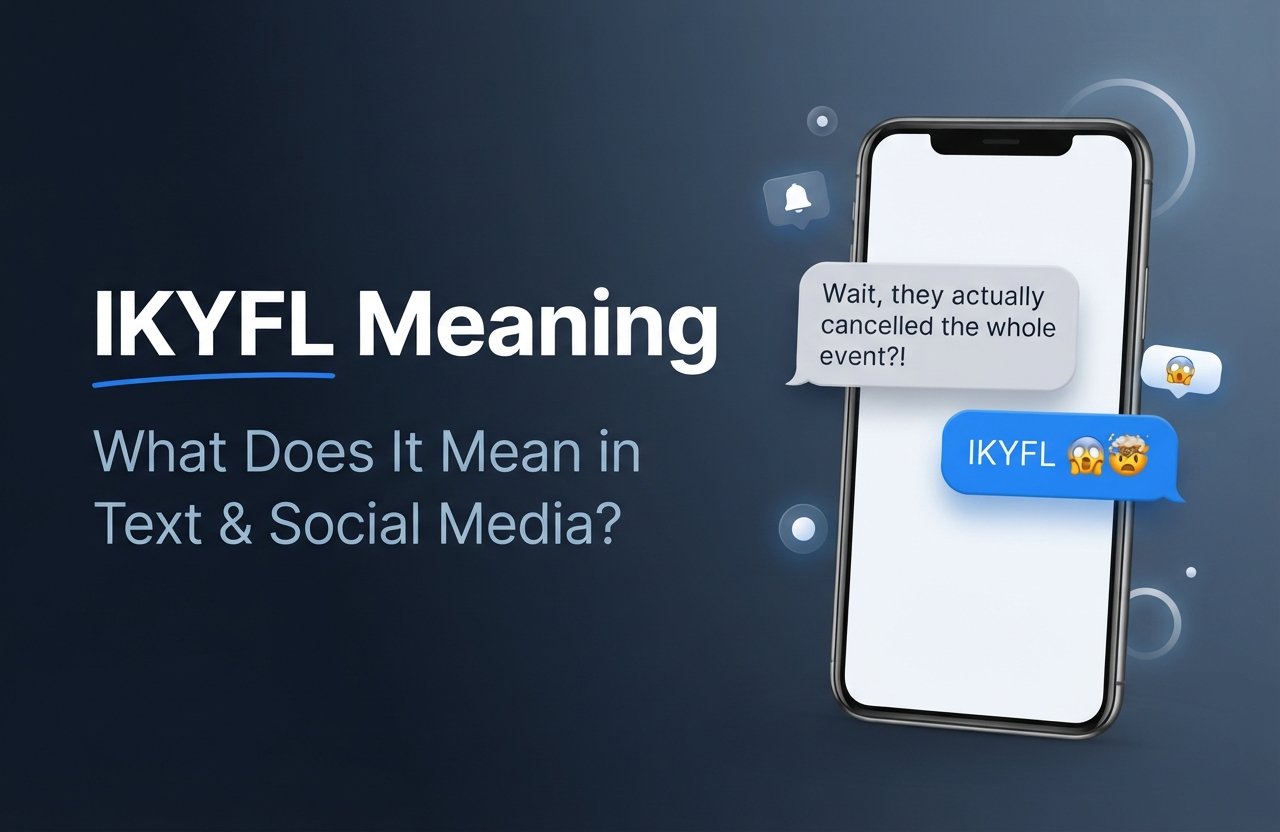
IKYFL Meaning: What It Means in Text, Slang, and Social Media
If you have recently received a message containing IKYFL meaning or noticed this abbreviation in a TikTok comment, Instagram reply, Snapchat conversation, or text message, you might be wondering what those letters actually stand for. IKYFL is an informal internet slang abbreviation commonly used to express disbelief, shock, surprise, or suspicion about something another person has said. Its most widely recognized meaning is “I Know You Fing Lying.”* People use it when a statement sounds unbelievable, exaggerated, or difficult to accept. Depending on the situation, it can be a funny reaction between friends or a direct expression of doubt during a serious conversation. Understanding the context is important because the same abbreviation can communicate different emotions depending on the relationship between the people involved.
What Does IKYFL Mean?
IKYFL stands for “I Know You Fing Lying.”* It is a casual expression commonly found in online conversations, text messages, and social media discussions.
People generally use this abbreviation when they hear something that seems unbelievable. Rather than writing a complete sentence, they use five letters to communicate a strong reaction.
For example:
- A friend tells you they won a free holiday.
- Someone claims they purchased an expensive phone for an unusually low price.
- A person shares a surprising story that sounds too strange to be true.
- Someone makes an exaggerated statement during a conversation.
In these situations, another person might respond with IKYFL.
The expression does not always mean that someone genuinely believes another person is lying. It can also communicate playful disbelief, excitement, or amazement.
For instance, if your friend says they met their favourite celebrity unexpectedly, replying with this abbreviation might simply mean that you cannot believe what you are hearing.
However, if the conversation involves an argument or a disagreement, the same expression can sound like a serious accusation.
That is why understanding the situation is more important than simply memorizing the abbreviation.
IKYFL Meaning in Text Messages
In text messaging, IKYFL is generally used as a quick reaction to surprising or questionable information.
People often prefer short expressions because they make digital conversations faster and more expressive. Instead of typing a complete response, they can use a familiar abbreviation to communicate their feelings.
Consider this conversation:
Person A: I just bought a brand-new laptop for $50.
Person B: IKYFL 😂
In this example, Person B is expressing disbelief. The laughing emoji suggests that the response is probably playful rather than an actual accusation.
Here is another example:
Person A: I told my teacher I finished the entire project in ten minutes.
Person B: IKYFL.
This response suggests that Person B finds the statement difficult to believe.
The expression can communicate several emotions in text messages:
- Disbelief: The sender does not believe what they have just heard.
- Surprise: Something unexpected has happened.
- Amusement: The sender finds a statement funny or ridiculous.
- Suspicion: The sender thinks someone might not be telling the truth.
- Frustration: The sender is annoyed by an exaggerated or questionable statement.
The surrounding conversation usually reveals which meaning the sender intends.
Why People Use This Abbreviation in Messages
There are several reasons why people use shortened expressions in digital communication.
First, abbreviations save time. A person can communicate a strong reaction without writing a long sentence.
Second, internet slang creates a casual conversational style. Friends often use informal expressions to make their conversations feel more natural.
Third, abbreviations can make reactions more expressive. A short response accompanied by an emoji can communicate surprise, humour, or disbelief immediately.
However, not everyone understands internet slang. If you are communicating with someone unfamiliar with these expressions, writing the complete sentence may prevent confusion.
What Does IKYFL Mean on Snapchat?
On Snapchat, IKYFL generally carries the same meaning as it does in ordinary text messaging.
Users may send it in private conversations, group chats, or replies to someone’s story.
Snapchat conversations are often informal, so short abbreviations can be convenient when responding quickly.
For example:
You: I accidentally sent a message to the wrong person.
Friend: IKYFL 😭
Here, the response communicates surprise or amusement about the situation.
Another example:
You: I stayed awake until 5 AM watching movies.
Friend: IKYFL 😂
Your friend is reacting to something unexpected or difficult to imagine.
Does IKYFL Have a Different Meaning on Snapchat?
No. Snapchat does not give this abbreviation a separate official definition.
Its meaning generally remains connected to disbelief or suspicion. However, the tone can change according to the conversation.
For example:
- In a funny conversation, it may communicate playful surprise.
- In a personal conversation, it may suggest doubt.
- During an argument, it may sound confrontational.
- In a group chat, it may simply be a dramatic reaction.
The sender’s relationship with the recipient also plays an important role.
What Does IKYFL Mean on TikTok?
TikTok is another place where people encounter informal internet expressions.
The abbreviation may appear in video comments, reply threads, captions, and conversations about unexpected events.
On this platform, people often respond to surprising claims, unusual experiences, dramatic stories, and unbelievable situations.
For example, imagine someone uploads a video explaining that they paid an unusually high amount for a simple meal.
A viewer might comment:
“IKYFL, that is way too expensive!”
The commenter is expressing disbelief about the price.
Similarly, if someone shares an unexpected personal achievement, another user might reply with the abbreviation to show surprise.
Common TikTok Situations Where People Use It
Some typical situations include:
- Unexpected stories: Someone shares an experience that sounds almost impossible.
- Surprising prices: A person reveals an unusually expensive purchase.
- Funny situations: A video shows something ridiculous or unexpected.
- Relationship discussions: Someone shares a surprising experience involving a partner.
- Unexpected achievements: A creator announces something that viewers find difficult to believe.
It is important to understand that the abbreviation does not have a separate TikTok-specific meaning. The platform simply provides another environment where people use the expression.
What Does IKYFL Mean on Instagram?
Instagram users may encounter this abbreviation in direct messages, comments, story replies, and conversations with friends.
Its meaning is generally consistent across these different features.
For example, suppose someone posts an Instagram story showing an expensive purchase.
A friend replies:
“IKYFL, how much did that cost?”
The message communicates surprise and disbelief.
Another example might involve a relationship update.
Person A: He actually remembered our first conversation from five years ago.
Person B: IKYFL 😭
Here, the response communicates amazement.
IKYFL in Instagram Comments
In public comments, the abbreviation can be used as a reaction to something that attracts attention.
It may express:
- Disbelief about a statement.
- Surprise about an unexpected event.
- Humour about a ridiculous situation.
- Doubt about someone’s explanation.
- Shock about a personal announcement.
The important point is that a comment should be interpreted within the context of the original post.
A short abbreviation rarely communicates every detail of the sender’s intention.
Breaking Down the Letters in IKYFL
Understanding the individual letters makes the abbreviation easier to recognize.
| Letter | Meaning |
| I | I |
| K | Know |
| Y | You |
| F | F***ing |
| L | Lying |
When combined, the letters form the expression “I Know You F***ing Lying.”
The word containing the letter F adds emphasis and makes the expression stronger than ordinary statements such as “I don’t believe you.”
This is why the abbreviation can sound humorous in a casual conversation but aggressive in a serious disagreement.
Why Is the F Included?
The F represents profanity used as an intensifier.
In informal English, swear words are sometimes added to expressions to communicate stronger emotions.
For example:
- I really don’t believe you.
- I absolutely cannot believe that.
- I know you are lying.
The abbreviated expression uses stronger language to make the reaction more forceful.
However, the presence of profanity means it is not appropriate for every audience.
Some people may find it funny, while others may consider it disrespectful.
Is IKYFL a Joke or a Serious Accusation?
One of the most important things to understand is that this abbreviation can communicate different intentions.
It is not automatically a serious accusation.
In everyday conversations, friends sometimes use exaggerated language to react to surprising information.
For example:
Friend: I finished a 20-hour project in one afternoon.
You: IKYFL 😂
You might not genuinely believe your friend is dishonest. You may simply be surprised by the claim.
On the other hand, consider this conversation:
Person A: I never received your payment.
Person B: IKYFL. I sent you the confirmation yesterday.
In this situation, the abbreviation communicates frustration and suspicion.
Signs That It Is Being Used Playfully
The expression is more likely to be playful when:
- The conversation is already humorous.
- Both people regularly joke with each other.
- The message includes laughing or crying emojis.
- The statement is obviously exaggerated.
- There is no ongoing disagreement.
Signs That It Is Being Used Seriously
It may communicate genuine suspicion when:
- The conversation involves an argument.
- The sender is questioning someone’s honesty.
- Previous disagreements have affected the relationship.
- The message contains no humorous context.
- The sender is responding to a potentially dishonest statement.
Never assume that every person uses internet slang in exactly the same way.
Understanding the relationship and the surrounding messages is the safest approach.
How to Use IKYFL in Everyday Conversations
Knowing what an abbreviation means is only the first step. Understanding when and how to use it is equally important.
This expression is primarily suitable for informal communication. It works best when both people understand the language and are comfortable with casual slang.
Here are several situations where it might naturally appear.
1. When Someone Shares Unexpected News
Imagine your friend tells you something you were not expecting.
Example:
Friend: I just got selected for a job without attending an interview.
You: IKYFL 😂
Meaning: You are surprised and find the news difficult to believe.
2. When Someone Makes an Exaggerated Claim
People sometimes exaggerate stories to make conversations more entertaining.
Example:
Friend: I finished watching an entire television series in one night.
You: IKYFL!
Meaning: You cannot believe they watched so many episodes in such a short time.
3. When Someone Reveals an Expensive Purchase
Unexpected prices are another situation where this abbreviation can make sense.
Example:
Friend: I paid $900 for a pair of shoes.
You: IKYFL, seriously?
Meaning: You are shocked by the amount of money they spent.
4. When Someone Shares Relationship News
Friends often discuss relationships, unexpected messages, and surprising personal experiences.
Example:
Friend: My ex just called me after three years.
You: IKYFL 😭
Meaning: You are surprised by the unexpected situation.
5. When Someone Tells an Unbelievable Story
It can also be used when someone shares a story that sounds extremely unusual.
Example:
Friend: A stranger offered to pay for my entire shopping bill.
You: IKYFL 😂
Meaning: You are expressing amazement and disbelief.
6. When Reacting to a Social Media Post
You might see someone sharing an unusual experience online.
For example:
Post: Someone claims they purchased a luxury car for the price of a basic smartphone.
Comment: IKYFL!
The comment communicates doubt about the claim.
These examples demonstrate that the expression is more about communicating an emotional reaction than making a formal statement.
How to Reply When Someone Sends You IKYFL
If someone sends you this abbreviation, your response should depend on what they are trying to communicate.
You do not necessarily need to explain yourself. Sometimes a humorous response is enough.
Here are several possible replies.
1. If You Are Telling the Truth
If someone does not believe something you said, you can respond confidently.
Examples:
- “I’m serious!”
- “I promise it’s true.”
- “Believe it or not!”
- “I have proof.”
- “I’m not even joking.”
These responses help clarify that your statement is genuine.
2. If You Are Joking
If your original message was a joke, you can continue the humour.
Examples:
- “You know me too well.”
- “I had to make it interesting.”
- “Don’t expose me.”
- “Just kidding!”
- “You caught me.”
This keeps the conversation relaxed.
3. If You Are Surprised by Their Reaction
Sometimes the other person may misunderstand your message.
You can reply:
- “Why would I make that up?”
- “I’m telling you the truth.”
- “I know it sounds unbelievable.”
- “That’s exactly what happened.”
These responses are useful when you want to make your statement clearer.
4. If You Feel Offended
Not everyone appreciates being told that they are lying, even jokingly.
If the expression feels disrespectful, you can respond politely:
- “I’m being serious.”
- “You don’t have to believe me.”
- “I would appreciate it if you took me seriously.”
- “I’m not comfortable with that kind of joke.”
Your response should reflect the relationship and the seriousness of the conversation.
Is IKYFL Rude or Offensive?
Yes, it can be considered rude or offensive because its full form contains a strong swear word.
However, whether someone finds it offensive depends on the situation, the relationship, and the communication style of the people involved.
Among close friends, it may be accepted as ordinary joking language.
Between strangers, colleagues, or people who do not know each other well, it can sound disrespectful.
Consider these situations.
| Situation | Possible interpretation |
| Close friends joking | Playful disbelief |
| A conversation with a stranger | Rude or inappropriate |
| An argument | Direct accusation |
| A funny social media comment | Humorous surprise |
| A professional conversation | Unprofessional language |
| A conversation with family | Depends on family communication style |
Why the Expression Can Sound Aggressive
The problem is not only the swear word.
The phrase also suggests that the other person is lying.
When someone receives that message without understanding the sender’s humour, they may interpret it as an attack on their honesty.
Digital communication makes this problem more common because messages do not always communicate facial expressions, voice tone, or body language.
For example, a friend might send the abbreviation while laughing. However, the recipient may read it as a serious accusation.
For this reason, it is better to avoid strong slang when discussing sensitive topics.
Is IKYFL Appropriate for Professional Conversations?
Generally, no.
Professional communication requires clear, respectful, and appropriate language.
Using an expression containing profanity can create an unnecessary misunderstanding, particularly when communicating with clients, managers, teachers, business partners, or customers.
Imagine receiving an unexpected update from a business client.
Client: The website traffic increased by 300% this month.
An unprofessional response would be:
“IKYFL!”
A more suitable response would be:
“That is impressive. Could you share the analytics report?”
The second response communicates interest without sounding disrespectful.
Better Alternatives for Workplace Communication
If you want to express disbelief without using inappropriate language, consider these alternatives:
| Alternative | When to use it |
| Are you serious? | When something is surprising |
| Is that really true? | When you need confirmation |
| That is unbelievable! | When something is unexpected |
| No way! | During casual but clean conversations |
| I find that hard to believe. | When you have doubts |
| Can you confirm that? | In professional communication |
| Really? | For a short reaction |
These expressions communicate similar emotions without using profanity.
Difference Between IKYFL and Similar Internet Slang
Internet slang contains many abbreviations that communicate surprise, agreement, disagreement, and disbelief.
Some expressions may look similar in conversations, but their meanings are different.
Understanding these differences can help you avoid confusion.
IKYFL vs. IKR
IKYFL: I Know You F***ing Lying.
IKR: I Know, Right?
The main difference is that IKYFL communicates disbelief, while IKR communicates agreement.
Example:
Person A: That movie was amazing.
Person B: IKR!
Person B agrees with the opinion.
However:
Person A: I watched the entire movie five times today.
Person B: IKYFL 😂
Person B is expressing disbelief.
IKYFL vs. LOL
LOL stands for “Laughing Out Loud.”
It is commonly used to communicate amusement or laughter.
IKYFL is different because it primarily communicates disbelief or suspicion.
For example:
Person A: I accidentally walked into the wrong classroom.
Person B: LOL!
The response communicates amusement.
However:
Person A: I accidentally entered the wrong country.
Person B: IKYFL!
The response communicates disbelief about the statement.
IKYFL vs. FR
FR stands for “For Real.”
It is used to emphasize that something is genuine or to ask whether someone is serious.
Example:
Person A: I got promoted today.
Person B: FR?
Here, Person B wants confirmation.
IKYFL, on the other hand, expresses a stronger reaction of disbelief.
IKYFL vs. NGL
NGL stands for “Not Gonna Lie.”
People use it before expressing an honest opinion.
Example:
“NGL, that restaurant is expensive.”
It introduces a personal opinion.
IKYFL is generally used as a reaction to another person’s statement.
IKYFL vs. Cap
Cap is slang for a lie or something considered untrue.
No cap means that someone is being honest or serious.
Example:
Person A: I can run 10 kilometres without stopping.
Person B: That’s cap!
The second person believes the statement is false.
IKYFL can communicate a similar reaction, but it is a complete abbreviated expression with stronger language.
IKYFL vs. ICL
ICL generally stands for “I Can’t Lie.”
It is used when someone wants to introduce an honest opinion or statement.
Example:
“ICL, that was the best match I’ve watched this year.”
The expression is different because it introduces the speaker’s honesty rather than directly questioning someone else’s statement.
Comparison Table
| Slang | Full form | Main purpose |
| IKYFL | I Know You F***ing Lying | Disbelief |
| IKR | I Know, Right? | Agreement |
| LOL | Laughing Out Loud | Amusement |
| FR | For Real | Confirmation or emphasis |
| NGL | Not Gonna Lie | Honest opinion |
| ICL | I Can’t Lie | Honest opinion |
| Cap | Lie | Calling out dishonesty |
| No Cap | No Lie | Emphasizing truth |
The main lesson is that internet abbreviations are not interchangeable. Each one has a different conversational purpose.
Does IKYFL Have Different Meanings?
Although the most widely documented expansion is “I Know You F***ing Lying,” internet abbreviations can sometimes have alternative interpretations.
The exact wording may vary between users.
For example, some people understand the expression as:
- I Know You’re F***ing Lying.
- I Know You F***ing Lyin’.
These versions communicate essentially the same idea.
The difference is mainly grammatical and reflects informal digital language.
It is also possible for someone to create a personal or humorous interpretation of an abbreviation. However, that does not automatically make the alternative a widely accepted definition.
Which Meaning Should You Understand First?
When you encounter IKYFL in an ordinary text message or social media conversation, the safest starting point is its established slang meaning related to disbelief and suspected lying.
Then examine the surrounding conversation.
For example:
- If someone shares unbelievable news, it may be playful.
- If someone makes a questionable claim, it may express suspicion.
- If someone is arguing, it may communicate genuine frustration.
Do not assume that an unusual personal interpretation is the standard meaning.
Where Did IKYFL Originate?
The precise origin of IKYFL is not clearly established.
Like many internet abbreviations, it is difficult to identify the first person who used it or determine the exact date when it entered everyday digital communication.
The expression developed within the broader culture of informal online language, where people shorten longer phrases to make messages quicker and more expressive.
Text messaging, online communities, social networking platforms, and comment sections all provide environments where abbreviations can spread.
However, it would be inaccurate to claim that a particular social media platform invented the expression without reliable historical evidence.
How Internet Slang Becomes Popular
Internet expressions often spread through repeated use.
A typical process looks like this:
- Someone uses a shortened expression in an online conversation.
- Other users understand it and begin using it.
- The expression appears in comments and group discussions.
- More people encounter it through social media.
- It becomes recognizable within certain online communities.
Not every abbreviation follows the same path.
Some remain limited to particular communities, while others become widely recognized across different platforms.
The popularity of an expression can also change over time.
An abbreviation that is common in one group may be unfamiliar to another.
Is IKYFL a New Expression?
It is not possible to establish an exact creation date from the available reliable evidence.
However, the abbreviation has been documented in internet slang references and online publications.
Its appearance in digital communication should not be confused with the invention of the underlying phrase.
The full expression and its informal variations may have existed in conversation before people began using the shortened form.
This distinction matters because internet slang does not always have a clear starting point.
Why People Prefer Short Internet Abbreviations
Digital communication has changed the way people write and respond to messages.
In traditional communication, people usually express their reactions through complete sentences. Online conversations, however, often involve shorter messages, emojis, abbreviations, and informal expressions.
There are several reasons why people prefer shortened language.
1. Faster Communication
Typing a complete sentence takes longer than using a short abbreviation.
When someone wants to react immediately, a few letters can communicate their feelings quickly.
2. More Expressive Conversations
Internet slang can add personality to a conversation.
For example, replying with a simple “I don’t believe you” may sound serious, while an informal abbreviation with a laughing emoji can make the response feel more playful.
3. Social Connections
Friends and online communities often develop their own communication styles.
Using familiar expressions can make conversations feel more natural among people who understand the same slang.
4. Digital Culture
Social media encourages short and immediate interactions.
Comment sections, direct messages, and group chats often favour quick reactions rather than long explanations.
5. Humour and Entertainment
Many internet expressions are used for entertainment.
People sometimes exaggerate their reactions to make conversations more amusing. This is one reason strong expressions can be used jokingly without necessarily communicating anger.
However, these benefits do not mean every abbreviation is appropriate everywhere.
Understanding the audience remains essential.
Common Mistakes People Make When Understanding IKYFL
Because internet slang is often informal, people sometimes misunderstand its meaning.
Here are some common mistakes worth avoiding.
Mistake 1: Assuming It Always Means Someone Is Lying
This is one of the most common misunderstandings.
Although the full expression refers to someone lying, people may use it simply to express surprise.
For example:
Friend: I got a free upgrade to business class.
Reply: IKYFL 😂
The sender may simply be amazed by the unexpected news.
Mistake 2: Ignoring the Conversation
Looking at an abbreviation without reading the surrounding messages can lead to an incorrect interpretation.
The same expression may communicate humour in one conversation and frustration in another.
Always consider what was said before and after it.
Mistake 3: Thinking It Is Appropriate for Every Audience
The full expression contains profanity.
Using it with professional contacts, unfamiliar people, or individuals who dislike strong language can create an uncomfortable situation.
Mistake 4: Confusing It With Similar Abbreviations
IKYFL and IKR may look similar because they begin with the same letters.
However, they communicate different reactions.
IKR expresses agreement, whereas the other abbreviation generally expresses disbelief.
Mistake 5: Assuming Emojis Have One Fixed Meaning
An emoji can help explain the sender’s tone, but it is not definitive proof of their intention.
A laughing emoji might indicate humour, nervousness, sarcasm, or an attempt to soften a serious statement.
The complete conversation remains the most reliable way to understand the message.
Is IKYFL Used by Both Girls and Boys?
Yes. The abbreviation is not restricted to a particular gender.
Anyone familiar with the expression may use it in casual conversations, online comments, or text messages.
Its meaning does not change simply because the sender is a girl or a boy.
However, the tone can depend on the relationship between the people communicating.
For example, two close friends may use it as a joke.
Someone using it during a disagreement may communicate genuine suspicion.
A person sending it in a romantic conversation might simply be reacting to something surprising.
What Does It Mean When a Girl Sends IKYFL?
If a girl sends this abbreviation, it generally communicates disbelief, surprise, or suspicion about something you said.
For example:
You: I have never watched that popular television series.
Her: IKYFL 😂
She might be surprised that you have never watched it.
It does not automatically indicate romantic interest, anger, or flirting.
The surrounding conversation is necessary to understand her intention.
What Does It Mean When a Boy Sends IKYFL?
If a boy sends the abbreviation, its basic meaning remains the same.
He may be reacting to a surprising statement, joking about an unbelievable situation, or questioning whether something is true.
For example:
You: I won the competition without preparing.
Him: IKYFL!
He is probably expressing disbelief.
Again, the abbreviation alone cannot establish whether the message is friendly, sarcastic, or serious.
How to Understand the Tone Behind IKYFL
Understanding tone is one of the most useful skills when interpreting online slang.
Unlike face-to-face communication, text messages do not naturally include facial expressions, voice changes, or physical gestures.
As a result, people rely on wording, emojis, punctuation, and conversation history.
Here are some practical ways to interpret the expression more accurately.
Look at the Previous Message
The original message often provides the strongest clue.
If someone sends the abbreviation after an unbelievable story, it probably expresses surprise or doubt.
If they send it after a serious disagreement, it may be an accusation.
Check the Emojis
Emojis can provide additional information.
For example:
| Emoji | Possible tone |
| 😂 | Humour or playful disbelief |
| 😭 | Dramatic surprise or amusement |
| 🤣 | Strong amusement |
| 👀 | Suspicion or curiosity |
| 😳 | Shock or surprise |
| 🙄 | Frustration or sarcasm |
These interpretations are not universal rules. People use emojis differently, so consider the sender’s usual communication style.
Consider Your Relationship
The relationship between two people can significantly influence how a message is interpreted.
A close friend may use strong language without intending disrespect.
A stranger using the same expression may sound confrontational.
Read the Entire Conversation
Do not judge a message based on one abbreviation.
If the conversation is relaxed and humorous, the expression is more likely to be playful.
If the discussion involves dishonesty, broken promises, or an argument, it may be more serious.
Should You Use IKYFL in Your Messages?
You can use it if you understand its meaning and the person receiving your message is comfortable with informal language.
However, it is worth considering the situation before sending it.
Suitable situations include:
- Casual conversations with close friends.
- Humorous group chats.
- Informal social media comments.
- Conversations involving surprising news.
- Friendly discussions where strong slang is accepted.
Situations where you should avoid it include:
- Professional emails.
- Business discussions.
- Academic assignments.
- Formal customer communication.
- Conversations with people who dislike profanity.
- Sensitive discussions involving personal problems.
The purpose of communication is to make your meaning clear.
If an abbreviation is likely to create confusion, using a complete sentence is usually the better choice.
What Are the Clean Alternatives to IKYFL?
Not everyone wants to use profanity in digital communication.
Fortunately, several expressions communicate similar feelings without using inappropriate language.
Here are some alternatives:
| Clean alternative | Meaning |
| No way! | Expressing surprise |
| Are you serious? | Asking whether something is true |
| You’re joking! | Showing disbelief |
| I can’t believe it! | Expressing amazement |
| That’s unbelievable! | Reacting to something unexpected |
| Seriously? | Requesting confirmation |
| You must be kidding! | Expressing doubt |
| Is that true? | Asking for clarification |
Which Alternative Is Best?
The best alternative depends on your intention.
If you are surprised, use “No way!”
If you want confirmation, use “Are you serious?”
If something sounds impossible, use “That’s unbelievable!”
If you are communicating professionally, use “Could you confirm whether that is accurate?”
These alternatives help you express your reaction without creating unnecessary misunderstandings.
Is IKYFL the Same as Calling Someone a Liar?
Not necessarily.
The full expression literally challenges someone’s honesty, but its conversational meaning can be less serious.
There is an important difference between accusing someone of deliberately lying and reacting to a statement that sounds unbelievable.
For example:
Situation A:
Your friend tells you they received a free international holiday.
You reply with the abbreviation and a laughing emoji.
This may simply communicate surprise.
Situation B:
Someone repeatedly gives you false information about a financial transaction.
You respond with the same abbreviation during an argument.
Here, it may communicate a serious accusation.
The words are identical, but the intentions are different.
This is why understanding context is essential when interpreting informal language.
Does Capitalization Change Its Meaning?
No. Writing the abbreviation in uppercase or lowercase does not normally change its underlying meaning.
You may encounter these variations:
- IKYFL
- ikyfl
- Ikyfl
All three generally refer to the same expression.
Uppercase letters are common in internet abbreviations because they make shortened phrases easier to recognize.
Lowercase writing is also common in casual texting because many people prefer typing without capitalizing every word.
The choice is usually a matter of personal writing style rather than a change in definition.
Why Understanding Internet Slang Matters
Learning internet slang is useful because digital communication has become an important part of everyday life.
People communicate through messaging applications, social networks, online communities, and other digital platforms.
These environments introduce shortened expressions that may not appear in traditional dictionaries or formal writing.
Understanding them can help you:
- Interpret messages more accurately.
- Avoid unnecessary misunderstandings.
- Recognize jokes and sarcastic reactions.
- Communicate naturally with friends.
- Understand social media comments.
- Identify expressions that are inappropriate in professional settings.
However, learning slang does not mean you should use every expression you encounter.
A good communicator understands the difference between casual language and formal communication.
IKYFL is a useful example because its meaning is relatively straightforward, but its emotional tone can change significantly depending on the situation.
A Practical Guide to Understanding IKYFL in Different Situations
If you are still unsure how to interpret the expression, the following examples provide a simple reference.
| Conversation | Possible meaning |
| “I got a free phone.” “IKYFL!” | Surprise or disbelief |
| “I met my favourite actor.” “IKYFL 😭” | Amazement |
| “I finished the project in five minutes.” “IKYFL 😂” | Playful disbelief |
| “I never borrowed your money.” “IKYFL.” | Suspicion or accusation |
| “That small coffee cost $25.” “IKYFL!” | Shock about the price |
| “I won the competition.” “IKYFL!” | Surprise |
| “I forgot my own birthday.” “IKYFL 😂” | Humorous disbelief |
These examples demonstrate why the surrounding conversation matters more than the abbreviation alone.
The Simplest Way to Remember Its Meaning
If you want to remember the meaning without getting confused, think of IKYFL as a stronger, informal way of saying:
- “I don’t believe you.”
- “You cannot be serious.”
- “There is no way that happened.”
- “Are you actually telling the truth?”
The original expression contains profanity, so these alternatives are useful when explaining its meaning to someone who prefers cleaner language.
Frequently Asked Questions About IKYFL
1. What does IKYFL mean in texting?
IKYFL stands for “I Know You F***ing Lying.” It is an informal texting abbreviation used to express disbelief, surprise, or suspicion about something another person has said.
2. What does IKYFL mean on Snapchat?
On Snapchat, it generally means “I Know You F***ing Lying.” People use it in chats and story replies when something sounds unbelievable or surprising.
3. Is IKYFL a bad word?
Yes. Its full form contains profanity, making it inappropriate for many professional and formal situations. Close friends may use it jokingly in casual conversations.
4. Does IKYFL mean someone is lying?
Not always. Although its full form refers to someone lying, people also use it to express playful disbelief, shock, or surprise without making a serious accusation.
5. What should I reply when someone says IKYFL?
You can respond with “I’m serious,” “I promise it’s true,” or “Believe it or not.” If the message is humorous, you can respond with a joke or laughing emoji.
6. Can IKYFL be used in a professional conversation?
It is generally best to avoid it in professional communication because it contains profanity and can sound confrontational. Alternatives such as “Are you serious?” or “Could you confirm that?” are more appropriate.
Conclusion
IKYFL is an informal internet abbreviation that stands for “I Know You F***ing Lying.” People commonly use it in text messages, Snapchat conversations, TikTok comments, Instagram replies, and other online discussions to express disbelief, surprise, or suspicion.
Although the expression can sound aggressive because it contains profanity, it is not always intended as a serious accusation. Friends may use it humorously when someone shares an unbelievable story, makes an exaggerated claim, or reveals unexpected information.
The most important factor is context. The relationship between the sender and recipient, the surrounding conversation, and the use of emojis can all influence how the message should be understood.
It is also important to recognize that this expression is not suitable for every situation. While it may work in casual conversations, cleaner alternatives are better for professional communication and formal discussions.
Ultimately, understanding informal internet language helps you interpret digital conversations more accurately. When you encounter this abbreviation, remember its commonly accepted meaning, consider the situation, and avoid assuming that every sender intends the same tone.