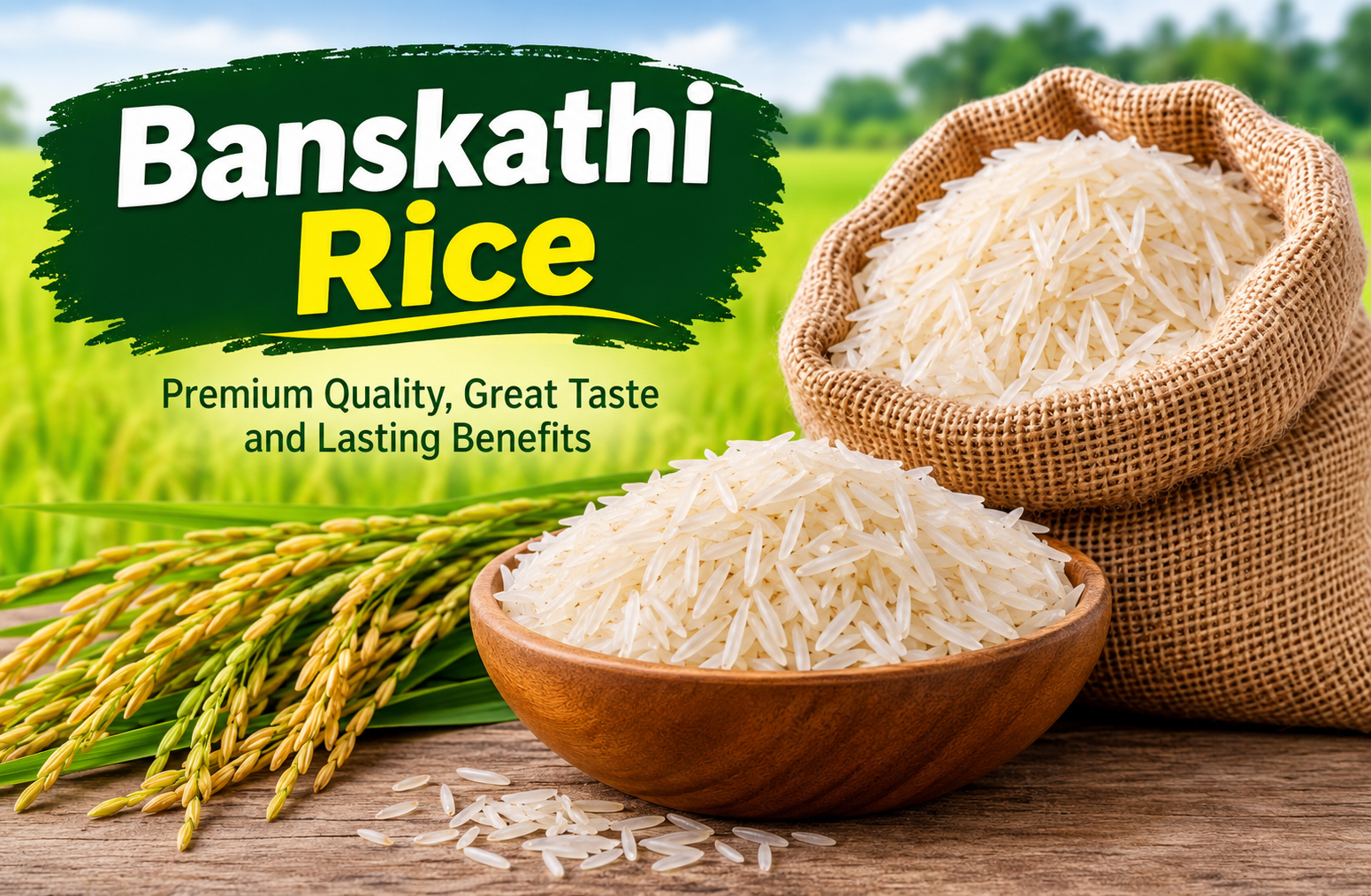
Banskathi Rice: Origin, Benefits, Uses, and Cooking Guide
Rice is an important part of everyday food culture across South Asia, but not every variety offers the same taste, texture, aroma, or cooking experience. Banskathi rice is a lesser-known rice variety associated with West Bengal, India, and is valued in regional markets for its distinctive grain characteristics and suitability for everyday meals. It is also marketed in different forms, including parboiled and polished rice, making it an interesting option for households, restaurants, and rice-based food businesses.
Whether you have recently come across this variety in a grocery store, heard about it from someone familiar with Bengali cuisine, or want to understand how it compares with popular varieties such as Basmati, Miniket, and Swarna, knowing its characteristics can help you make a better choice.
One important point deserves attention from the beginning: descriptions of this rice are not completely consistent across sellers and agricultural references. Some commercial products are described as long and slender, while traditional agricultural references also identify Banskathi as a local landrace with different grain characteristics. Therefore, it is useful to distinguish the traditional variety from commercially marketed products rather than assuming every bag contains identical rice.
This guide explores its background, appearance, aroma, nutritional considerations, cooking methods, culinary applications, storage requirements, purchasing advice, and practical limitations. It also explains what buyers should check before choosing a particular product.
What Is Banskathi Rice?
Banskathi is a rice name associated with agricultural and food traditions in West Bengal, India. It appears in discussions of regional rice varieties and is also used commercially to identify non-Basmati rice products.
Rice is generally classified according to several characteristics, including:
- Grain length and width
- Aroma and natural flavour
- Texture after cooking
- Amylose content
- Milling and processing method
- Growing region and agricultural background
These characteristics influence how rice behaves in the kitchen. Two varieties that look similar before cooking may produce noticeably different results after boiling.
In commercial markets, this rice is frequently promoted as a premium non-Basmati option. Depending on the manufacturer, it may be sold as a long-grain, medium-grain, polished, or parboiled product.
The difference matters because the name alone does not guarantee a particular grain size or cooking result.
Is It a Traditional Bengali Rice Variety?
Yes, Banskathi is associated with traditional rice cultivation in Bengal. However, its precise agricultural identity should not be confused with every commercial product carrying the same name.
Research published in the Pharma Innovation Journal in 2023 includes Banskathi among indigenous rice landraces studied in Bankura district. The research records characteristics of the particular landrace examined, including a reported crop duration of approximately 140 to 150 days.
This provides an agricultural reference point for understanding its regional background.
At the same time, modern rice markets contain products that have been processed, graded, packaged, and sold under commercial names. Their characteristics may differ from those of the traditional landrace.
Is Banskathi Rice the Same as Basmati?
No. Although some sellers use promotional descriptions comparing its slender grains with Basmati, these are not interchangeable rice classifications.
Basmati is a recognized group of aromatic rice varieties with specific geographical and quality characteristics.
Banskathi is generally marketed as non-Basmati rice.
The distinction is important for several reasons:
- Grain characteristics: Commercial products may have long or medium-sized grains, but appearance alone does not establish Basmati identity.
- Aroma: Some products have a noticeable natural fragrance, while others have a milder smell.
- Cooking behaviour: Water absorption, softness, and grain separation depend on the particular product.
- Price: Non-Basmati products are often positioned differently in the market.
- Culinary use: Both can be used in rice-based dishes, but they may produce different results.
For buyers, the best approach is to evaluate the actual product instead of relying on comparisons used in advertisements.
Origin and Agricultural Background
Understanding where the rice comes from helps explain its regional importance and commercial identity.
West Bengal has a long history of rice cultivation. Rice is central to the region’s food culture, agricultural economy, and traditional cooking.
The state’s climate, water availability, soil conditions, and seasonal growing patterns support different types of rice cultivation.
Traditional rice varieties developed in these environments often have characteristics shaped by local agricultural practices. Farmers have historically selected and maintained varieties according to their growing conditions, grain quality, cooking properties, and household preferences.
Banskathi belongs to this wider regional rice landscape.
Banskathi in West Bengal Agriculture
Banskathi appears in agricultural research documenting indigenous rice diversity in West Bengal.
An important distinction is that a traditional landrace and a modern commercial rice product are not necessarily the same thing.
A landrace refers to a locally maintained crop population that has developed through traditional cultivation and selection. It may contain variation in physical characteristics.
Commercial rice, on the other hand, may be processed and marketed according to specific grain-size and quality standards.
This explains why different product descriptions can sometimes appear inconsistent.
The Role of Modern Rice Processing
Rice processing influences the appearance, cooking behaviour, and storage characteristics of the final product.
The main processing stages may include:
- Cleaning harvested paddy.
- Removing the outer husk.
- Milling the grain.
- Separating broken grains.
- Sorting and grading.
- Packaging for distribution.
Some manufacturers also use parboiling before milling.
Parboiling involves soaking, heating, and drying paddy before removing the husk and bran. This process changes the physical structure of the grain and can influence its cooking performance.
Consequently, two packages carrying the same variety name may not behave identically if one is raw milled rice and the other is parboiled rice.
Main Characteristics of Banskathi Rice
The characteristics of this rice depend on the specific variety, growing conditions, and processing method. Nevertheless, commercial descriptions and agricultural references provide several useful points for buyers.
1. Grain Appearance
Grain appearance is often the first feature people notice when purchasing rice.
Commercially marketed Banskathi products may feature:
- Slender or medium-sized grains
- White or off-white colour
- A relatively uniform appearance after sorting
- Different grain lengths depending on the product grade
Some sellers promote long-grain versions, while traditional agricultural descriptions may refer to a different grain profile.
For this reason, buyers should check the actual packaging specifications instead of assuming that every product has the same dimensions.
2. Natural Aroma
Aroma is another characteristic associated with some products sold under this name.
The intensity can vary according to the rice’s genetic characteristics, freshness, processing, and storage.
A pleasant natural smell can improve the overall eating experience, particularly in dishes where rice is served with relatively simple ingredients.
However, not every product will have the same fragrance.
A strong artificial or unusual smell should not automatically be interpreted as superior quality. Fresh, properly stored rice should have a clean and natural smell.
3. Texture After Cooking
Texture is especially important when selecting rice for daily meals.
Different products may produce:
- Soft and tender grains
- Relatively separate cooked grains
- A slightly moist texture
- A firmer result when less water is used
The final texture depends on more than the variety name.
Water quantity, soaking time, cooking temperature, grain age, and parboiling can all influence the result.
4. Processing Options
Banskathi products may be available in several forms.
Raw rice: This rice is milled without first undergoing the parboiling process. Its cooking behaviour depends on the variety and milling quality.
Parboiled rice: Paddy is partially processed using water and heat before milling. The resulting grain may have a firmer structure and different water absorption properties.
Polished rice: The bran layers are removed during milling, producing a cleaner and often whiter appearance.
These descriptions refer to processing methods, not necessarily separate varieties.
5. Everyday Food Compatibility
One reason regional rice varieties remain popular is their usefulness in ordinary household cooking.
Depending on the specific product, this rice can be considered for:
- Regular lunch and dinner
- Rice served with lentils
- Vegetable curries
- Fish and meat dishes
- Pulao
- Selected biryani preparations
- Fried rice
The best application depends on whether the cooked grains remain separate, become soft, or develop a slightly sticky texture.
Nutritional Value and Health Considerations
Rice is primarily a source of carbohydrates, which provide energy for everyday activities. Its nutritional composition depends on the variety, processing method, and serving size.
When evaluating this variety from a nutritional perspective, it is important to separate general rice nutrition from specific claims about individual products.
There is not enough reliable, publicly available nutritional information to assign one universal calorie, protein, fibre, or mineral value to every product sold under this name.
1. Carbohydrates and Energy
Carbohydrates are the main component of most white rice varieties.
The body breaks down digestible carbohydrates into glucose, which provides energy for the brain, muscles, and other organs.
Rice can therefore be part of a balanced diet, particularly for people who need an accessible source of dietary energy.
However, portion size matters.
Eating large servings of polished rice without enough vegetables, protein, or other nutritious foods may make a meal less balanced.
A practical approach is to combine rice with:
- Lentils or beans
- Fish or chicken
- Seasonal vegetables
- Leafy greens
- Other protein-rich foods
This creates a more varied meal than eating rice alone.
2. Protein Content
Rice contains some plant protein, although it should not be considered a complete replacement for protein-rich foods.
People who regularly eat rice can improve the nutritional balance of their meals by including lentils, chickpeas, beans, eggs, dairy products, fish, or meat.
These combinations are particularly useful in South Asian diets, where rice and lentils are already common food combinations.
3. Fibre Content
The fibre content of rice depends heavily on its processing.
Brown rice retains more of its bran layer, while highly polished white rice contains less fibre.
If a particular Banskathi product is heavily polished, it should not automatically be considered a high-fibre food.
People who want more dietary fibre can combine their rice meals with vegetables, legumes, and whole grains.
4. Vitamins and Minerals
Rice can contain small amounts of several vitamins and minerals.
However, milling removes some nutrients naturally present in the outer layers of the grain.
Parboiling may help retain certain nutrients within the grain compared with conventional milling, although the exact nutritional differences depend on the processing method.
Consumers should check the manufacturer’s nutritional label for specific information.
5. Is It Suitable for a Gluten-Free Diet?
Plain rice is naturally gluten-free.
This makes rice a useful staple for people who need to avoid gluten.
However, people with celiac disease should check product packaging and manufacturing information to ensure that the rice has not been contaminated with gluten-containing grains during processing, transportation, or packaging.
Important: No particular variety of rice should be described as a treatment for diabetes, digestive disorders, high blood pressure, or weight-related conditions. Its suitability depends on the overall diet and individual nutritional requirements.
Benefits of Choosing Banskathi Rice
The benefits of a rice variety should be considered in terms of its practical usefulness rather than exaggerated health promises.
For many households, the most important factors are taste, affordability, cooking performance, availability, and compatibility with familiar dishes.
Here are some potential advantages of choosing a suitable product from this category.
1. Suitable for Everyday Meals
Rice is a regular part of many South Asian meals.
A suitable Banskathi product can be used as an everyday staple because it can accompany different curries, lentils, vegetables, and protein-based dishes.
Households that prepare rice frequently may appreciate a product that offers consistent cooking results.
2. Useful for Different Recipes
Versatility is another practical advantage.
Depending on its grain structure and cooking characteristics, it may work in several types of recipes.
For example, a product that produces relatively separate grains may be suitable for pulao and fried rice.
A softer variety may work better with lentils, vegetable preparations, and traditional meals.
This flexibility allows households to use one rice product for different cooking purposes.
3. An Alternative to Basmati
Basmati is widely recognized for its aroma, distinctive grain characteristics, and traditional culinary applications.
However, it is not the only option available to consumers.
Non-Basmati rice products provide alternatives for people who want different textures, prices, and everyday cooking characteristics.
The best choice depends on the recipe and personal preference rather than brand reputation alone.
4. Availability in Different Pack Sizes
Commercial sellers may offer different packaging options.
These can include:
- Small household packs
- Medium-sized family packs
- Larger bags for restaurants
- Wholesale packaging for commercial buyers
Smaller packs are useful when testing a product for the first time.
Larger packs may be more practical for regular consumers who have already confirmed the quality.
5. Suitable for Traditional Bengali Food
Rice is deeply connected with Bengali cuisine.
It is commonly served alongside fish curry, vegetables, lentils, meat preparations, and various regional dishes.
A suitable regional rice product can complement these meals without requiring complicated preparation.
Its suitability will depend on the final cooked texture and the preferences of the household.
6. Different Processing Choices
The availability of raw and parboiled products gives consumers some flexibility.
People who prefer a particular grain texture can compare processing types before purchasing.
This is useful because processing can influence cooking time, firmness, water absorption, and the appearance of the cooked rice.
Banskathi Rice vs Other Popular Rice Varieties
Comparing rice varieties is one of the easiest ways to understand whether a particular product suits your household.
However, these comparisons should be based on actual product specifications because commercial grades can vary.
| Rice variety | General characteristics | Common uses |
| Banskathi | Regional variety name; commercial grain characteristics vary | Daily meals, pulao, selected rice dishes |
| Basmati | Long, slender, aromatic grains | Biryani, pulao, special meals |
| Miniket | Commonly marketed as polished rice in Bengal | Everyday meals |
| Swarna | Popular non-Basmati rice variety | Daily meals and institutional cooking |
| Gobindobhog | Short-grain aromatic rice associated with Bengal | Khichuri, pulao, traditional dishes |
| Sona Masoori | Lightweight, medium-grain rice | Daily meals and South Indian cooking |
Banskathi vs Basmati Rice
The most important difference is their market and variety identity.
Basmati is known for its characteristic fragrance and elongated cooked grains.
Banskathi is generally sold as a non-Basmati option.
Although some commercial products have slender grains, this does not make them Basmati.
For biryani, the choice depends on the desired result.
If you want the familiar long, separate grains associated with traditional Basmati biryani, choose a suitable Basmati grade.
If you prefer experimenting with regional non-Basmati rice, a suitable Banskathi product may also work.
Banskathi vs Miniket Rice
Miniket is a familiar name in West Bengal’s rice market.
It is commonly purchased for everyday household meals.
Banskathi products may have different grain profiles, aromas, and processing characteristics.
The decision between the two should depend on:
- Preferred cooked texture
- Grain appearance
- Aroma
- Price per kilogram
- Cooking consistency
Neither variety is automatically better for every recipe.
Banskathi vs Swarna Rice
Swarna is a widely cultivated rice variety and is frequently used for everyday consumption.
It has an established role in agricultural production and commercial rice markets.
Banskathi is a more regionally distinctive name in many consumer markets.
Buyers comparing them should consider the specific grade and product information rather than relying only on general descriptions.
Banskathi vs Gobindobhog Rice
Gobindobhog is particularly associated with traditional Bengali cooking.
It is known for its short-grain appearance and characteristic aroma.
It is often selected for dishes where fragrance and a softer texture are important.
Commercially marketed Banskathi products can have different grain shapes and cooking properties.
Therefore, the two should not be treated as direct replacements in every recipe.
How to Cook Banskathi Rice Properly
Cooking rice correctly is just as important as selecting a good-quality product.
Even good rice can become sticky, mushy, or unevenly cooked if the water quantity and cooking time are not suitable.
The best method depends on whether you have purchased raw or parboiled rice.
The following method provides a practical starting point for ordinary stovetop cooking.
Ingredients
For approximately four servings, prepare:
- 1 cup of rice
- Water according to the product’s cooking requirements
- Salt, according to preference
- A small amount of oil or ghee, if desired
Step 1: Measure the Rice
Start by measuring the quantity you want to cook.
One cup is a convenient starting amount for a small family meal.
Measuring helps maintain consistency when repeating the recipe.
Step 2: Rinse the Grains
Place the rice in a bowl and add clean water.
Gently move the grains around with your fingers and drain the cloudy water.
Repeat this process until the water becomes noticeably clearer.
Rinsing helps remove loose starch, dust, and surface particles.
Avoid rubbing the grains aggressively because this can break them.
Step 3: Soak the Rice
Soaking can help some rice products cook more evenly.
For a raw, polished product, try soaking for approximately 15 to 30 minutes.
Parboiled products may need a different soaking period or may be cooked without soaking, depending on their specifications.
Always check the packaging instructions first.
Step 4: Select the Water Quantity
Water quantity has a major effect on texture.
A practical starting point for stovetop absorption cooking is approximately 1.5 to 2 cups of water for each cup of rice.
This is only a starting range, not a universal measurement.
The correct amount depends on:
- Whether the rice is raw or parboiled
- Grain size
- Soaking time
- Cooking vessel
- Heat level
- Desired texture
If you want separate grains, avoid adding excessive water.
Step 5: Bring the Water to a Boil
Place the water in a suitable saucepan.
Add a little salt if desired.
Bring the water to a gentle boil before adding the prepared rice.
Step 6: Add the Rice
Drain the soaked rice and carefully add it to the boiling water.
Stir gently once to distribute the grains.
Avoid stirring repeatedly because excessive movement can damage the grains and release additional starch.
Step 7: Cook at a Controlled Temperature
Reduce the heat after the water returns to a boil.
Cover the saucepan and allow the rice to cook gently.
Cooking time will vary by product, so begin checking the texture after approximately 10 to 12 minutes for raw rice.
Parboiled rice may require longer.
Step 8: Allow the Rice to Rest
Once the grains are tender and the water has been absorbed, switch off the heat.
Keep the lid closed for another five minutes.
This resting period allows moisture to distribute more evenly.
Step 9: Fluff and Serve
Use a fork or rice paddle to gently separate the grains.
Serve the rice with your preferred curry, vegetables, fish, lentils, or meat preparation.
Cooking tip: Test a small quantity before preparing a large batch. This is the easiest way to determine the correct water ratio and cooking time for an unfamiliar product.
Popular Dishes You Can Prepare
The versatility of a rice product depends on how it behaves after cooking.
A variety that remains relatively firm may work well in dishes requiring separate grains, while softer rice may be better for meals with gravy or lentils.
Here are several dishes worth considering.
1. Everyday Steamed Rice
Steamed rice is one of the simplest ways to enjoy a regional rice variety.
It can be served with:
- Dal
- Fish curry
- Vegetable curry
- Chicken curry
- Fried vegetables
- Seasonal greens
This preparation allows you to experience the natural taste and texture of the rice without adding too many ingredients.
2. Bengali Pulao
Bengali pulao is a fragrant rice dish prepared with spices, ghee, and other ingredients.
Depending on the recipe, it may include:
- Whole spices
- Ginger
- Ghee
- Cashews
- Raisins
- Vegetables
- Salt and mild seasonings
A rice product that retains its shape after cooking is generally preferable.
Before preparing pulao for guests, test the rice to ensure it does not become excessively soft.
3. Homemade Biryani
Biryani is a layered rice preparation in which rice is combined with meat, vegetables, spices, and aromatic ingredients.
Although Basmati is a common choice, some cooks experiment with regional non-Basmati varieties.
For this purpose, select a product that can withstand cooking without breaking apart.
Parboiled rice may be worth testing if you prefer a firmer grain.
The cooking process should be adjusted according to the product’s absorption and cooking time.
4. Vegetable Fried Rice
Fried rice is a practical way to use leftover cooked rice.
For better results, use rice that has cooled properly and has relatively separate grains.
Ingredients can include:
- Carrots
- Green beans
- Peas
- Spring onions
- Capsicum
- Garlic
- Soy sauce
- Black pepper
Cook the vegetables separately before combining them with the rice.
Avoid adding excessive liquid because this can make the dish soggy.
5. Rice and Lentils
Rice and lentils are a familiar combination across South Asia.
They provide a practical meal with carbohydrates and plant protein.
You can serve steamed rice with masoor dal, moong dal, or other lentil preparations.
For a softer meal, the rice can also be prepared alongside lentils in a khichuri-style recipe.
6. Rice with Fish Curry
Bengali food culture has a strong relationship with fish and rice.
A simple fish curry served with steamed rice creates a traditional meal that highlights the importance of rice in regional cooking.
The choice of rice depends on personal preference.
Some households prefer softer grains that absorb gravy, while others prefer rice that remains separate.
Raw Rice vs Parboiled Rice: Which Should You Choose?
Understanding processing methods is important when buying this product.
Raw and parboiled rice may have similar appearances after milling, but their processing histories are different.
Raw Rice
Raw rice is milled without undergoing the traditional parboiling process.
Potential characteristics include:
- A different cooking texture
- Water absorption that varies by variety
- A relatively direct cooking process
- Suitability for various household recipes
The actual result depends on the grain and milling quality.
Parboiled Rice
Parboiled rice is processed before milling.
The process generally includes soaking, steaming or heating, and drying the paddy.
This changes the grain structure.
Some practical characteristics include:
- A firmer cooked texture
- Different water absorption behaviour
- A tendency to retain grain shape under suitable cooking conditions
- Different cooking times compared with raw rice
Which Is Better for Daily Consumption?
There is no universal winner.
Choose raw rice if you prefer its particular taste and cooking characteristics.
Choose parboiled rice if you prefer the texture and cooking behaviour of that processing style.
The best approach is to purchase a small pack of each and compare them using the same recipe.
This gives you a more useful answer than relying on marketing descriptions.
How to Choose Good-Quality Rice
Selecting quality rice requires more than checking the price.
A good purchasing decision considers the condition of the grains, packaging, processing information, and reliability of the seller.
1. Check Grain Uniformity
Look at the grains through a transparent package, where possible.
A reasonably consistent batch should not contain excessive broken pieces or visibly damaged grains.
However, acceptable broken-grain percentages depend on the product grade.
2. Examine the Colour
Rice may naturally have different shades depending on its processing.
White and off-white appearances can both occur in commercial products.
Avoid rice that shows unexplained discoloration, visible mould, or signs of moisture damage.
3. Check the Smell
Fresh rice should have a clean, natural smell.
Avoid products with musty, sour, or unusual chemical-like odours.
An unpleasant smell may indicate poor storage or contamination.
4. Read the Packaging Information
Before purchasing, check:
- Product name
- Manufacturer or packer
- Country of origin
- Net weight
- Processing type
- Packing date
- Batch number
- Best-before information
- Food safety registration or licence details, where applicable
These details make it easier to identify the source of a product if a quality issue occurs.
5. Compare the Actual Grain Length
Some manufacturers advertise specific grain lengths.
If grain length matters to you, ask whether the measurement refers to raw grain or a particular commercial grade.
Do not assume that a product advertised as long-grain rice has the same characteristics as Basmati.
6. Purchase from Reliable Sellers
Choose sellers with clear product information and proper packaging.
For online purchases, read the product specifications carefully.
Customer reviews can provide useful information about packaging, delivery, and consistency, but they should not replace your own evaluation.
7. Compare Price Per Kilogram
A larger bag is not automatically better value.
Calculate the price per kilogram and compare products of similar quality.
Also consider storage capacity and how quickly your household consumes rice.
Buying more than you can store properly may create unnecessary waste.
Storage Tips for Maintaining Rice Quality
Proper storage helps preserve the quality of rice and protects it from moisture, insects, and contamination.
Rice should be kept in a clean, dry, and well-ventilated storage environment.
Use an Airtight Container
After opening the original package, transfer the rice into a clean, dry container with a secure lid.
Airtight storage helps reduce exposure to moisture and household pests.
Keep It Away from Direct Sunlight
Store rice away from direct sunlight and excessive heat.
Temperature fluctuations and moisture can negatively affect storage quality.
Avoid Mixing Old and New Rice
It is better to finish an older batch before adding a fresh one.
Mixing different batches can make it difficult to track freshness and identify storage problems.
Check for Insects Regularly
Inspect stored rice from time to time.
Look for:
- Small insects
- Web-like material
- Unusual powder
- Discoloured grains
- Moisture
- Unpleasant odours
If you notice mould or signs of contamination, do not consume the affected rice.
Keep the Storage Area Clean
Clean the storage container before refilling it.
Also keep the surrounding shelves and cupboards free from food particles that may attract insects.
Store Cooked Rice Safely
Cooked rice requires additional care.
Do not leave it at room temperature for extended periods.
Refrigerate leftovers promptly in a suitable covered container and follow recognised food safety guidance. Reheat thoroughly before serving.
Challenges and Limitations of This Rice Variety
Although Banskathi products may offer useful culinary options, there are several factors consumers should understand before making a purchase.
Being aware of these limitations can help avoid disappointment.
1. Inconsistent Product Descriptions
One of the biggest challenges is the variation in descriptions across sellers.
Some sources describe the product as long-grain rice, while others use medium-grain or short-grain descriptions.
This makes it difficult to establish one universal grain specification.
The name may refer to a traditional variety, a commercial grade, or a product sold under a familiar regional label.
Buyers should therefore check the actual product instead of relying entirely on the name.
2. Limited Publicly Available Nutritional Data
Reliable nutritional information for every commercially marketed product is not readily available.
Some online descriptions make broad claims about immunity, digestion, or weight management.
Such statements should not be treated as proven health benefits without suitable scientific evidence.
For accurate nutritional information, consult the product’s laboratory-tested nutritional label.
3. Different Cooking Requirements
Raw and parboiled products may require different quantities of water and different cooking times.
Even two products with similar grain sizes may produce different results.
This means first-time buyers may need to experiment before finding the correct cooking method.
4. Regional Availability
Availability can differ between locations.
In West Bengal, regional rice products may be easier to find through local rice mills and grocery retailers.
Outside their main markets, consumers may need to rely on specialty grocery shops or online sellers.
Transportation and packaging costs can also affect retail prices.
5. Quality Differences Between Manufacturers
Two products with the same variety name may differ in:
- Grain sorting
- Broken-grain percentage
- Moisture content
- Milling quality
- Packaging standards
- Storage conditions
These factors can influence the final cooking experience.
6. Confusion with Basmati Marketing
Some advertisements use comparisons with Basmati to attract customers.
While comparisons can help explain grain appearance, they should not create confusion about the actual variety.
Buyers should confirm whether the product is officially identified as non-Basmati rice.
Commercial and Business Uses
This rice category is not limited to household consumption.
Depending on its quality, consistency, and purchasing cost, it may also have applications in food businesses and agricultural trade.
1. Restaurants
Restaurants that serve rice-based meals need products that offer consistent cooking results.
A suitable product may be used for:
- Daily rice servings
- Vegetable pulao
- Rice meals with curry
- Selected biryani preparations
- Catering menus
Restaurant owners should test several batches before selecting a regular supplier.
2. Hotels and Catering Businesses
Hotels and catering services often purchase rice in larger quantities.
Their purchasing decisions usually depend on:
- Cost per serving
- Grain consistency
- Cooking yield
- Customer preferences
- Supplier reliability
- Storage requirements
A product that performs consistently across large batches can be more useful than one that looks attractive but produces unpredictable results.
3. Rice Mills and Distributors
Rice mills and distributors may be involved in processing, grading, packaging, and supplying regional rice products.
Their responsibilities include maintaining product quality and providing accurate descriptions.
Proper grading and transparent packaging information help build trust with retailers and consumers.
4. Grocery Retailers
Retailers can introduce regional rice varieties to customers who want alternatives to widely marketed products.
Clear labelling is particularly important.
Product descriptions should accurately identify grain type, processing method, origin, and available grades.
5. Household Bulk Purchasing
Families that consume rice regularly may prefer larger packs.
However, bulk purchasing should only be considered when suitable storage facilities are available.
Buying a smaller quantity first is often a sensible way to evaluate an unfamiliar product.
Agricultural Research and Improved Rice Varieties
An interesting aspect of the name Banskathi is its appearance in agricultural breeding research.
This provides an opportunity to understand how traditional rice diversity can contribute to modern crop development.
The Tamil Nadu Agricultural University provides information about a rice variety called ADT 54.
Its published variety information identifies its parentage as I.W. Ponni and Banskathi.
According to the university, ADT 54 has:
- A crop duration of approximately 130 to 135 days
- A recommended growing season of late Samba and Thaladi
- An average grain yield of approximately 6,307 kg per hectare
- Medium-slender grains
- A milling outturn of 72.3%
- Head rice recovery of 63.1%
- Moderate resistance to stem borer and blast
These figures describe ADT 54, not every traditional or commercial product sold as Banskathi.
The distinction is important.
ADT 54 is a developed variety produced through hybridization using I.W. Ponni and Banskathi as parents. It should not be confused with the original parent variety.
Readers interested in agricultural specifications can consult the Tamil Nadu Agricultural University rice variety information.
Why Is This Research Important?
Rice breeding programmes use existing genetic material to develop varieties with useful agricultural and grain characteristics.
Traditional rice varieties can contribute valuable genetic diversity.
Breeders may investigate characteristics such as:
- Crop duration
- Grain quality
- Milling recovery
- Resistance to pests
- Disease tolerance
- Yield potential
- Adaptation to growing environments
The development of ADT 54 illustrates how a traditional rice variety can become part of a wider agricultural improvement programme.
It also shows why accurate agricultural identification matters when discussing regional rice varieties.
Frequently Asked Questions About Banskathi Rice
1. What is Banskathi rice?
It is a rice name associated with traditional cultivation in West Bengal, India. It is also commercially marketed as a non-Basmati rice product. Grain characteristics can vary between traditional varieties and commercial products.
2. Is Banskathi rice a type of Basmati?
No. It is generally marketed as non-Basmati rice. Some commercial products may have slender grains, but this does not make them Basmati.
3. Is Banskathi rice good for everyday consumption?
Yes, a suitable product can be used for everyday meals. It can be served with lentils, vegetables, fish, meat, and different curries. The best choice depends on personal taste and cooking preferences.
4. Can Banskathi rice be used for biryani?
Yes, some commercial grades may work for homemade biryani. Choose a product that retains its shape after cooking and test the water ratio before preparing a large batch.
5. Is Banskathi rice available in parboiled form?
Yes. Commercial sellers offer parboiled versions. Processing can influence grain firmness, water absorption, and cooking time, so check the packaging before preparation.
6. What is the difference between Banskathi and ADT 54 rice?
Banskathi is identified as a parent in the development of ADT 54. ADT 54 is a separate improved rice variety developed through hybridization between I.W. Ponni and Banskathi. Their agricultural and grain specifications should not be treated as identical.
Conclusion
Banskathi represents an interesting part of Bengal’s regional rice landscape. Its connection with traditional cultivation, appearance in agricultural research, and presence in modern commercial markets make it worth understanding for consumers interested in regional rice varieties.
It is generally marketed as a non-Basmati option, with different products offering different grain sizes, processing methods, and cooking characteristics. Some versions may be suitable for everyday meals, while selected grades can also be considered for pulao, fried rice, and homemade biryani.
However, buyers should understand that the name does not guarantee one standard grain profile. Traditional agricultural references and commercial product descriptions do not always describe the same material. Checking the manufacturer, processing method, grain quality, and packaging information is therefore essential.
The agricultural connection is equally interesting. The development of ADT 54 using Banskathi as one of its parent varieties demonstrates how traditional rice diversity can contribute to modern crop improvement.
Ultimately, choosing good rice comes down to understanding its actual characteristics rather than relying on marketing claims. A small cooking test, careful product selection, and proper storage can help consumers determine whether this regional rice option meets their everyday needs.