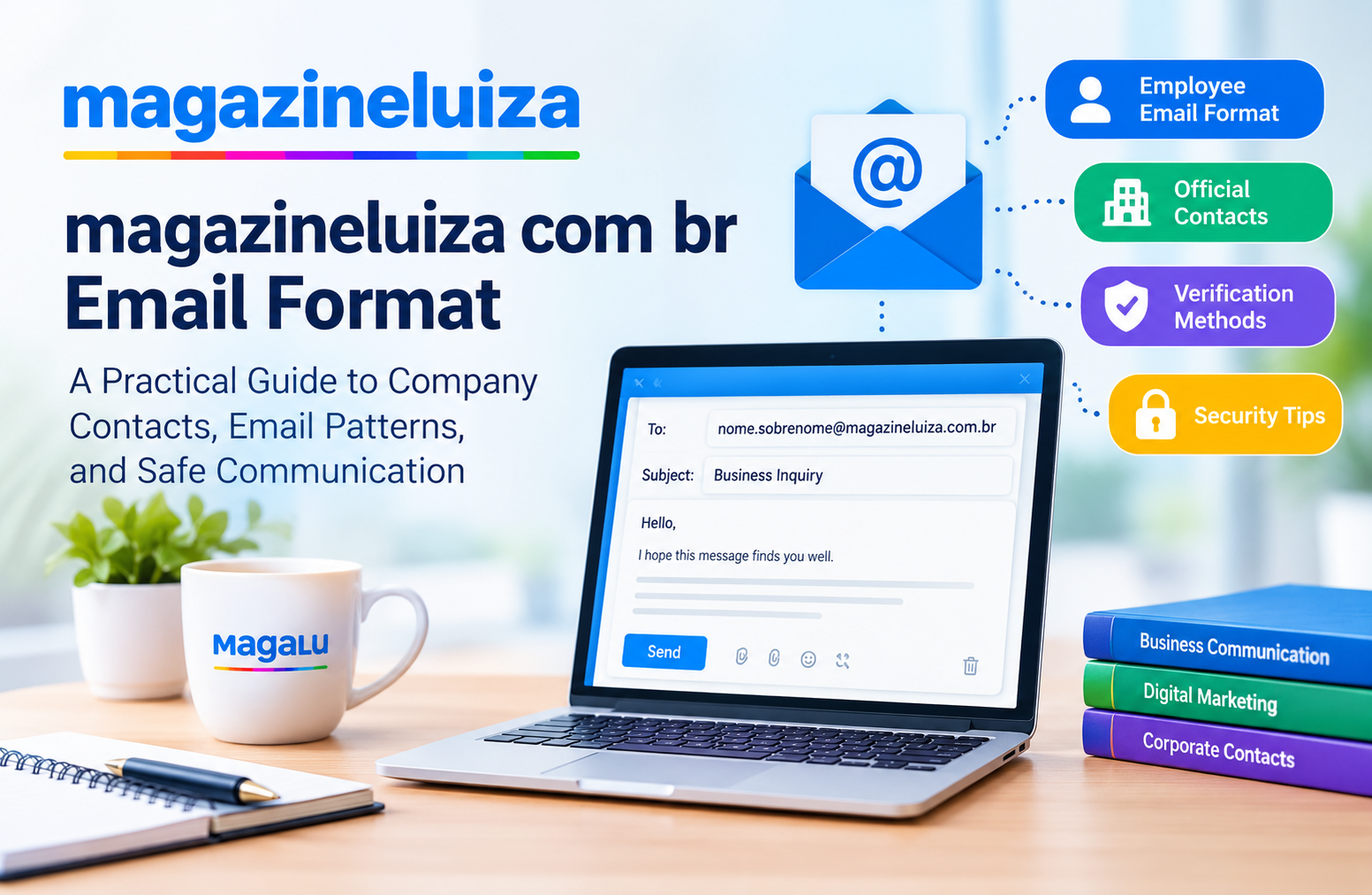
Magazineluiza com br Email Format: A Practical Guide
Understanding the magazineluiza com br email format can help professionals, researchers, suppliers, and business teams identify the correct way to address email communications associated with Magazine Luiza, one of Brazil’s major retail companies. However, finding a likely corporate email pattern is not the same as confirming an individual’s email address. The distinction matters when accuracy, professional communication, and privacy are important.
Magazine Luiza operates in Brazil’s retail and e-commerce market under the Magalu brand. People searching for its email format may want to contact an employee, reach a department, verify a business contact, or organize professional outreach. Each purpose requires a slightly different approach.
The most reliable method is to establish the company’s official communication channels first, look for publicly available contact details, and treat any unverified email pattern as a possibility rather than a confirmed fact. This guide explains how to research the format, assess potential addresses, avoid common mistakes, and communicate professionally without relying on guesswork.
What Is the Magazineluiza com br Email Format?
The term magazineluiza com br email format refers to the possible structure of email addresses associated with Magazine Luiza’s corporate domain. An email format generally describes how a company combines names, initials, or other identifiers to create employee email addresses.
For example, a company might use one of these general patterns:
- firstname.lastname@company.com
- firstinitiallastname@company.com
- firstname@company.com
- department@company.com
These are examples of common business email structures, not verified Magazine Luiza employee addresses.
The domain is an important part of the address. In this case, magazineluiza.com.br is the domain name associated with the search query. The .com.br ending is commonly used by businesses and other organizations operating in Brazil.
However, identifying a domain does not establish which naming convention its employees use. Companies can operate multiple email systems, maintain separate addresses for different departments, or change their internal conventions over time.
A format that appears plausible may also fail because an employee uses a different name, an alternate domain, or an internal alias.
Why Email Formats Matter in Business Communication
Corporate email formats can help people understand how organizations structure professional communication. They can also support legitimate business research when combined with publicly available information.
For example, a supplier researching a retail company’s procurement team may need to identify the appropriate department. A journalist might be looking for a publicly listed media contact. A job applicant may want to reach a recruiter using contact information published by the employer.
In each case, the goal should be to find an appropriate, verified contact rather than generate large numbers of possible addresses.
Email formats are useful starting points, but they are not proof of delivery, employee identity, or authorization to communicate with a particular person.
Official Email Addresses Associated With Magazine Luiza
Before trying to identify an employee’s address, it is useful to examine contact details published by the company itself. Publicly listed email addresses provide stronger evidence than guessed patterns.
The following examples are published in official or company-related sources. They serve different purposes and should not be treated as interchangeable.
| Purpose | Publicly listed email |
| General website support | atendimento.site@magazineluiza.com.br |
| App-related support | atendimentoappmagalu@magazineluiza.com.br |
| Business partnerships | b2b@magazineluiza.com.br |
| Investor relations | ri@magazineluiza.com.br |
| Data protection inquiries | encarregado@magazineluiza.com.br |
These addresses are associated with specific functions. Their inclusion does not mean they are appropriate for every business inquiry.
For example, a question about a retail order belongs with customer support, while a supplier exploring a commercial relationship may find the business partnership channel more suitable.
The company’s official security and contact information provides additional guidance on legitimate communication and fraud prevention. Contact details and available services may change, so check the relevant official page before sending sensitive information.
Why Public Email Addresses Are More Reliable
A published address has a clear advantage over a guessed employee address: there is an identifiable source for the information.
A contact listed on an official company website or a current corporate document has a stronger basis for trust than an address generated by combining an employee’s name with a company domain.
Nevertheless, a published address should still be checked for relevance. A valid support address may not forward a message to the purchasing department, and an investor relations inbox may not handle recruitment questions.
Choosing the right channel can reduce unnecessary delays and improve the chance that a message reaches the appropriate team.
How to Research the Magazineluiza com br Email Format
Researching a company’s email conventions requires more than finding its domain. A reliable process separates verified information from assumptions and avoids unnecessary contact attempts.
The following steps provide a practical approach for business research, professional networking, and legitimate outreach.
1. Confirm the Official Company Domain
Begin by identifying the company’s official website and confirming the domain used in its published contact information.
For this search, the relevant domain is magazineluiza.com.br. However, the existence of that domain does not prove that every address ending with it belongs to an employee.
Large organizations may also use subdomains, specialist communication platforms, and external service providers. Some departments may have dedicated inboxes, while others use web forms or ticketing systems.
Before using an address, check whether the company publishes it on an official page, a corporate filing, or another trustworthy source.
Avoid relying on the appearance of a domain alone. A message can display a familiar company name while originating from an unrelated sender.
2. Search for Publicly Listed Department Contacts
The next step is to determine whether the organization already provides a contact channel for the purpose of your inquiry.
Useful places to investigate include:
- The company’s official contact page.
- Its supplier or business partnership information.
- Its investor relations website.
- Publicly available corporate reports.
- Official recruitment and careers pages.
- Professional profiles that identify an appropriate business contact.
This approach often eliminates the need to discover an employee’s individual address.
For example, a business offering products or services to a retailer may be better served by an official partnership channel than by contacting employees whose responsibilities are unrelated to purchasing decisions.
3. Identify Whether the Contact Is Role-Based or Individual
Email addresses generally fall into two broad categories.
Role-based addresses are associated with a function rather than one person’s identity. Examples include support@company.com and partnerships@company.com.
Individual addresses identify a particular person, often through a name, initials, or another identifier.
Role-based addresses are often easier to verify because companies publish them for specific purposes. Individual addresses can be harder to establish because naming conventions differ and may change when employees move between roles.
For Magazine Luiza, the public examples listed earlier demonstrate that function-specific addresses exist. They do not establish a universal format for personal employee accounts.
This distinction is important when interpreting search results. One confirmed departmental address cannot establish the naming convention used by every employee.
4. Examine Reliable Public Documents
Corporate documents can provide additional evidence about official contact channels.
Annual reports, investor relations documents, regulatory filings, and company announcements sometimes list email addresses for specific representatives or departments.
When reviewing a document, check its publication date, issuing organization, and intended purpose. An address appearing in an old report may still work, but it should not automatically be treated as current.
Also distinguish between an address published for a named executive and a general employee naming pattern. The former verifies a specific published contact at the time of publication. It does not necessarily reveal the structure of other accounts.
5. Record the Evidence Behind Each Contact
For professional research, maintaining a simple contact record can prevent confusion.
Useful fields include:
- Contact name, if publicly available.
- Department or professional role.
- Email address and its source.
- Date the information was checked.
- Purpose for contacting the person.
- Verification status.
Use clear labels such as officially published, confirmed by the organization, or unverified. Avoid marking an address as confirmed simply because it follows a plausible naming convention.
This approach is especially useful when several people contribute to the same research process. It allows others to understand the basis for a contact instead of repeating the search or treating an assumption as a fact.
Common Corporate Email Patterns and Their Limitations
Understanding general business email structures helps explain what people mean when they search for a company’s email format.
However, these patterns are examples of common industry practices, not evidence of Magazine Luiza’s internal email policy.
First Name and Last Name
Some companies combine an employee’s first and last names.
A fictional example would be:
ana.silva@example.com
This structure is easy to understand and can distinguish employees with different names. However, it may create complications when several employees share the same name.
Organizations using this convention may add initials, numbers, or another identifier to resolve duplicates.
First Initial and Last Name
Another common structure uses the first initial followed by the surname.
A fictional example is:
asilva@example.com
This format is relatively short, but it can create ambiguity when multiple employees have the same initial and surname.
It should not be assumed to apply to a particular company without supporting evidence.
First Name Only
Some organizations use the employee’s first name as the local part of an email address.
A fictional example is:
ana@example.com
This format is simple, but it becomes difficult to manage when many employees share the same first name. As a result, it may be limited to certain roles, smaller organizations, or specific systems.
Department or Function
Organizations also use addresses that identify a team or function.
Examples include:
- sales@example.com
- careers@example.com
- media@example.com
Such addresses may be shared by several employees or managed through a customer relationship platform.
The main advantage is continuity. A department address can remain active even when individual employees change roles.
Why No Pattern Should Be Assumed
A business may use more than one email convention across its systems. Acquisitions, changes in technology, employee name changes, and the creation of new departments can all affect how addresses are structured.
Consequently, the magazineluiza com br email format cannot be reliably established from the domain alone.
A useful research result should identify the source of a specific address or explain that a pattern remains unconfirmed.
How to Verify a Potential Business Email Address
Email verification involves several different questions. An address may be formatted correctly but still not exist. It may exist without belonging to the person you expect. It may also be valid but unsuitable for your intended message.
A careful verification process considers these issues separately.
Check the Address Structure
First, review the basic syntax.
A typical email address contains a local part, an @ symbol, and a domain. The local part identifies the mailbox, while the domain indicates the mail system receiving the message.
Check for:
- Missing characters.
- Accidental spaces.
- Incorrect punctuation.
- Misspelled domain names.
- Extra characters copied from a webpage.
Correct syntax is necessary, but it does not establish that a mailbox exists.
Verify the Source
Next, establish where the address came from.
An address published on the company’s own website has a clearer provenance than one copied from an anonymous directory. A current official document may also provide useful evidence.
If a person claims to represent Magazine Luiza, compare their contact details with information available through official company channels.
Be particularly cautious when a message requests payments, passwords, identification documents, or urgent action.
Understand What Technical Verification Can Prove
Some email verification services examine domain configuration and attempt to determine whether a mail server accepts an address.
These checks have limitations. Mail servers may reject external verification requests, use catch-all configurations, or provide responses that do not conclusively establish mailbox ownership.
A technically acceptable address is not necessarily an active employee account.
Likewise, a successful delivery does not prove that the recipient is the correct person for a particular business purpose.
Confirm Identity Through an Independent Channel
If the message involves a significant business decision, verify the contact independently.
For instance, you might consult a publicly listed company contact page or use an established corporate communication channel to confirm the appropriate department.
Do not rely exclusively on contact details supplied in a suspicious email. An attacker may control both the message and the alternative contact information included in it.
Avoid Treating Delivery as Proof of Identity
An email can reach a real mailbox and still be misdirected. It can also be forwarded, monitored by a shared team, or handled by an automated system.
The strongest verification combines a credible source, a relevant professional role, and confirmation through an appropriate channel.
Benefits of Identifying the Correct Corporate Email
Finding the right contact channel offers several practical benefits.
More Relevant Communication
A message sent to the appropriate department is more likely to receive relevant attention than one sent to an unrelated inbox.
A supplier asking about commercial opportunities, for example, needs a different contact from a customer seeking help with an order.
Matching the message to the department helps the organization understand what is being requested.
Less Time Spent on Repeated Outreach
Using verified contact information reduces wasted effort caused by incorrect addresses and messages sent to irrelevant recipients.
It also helps researchers maintain accurate records rather than repeatedly testing variations of the same address.
Better Professional Credibility
Accurate contact information supports professional communication. A concise, relevant email sent through an appropriate channel demonstrates that the sender has made an effort to understand the organization’s structure.
By contrast, repeatedly sending speculative messages to unrelated employees can create a poor impression.
Improved Research Quality
A contact record that distinguishes published facts from assumptions is easier to review and update.
This matters for sales research, supplier discovery, recruitment, journalism, and corporate relationship management.
The goal should be to improve the quality of communication rather than simply collect as many addresses as possible.
Challenges When Researching Corporate Email Addresses
Even careful research can encounter obstacles. Understanding these limitations helps prevent misleading conclusions.
Multiple Employees With Similar Names
Large organizations employ people who share common first names and surnames. A simple naming convention may therefore produce duplicate combinations.
Companies can resolve these collisions in several ways, including additional initials or numbers. Without evidence, it is impossible to know which approach a particular organization uses.
Outdated Information
Employees leave organizations, change departments, or receive new email accounts. Corporate websites and third-party directories may not update at the same time.
An address that appeared in an old publication should be treated as historical evidence unless its current status can be established.
Restricted Mail Server Responses
Some corporate mail systems do not disclose whether a particular mailbox exists. This can make automated verification inconclusive.
A failed verification result may reflect technical restrictions rather than an invalid address. Similarly, a positive technical result does not establish the recipient’s identity.
Different Systems for Different Departments
Customer service, marketing, investor relations, recruitment, and commercial partnerships may use separate systems.
A company may publish dedicated addresses for these functions without using a single, consistent employee email pattern across all systems.
This is why a department-specific contact is often more useful than an assumed individual format.
Privacy and Professional Boundaries
Public availability does not mean every use of personal contact information is appropriate.
Researchers should consider whether the information is relevant to the intended purpose, whether the person has a professional reason to receive the message, and whether the method of collection respects applicable privacy requirements.
For business outreach, relevance and transparency are generally more useful than collecting large lists of speculative addresses.
Practical Applications for Business Research and Outreach
Researching corporate contact information can support several legitimate activities.
Supplier and Partnership Inquiries
A company seeking a commercial relationship with Magazine Luiza should begin with publicly identified business channels.
A supplier can briefly explain its offering, describe the potential value to the retailer, and ask whether the message can be directed to the relevant team.
This is more appropriate than guessing an employee’s address without knowing their responsibilities.
Sales Prospecting
Sales teams sometimes research organizations before initiating contact. In this context, the quality of the research matters more than the number of addresses collected.
A useful prospect record identifies the person’s public professional role, explains why the proposed offering is relevant, and documents the source of the contact information.
Messages should be personalized to the recipient’s professional responsibilities and comply with applicable marketing and privacy requirements.
Recruitment and Career Questions
People interested in employment should prioritize the company’s official careers resources and published recruitment contacts.
A guessed address may belong to another person or may never reach the recruitment team. Using the established application process generally makes it easier for the employer to associate an inquiry with the appropriate vacancy.
Journalism and Media Requests
Journalists and researchers should look for official media relations contacts when requesting statements or background information.
A department specifically responsible for public communication is often better suited to handling a press inquiry than an employee whose role is unrelated to communications.
Investor and Corporate Questions
Investors and analysts should use the company’s published investor relations channel for financial reports, shareholder information, and other appropriate corporate inquiries.
A publicly listed investor relations email is more reliable for this purpose than an address inferred from the name of an executive.
Writing an Effective Email to a Corporate Contact
Finding an appropriate address is only part of successful communication. The message itself should make the reason for contact clear.
Use a Specific Subject Line
A subject line should summarize the purpose of the message without exaggeration.
Examples include:
- Business Partnership Inquiry
- Supplier Introduction
- Question About Investor Information
- Media Inquiry Regarding Company Operations
Choose a subject that accurately reflects the message. Avoid misleading phrases designed to create urgency or imply an existing relationship.
Introduce Yourself Clearly
The opening should identify the sender and their organization, where relevant.
Explain why you are contacting the recipient and how the inquiry relates to their professional role. Avoid lengthy introductions that make the purpose difficult to understand.
Keep the Request Focused
A first email should normally address one main purpose. Include only the information necessary for the recipient to understand the request and decide what to do next.
If you are contacting a business partnership team, explain the proposed relationship and its relevance. If the message concerns customer support, provide the order information requested through the official support process.
Do not include unnecessary personal information or confidential documents.
Provide a Professional Closing
End with a brief, courteous closing. Include your name, organization, and appropriate business contact details.
If the recipient is not responsible for the subject, a polite request for the correct department is more productive than repeated follow-ups.
Example of a Business Inquiry
The following template can be adapted for a legitimate supplier or partnership inquiry.
Subject: Business Partnership Inquiry
Dear Magazine Luiza Team,
I am contacting you to ask about the appropriate process for exploring a potential business partnership with Magazine Luiza.
Our organization provides services in [briefly describe your service or product]. We would appreciate guidance on whether your team reviews proposals of this type and which department would be best suited to receive further information.
Thank you for your time and consideration.
Kind regards,
[Your Name]
[Your Organization]
This template is intentionally general. It should be adapted to the recipient and sent through an appropriate, verified channel.
Security Considerations When Contacting Magazine Luiza
Corporate email research also requires attention to security. A familiar company name or domain can be used in misleading messages, and some fraudulent communications are designed to imitate legitimate business activity.
Check the Full Sender Address
Read the entire address rather than relying on the displayed sender name.
Fraudulent messages may use similar-looking domains, additional words, or subtle spelling differences. A display name alone does not establish the sender’s identity.
Be Cautious With Unexpected Attachments
Do not open unexpected attachments or follow suspicious links simply because a message appears to come from a well-known retailer.
Be especially careful with messages claiming that an account will be suspended, a payment is overdue, or a limited offer will disappear unless you act immediately.
Never Share Passwords or Verification Codes
A legitimate business inquiry should not require you to disclose your email password or a one-time security code.
If a message requests sensitive information, stop and verify the request through an independent official channel.
Verify Payment and Banking Instructions
Business email compromise can involve fraudulent changes to payment details or invoices.
If a supposed company representative requests a bank transfer or provides new payment instructions, confirm the information through a trusted channel before taking action.
Report Suspicious Communications
If you receive a message claiming to represent Magazine Luiza and suspect fraud, avoid replying or sharing personal information. Use the company’s official security and support resources to determine the appropriate reporting process.
These precautions apply whether you are contacting customer support, researching suppliers, or communicating with a potential business partner.
Frequently Asked Questions
1. What is the Magazineluiza com br email format?
The search term refers to the possible structure of email addresses associated with Magazine Luiza. The company publishes several function-specific addresses, but a universal employee email format has not been established by the evidence presented here.
2. Does Magazine Luiza use the domain magazineluiza.com.br?
Yes. The company publishes official contact addresses using magazineluiza.com.br. However, the domain alone does not verify an individual mailbox or establish that a particular person works for the company.
3. How can I contact Magazine Luiza for a business partnership?
The company publishes b2b@magazineluiza.com.br for business partnership inquiries. Confirm that this channel remains appropriate by checking the official business contact page before sending your proposal.
4. How can I verify a Magazine Luiza email address?
Look for the address on an official company page or a credible corporate document. Check the spelling and intended purpose, and independently confirm the sender when the communication involves sensitive information or financial decisions.
5. Can I guess an employee’s email address from their name?
You can identify possible naming conventions used by businesses, but guessing does not establish that an address exists or belongs to a particular employee. Use publicly verified contact details whenever possible.
6. Is an email address using the company domain always safe?
No. A familiar domain is not sufficient proof that a message is legitimate or that its sender is trustworthy. Check the complete sender address, examine the message carefully, and verify sensitive requests independently.
Conclusion
Researching the magazineluiza com br email format requires a distinction between a company’s official domain, its publicly listed departmental addresses, and the possible naming conventions used for individual employees.
The most dependable approach is to begin with official contact information, identify the department relevant to your purpose, and verify the source of any address before using it. General email patterns can explain how corporate addresses are structured, but they cannot confirm an individual employee’s mailbox.
For business outreach, supplier inquiries, recruitment questions, and other professional communication, a relevant published contact is usually a better starting point than an unverified address. Careful research, concise messaging, and appropriate security checks help make the process more accurate and professional.