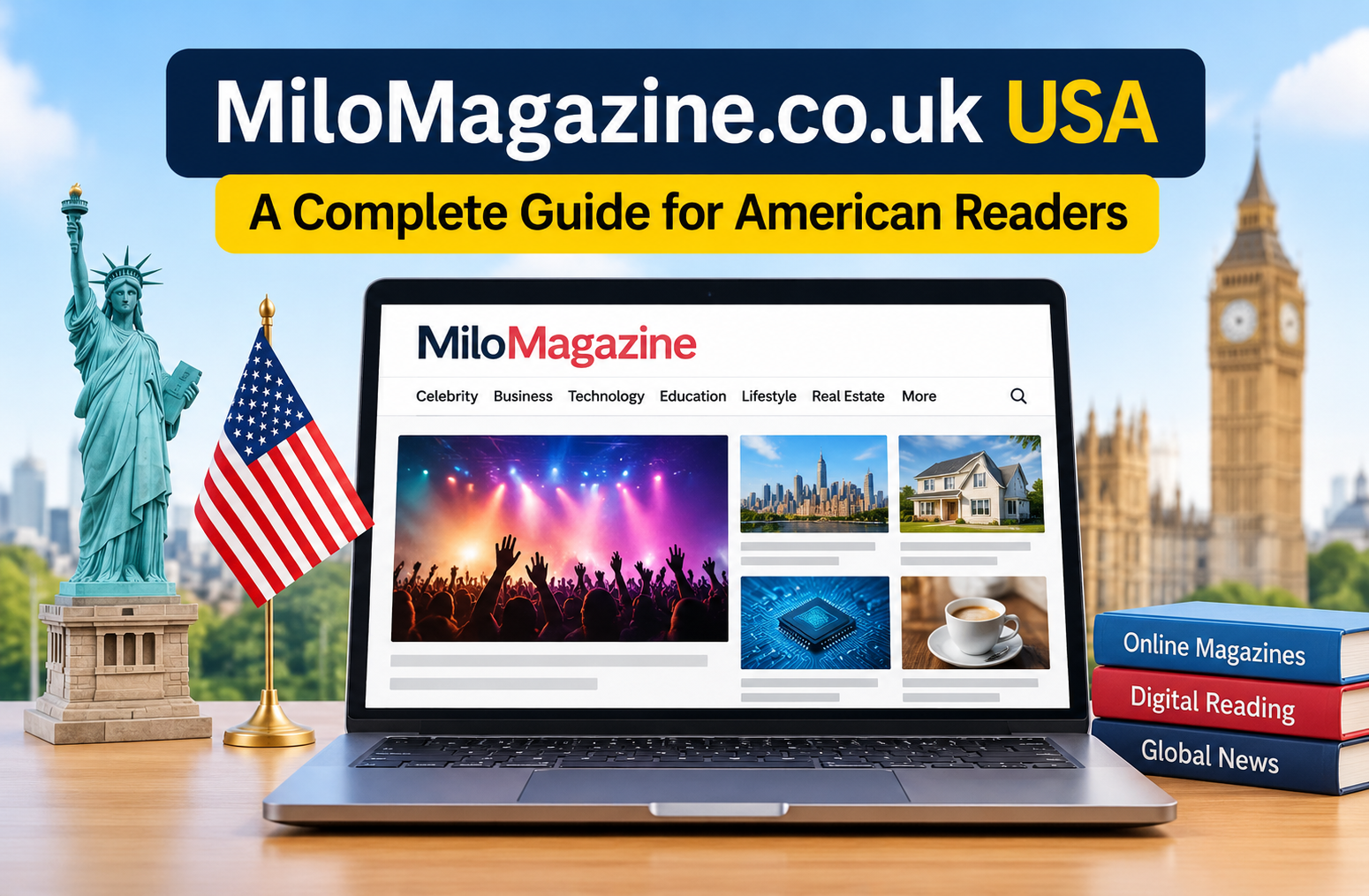
MiloMagazine.co.uk USA: A Complete Guide for American Readers
Introduction
MiloMagazine.co.uk USA is a search term that raises an interesting question for readers who want to understand the website, its content, and its relevance to people living in the United States. Milo Magazine is an online publication available through the domain milomagazine.co.uk. Although its web address uses a UK domain extension, its publicly accessible articles cover subjects that may interest readers from different countries. Understanding the website requires looking beyond its domain name and examining the information it actually publishes.
Online magazines have become an important source of everyday information. People use them to explore celebrity stories, learn about business developments, understand technology, discover lifestyle ideas, and research practical subjects. However, not every publication follows the same editorial approach. Some focus on one subject, while others publish articles across several categories. Milo Magazine follows a broader content approach, making it relevant to readers with different interests.
For American readers, the most important distinction is between accessing an international website and using a publication specifically designed for the US market. These are not necessarily the same thing. A website may be available in the United States without operating a separate American edition. Readers should therefore understand its content, check the geographical relevance of individual articles, and evaluate information before relying on it.
This guide examines what Milo Magazine offers, how American visitors can explore its content, what benefits and limitations they should understand, and how to assess the information they find.
What Is MiloMagazine.co.uk USA?
Milo Magazine is an online publication hosted at milomagazine.co.uk. Its homepage describes its purpose as providing readers with information, particularly about their favorite celebrities. However, the articles displayed on its homepage demonstrate a wider publishing approach.
The website features content covering subjects such as business, lifestyle, technology, education, entertainment, real estate, and practical everyday topics. Its published material is not limited to celebrity information. Instead, it provides a mixture of articles intended to address different reader interests.
The phrase MiloMagazine.co.uk USA generally connects the publication with American readers searching for information about the website. It should not automatically be interpreted as the name of a separate American magazine or an officially established regional edition.
There are three important details to understand:
- Website identity: The publication operates through the milomagazine.co.uk domain.
- International accessibility: Readers in the United States can visit its publicly accessible website.
- Regional publishing: Access from America does not establish that the publication has a separate US editorial office, American publisher, or dedicated American edition.
This distinction helps readers understand exactly what they are visiting.
A UK-style domain extension identifies the website address, but it does not independently establish the publisher’s physical location, ownership structure, or readership distribution. Similarly, the presence of American-related subjects does not prove that every article has been written specifically for American audiences.
The most reliable way to understand the publication is to examine its actual pages, article categories, publication dates, and available contact information.
Why Are American Readers Searching for Milo Magazine?
People search for websites for different reasons. Some want to discover new publications, while others want to check whether a particular website is accessible in their country.
Searches containing the words USA and Milo Magazine may reflect several common interests.
Understanding the Website
A visitor may encounter the domain through a search result, an article reference, or a recommendation. Before exploring an unfamiliar publication, readers naturally want to know what it offers.
They may have questions about its purpose, content categories, editorial approach, and intended audience.
A general introduction helps visitors decide whether the publication matches their interests.
Finding International Reading Material
American internet users are not limited to publications based in the United States. They can explore magazines and blogs from the United Kingdom, Canada, Australia, and other countries.
International publications can introduce readers to different perspectives, cultural discussions, and regional developments.
For example, an article about British housing costs may help an American understand differences between property markets. A technology article may discuss tools that are available internationally.
However, readers should always check whether the information applies to their location.
Checking Whether a US Edition Exists
Another possible reason for this search is uncertainty about the website’s regional identity.
A reader may wonder whether Milo Magazine has an American version with separate content, editors, or publishing arrangements.
The publicly visible website reviewed for this guide presents the main milomagazine.co.uk publication. Its homepage does not establish a separate US edition.
Therefore, readers should distinguish between an accessible international website and a dedicated American publication.
Exploring Different Content Categories
People also search for publications because they want convenient access to different subjects.
Rather than visiting several specialist websites, readers sometimes prefer a general-interest publication where they can explore multiple topics.
This broad approach is one of the most noticeable characteristics of Milo Magazine.
What Type of Content Does Milo Magazine Publish?
The content available on a publication is one of the strongest indicators of its purpose. Looking at its homepage provides a more practical understanding than relying only on its name or tagline.
Milo Magazine displays articles across several subject areas. The following sections explain the types of information readers may encounter.
Celebrity and Entertainment Information
Celebrity-related content is part of the publication’s stated identity.
People often search for information about actors, musicians, television personalities, public figures, and entertainment personalities. They may want to understand someone’s career, background, achievements, or public appearances.
Celebrity articles can help readers explore these subjects in one place.
However, personal information requires careful treatment. Readers should distinguish between publicly confirmed facts and unverified claims.
For example, information about a person’s professional achievements may be supported by official interviews or published records. Claims about private relationships, family matters, or personal finances require stronger evidence.
A responsible reader should not treat every online statement as established fact.
Business and Professional Topics
Business is another visible subject area on the website.
Business-related articles can introduce readers to workplace developments, customer relationships, marketing practices, entrepreneurship, and other professional subjects.
For American readers, international business content can be useful when it explains general concepts.
For example, customer engagement, online marketing, and workplace communication are subjects that may apply across different markets.
However, regulations, taxation, employment requirements, and business registration rules are often country-specific.
An article discussing British business regulations should not automatically be treated as guidance for an American company.
Technology and Digital Developments
Technology is an important part of modern online publishing.
Readers regularly search for information about digital platforms, software, artificial intelligence, online services, and emerging technologies.
Technology articles can help visitors understand unfamiliar terms and explore how digital tools work.
A useful technology article should explain more than basic definitions. It should describe practical applications, possible limitations, relevant costs, and situations where a particular tool may be useful.
Readers should also check publication dates because technology changes quickly.
An explanation that was accurate several years ago may no longer describe the latest version of a product or service.
Education and Learning
Educational content can support readers who want to understand academic subjects, learning methods, educational resources, and developments in teaching.
Students, parents, and professionals may all find educational articles relevant.
American readers should pay attention to geographical context when reading education-related information.
For example, school grades, university admission procedures, tuition arrangements, and qualification systems differ between countries.
An article describing the British education system may provide useful background, but it should not be confused with a guide to American schools or universities.
Lifestyle and Everyday Information
Lifestyle content generally covers practical subjects connected with daily routines and personal interests.
This may include home organization, family activities, travel planning, personal development, and everyday decisions.
Such articles can be useful because readers often search for straightforward explanations rather than specialist research.
For example, a guide about preparing a nursery may offer practical organizational ideas. A home-related article may explain common maintenance considerations.
Nevertheless, advice should be evaluated according to the reader’s circumstances.
A recommendation suitable for a British household may not always match American product availability, building standards, or local conditions.
Real Estate and Property Topics
Property-related subjects are relevant to people interested in housing, renting, purchasing, and property ownership.
International property content can help readers understand different housing markets and common property concepts.
However, American property transactions involve specific legal and financial arrangements.
State laws, property taxes, mortgage requirements, insurance arrangements, and closing procedures can vary considerably.
Readers should therefore use general articles as introductory information rather than as substitutes for location-specific professional guidance.
News and General Interest Articles
General-interest publications also provide articles about current developments and subjects that attract public attention.
Milo Magazine’s homepage includes a section highlighting recent articles.
This can help visitors discover newly published material without searching through every category individually.
However, the presence of a recent publication date does not automatically establish that an article contains independently verified reporting.
Readers should examine its sources, evidence, and context before accepting important claims.
Is MiloMagazine.co.uk Available in the USA?
American readers can access the publicly available website through its main domain.
A .co.uk extension does not automatically prevent visitors from other countries from opening a website. Domain extensions and website accessibility are separate matters.
For example, an American reader can visit a British online magazine in the same way that someone in the United Kingdom can explore an American publication.
The important consideration is whether the information is relevant to the visitor.
Does the Website Have a Separate American Edition?
The publicly visible homepage reviewed for this article does not establish a separate US edition.
There is a difference between publishing articles that discuss American subjects and operating a separate American publication.
A dedicated regional edition may have its own editorial team, regional homepage, local contact information, and content specifically developed for that market.
Without clear evidence of these arrangements, readers should not assume that a separate American version exists.
Can US Readers Benefit From Its Articles?
Yes, depending on the subject.
Articles about general technology concepts, digital communication, business principles, and everyday interests may be useful across international audiences.
Other subjects require greater attention.
For example:
- A general article about online productivity may apply to readers in several countries.
- A British housing guide may not explain American property regulations.
- A UK education article may not reflect US admission requirements.
- An international travel article may still require visitors to check current entry rules.
- A legal article should be evaluated according to the jurisdiction it discusses.
The best approach is to identify the article’s intended geographical audience before applying its recommendations.
How to Explore Milo Magazine From the United States
Visitors do not need specialist knowledge to explore an online publication. A few simple steps can make the experience more useful.
Step 1: Visit the Official Website
Start by entering the domain directly into your browser:
milomagazine.co.uk
Checking the full web address is important because websites sometimes have similar names.
A similar domain does not necessarily belong to the same publisher.
Step 2: Explore the Homepage
The homepage provides an overview of recently displayed content and available categories.
Visitors can scan article titles and introductory descriptions to identify subjects that match their interests.
This is often faster than opening random pages without understanding what the website publishes.
Step 3: Choose a Relevant Category
Look for the category that matches the information you need.
For example, a reader interested in professional subjects may begin with Business. Someone researching digital developments may prefer Technology.
Category selection helps narrow the reading experience.
Step 4: Check the Publication Date
The publication date is especially important when reading information that can change.
Technology, regulations, prices, health recommendations, and current events may become outdated.
A recent article is not automatically accurate, but a publication date helps readers understand when the information was presented.
Step 5: Review the Author Information
Check whether the article identifies its author.
An author name provides a starting point for evaluating responsibility and credibility. However, a name alone does not establish professional expertise.
For technical or sensitive subjects, look for relevant qualifications, professional experience, references, and supporting evidence.
Step 6: Examine Important Claims
Do not accept every statement simply because it appears in a professionally formatted article.
Look for:
- Links to original research or official information.
- Named organizations and reliable references.
- Clear explanations of dates and locations.
- Evidence supporting numerical claims.
- Distinctions between fact, opinion, and interpretation.
This process is particularly important for legal, financial, and health-related information.
Step 7: Decide Whether the Article Meets Your Needs
After reviewing the content, consider whether it actually answers your question.
A useful article should provide enough information to help readers understand a subject or make a better-informed decision.
If important details are missing, consult an authoritative source that specializes in the topic.
Main Benefits of Exploring Milo Magazine
The value of an online publication depends on the usefulness of its information and how easily readers can find relevant material.
Milo Magazine offers several potential benefits as a general-interest reading destination.
Access to Different Subjects
One noticeable benefit is the variety of topics displayed on the website.
Readers interested in business, entertainment, lifestyle, education, and technology can explore different subjects through one publication.
This approach may be convenient for people who enjoy discovering information outside their main interests.
It can also introduce visitors to subjects they had not previously considered researching.
Convenient Online Access
A browser-based publication can be accessed through common internet-connected devices.
Readers can visit the website using a desktop computer, laptop, tablet, or smartphone.
This makes it possible to explore articles without depending on a printed edition.
However, actual browsing quality can depend on the device, browser, internet connection, and website design.
Opportunities for General Learning
General-interest articles can introduce unfamiliar subjects in an accessible format.
For example, someone who has never researched property ownership may begin with an introductory article explaining basic concepts.
Similarly, a reader unfamiliar with digital marketing may use a general guide to understand important terminology.
These introductions can help readers identify what they need to research further.
Exposure to International Perspectives
A publication using a UK domain can introduce American readers to subjects discussed from a different geographical perspective.
This may be useful for understanding international lifestyle differences, educational systems, housing markets, and business practices.
Exposure to different perspectives can make online reading more informative.
The key is recognizing where international comparisons are useful and where local rules must take priority.
Flexible Reading Experience
Online articles allow visitors to select the subjects that interest them.
A person can read one article and leave without following a fixed publication schedule.
This flexibility is useful for readers who prefer researching individual questions instead of consuming an entire magazine issue.
Challenges American Readers Should Understand
Although international websites provide convenient access to information, readers should understand their limitations.
A careful approach helps prevent misunderstandings and unsupported assumptions.
Different Legal and Regulatory Systems
One of the most important challenges involves geographical differences.
The United States and United Kingdom have separate legal and regulatory systems.
Even when both countries use similar terminology, the applicable rules may be different.
Consider property ownership, employment arrangements, taxation, healthcare, and educational requirements.
An article discussing one country’s regulations may not apply to another.
American readers should identify the relevant state or federal authority before acting on legal or regulatory information.
Broad Subject Coverage
A general-interest website may publish articles across many unrelated categories.
This approach can be convenient, but it also means that readers should evaluate each article independently.
A publication that discusses entertainment and home improvement does not automatically have specialist expertise in medicine, law, or finance.
The credibility of a particular article depends on its author, research, sources, accuracy, and editorial quality.
Limited Public Information About Ownership
Readers often want to know who operates a publication.
Ownership information can help establish accountability and provide context about the organization behind the content.
The publicly visible homepage reviewed for this guide does not provide enough information to establish the publisher’s complete ownership structure.
This should be treated as an information gap rather than proof of misconduct.
Readers should avoid assuming that an unnamed publisher is automatically unreliable. Equally, they should not assume that a publication has established editorial credentials without supporting evidence.
Author Expertise Requires Verification
An author byline can help identify who is responsible for an article.
However, it is only one part of an effective credibility assessment.
A reader researching medical information, for example, should look for appropriate medical expertise and reliable supporting sources.
The same principle applies to legal, financial, and technical subjects.
Readers should give greater weight to articles that explain their evidence and identify relevant professional qualifications.
Information Can Become Outdated
Online content can remain accessible long after its original publication.
This creates a challenge when readers research subjects that change frequently.
A guide about software may describe an older interface. A financial article may refer to previous interest rates. A travel article may contain outdated entry information.
Always check dates and confirm time-sensitive details using current primary sources.
Similar Website Names Can Cause Confusion
Another issue is the existence of websites with similar names.
A reader should never assume that two publications are connected simply because their domains contain similar words.
Check the complete domain before sharing information or entering personal details.
This is a simple but important online safety practice.
How to Evaluate Information Published on Milo Magazine
Evaluating an article is more useful than judging an entire website based on its name.
Different articles can have different levels of quality, even when they appear on the same publication.
American readers can use the following approach to assess individual pages.
Check the Original Source
When an article makes a factual claim, look for the original source behind it.
For example, a government announcement should ideally be supported by the relevant government department.
A scientific claim may require an original study or a recognized medical institution.
A statement about a company’s services should be checked against the company’s official documentation.
Following the original source helps readers avoid repeating information that has been misunderstood or taken out of context.
Separate Facts From Opinions
Not every sentence in an article has the same purpose.
Some statements describe verifiable events. Others express an author’s interpretation.
Responsible reading involves recognizing this difference.
An article may explain why a particular business trend is important, but its predictions should not be confused with confirmed outcomes.
Examine the Evidence Behind Statistics
Numbers can make an article appear convincing, but statistics need context.
Readers should ask:
- Where did the figure come from?
- When was the information collected?
- What population or market does it represent?
- Is the source independent?
- Does the article explain how the figure was calculated?
A percentage without a clear source may provide little meaningful information.
Look for Balanced Explanations
A useful article should explain relevant limitations rather than presenting every subject as completely positive.
For example, an article about a digital service should discuss potential disadvantages, costs, privacy considerations, or compatibility issues when relevant.
Balanced explanations help readers understand the complete subject.
Compare Important Information
For decisions involving money, health, legal responsibilities, or safety, consult more than one reliable source.
This does not mean that every article requires extensive investigation.
It means that the consequences of an incorrect decision should influence how carefully information is checked.
Milo Magazine and Digital Reading Habits in the United States
American readers have access to an enormous range of digital publications.
News websites, specialist blogs, independent magazines, educational platforms, and professional resources all compete for attention.
In this environment, people increasingly search for information that is easy to understand and directly connected to their questions.
General-interest publications can support this behavior by making different topics available through one website.
However, convenience should not replace accuracy.
Readers should focus on the quality of information rather than the number of subjects a publication covers.
A website with many categories may be useful for discovery, but specialist questions still require specialist sources.
For example, someone researching a new smartphone may benefit from a general technology explanation. Before making a purchase, however, they should compare official specifications, independent testing, warranties, and current prices.
Likewise, an article introducing a legal concept may help a reader understand the terminology. It cannot replace advice based on the laws of the relevant American state.
This distinction makes digital reading more responsible and productive.
Is MiloMagazine.co.uk USA Suitable for Different Types of Readers?
The usefulness of an online publication depends on what an individual wants to learn.
Different readers may approach the same website with different expectations.
Casual Readers
Casual readers may enjoy exploring celebrity-related subjects, lifestyle articles, and general-interest discussions.
For this audience, the website can serve as a place to discover topics and browse articles during free time.
They should still verify important personal or professional claims before sharing them.
Students and Independent Learners
Students may use general-interest articles to become familiar with unfamiliar subjects.
For example, a business article may introduce basic professional concepts, while a technology article may explain digital terminology.
However, students should use academic books, research papers, and official educational resources when completing formal assignments.
A general blog should not automatically be treated as an academic reference.
Business Professionals
Professionals may find general discussions about business practices, marketing, and customer engagement useful as introductory reading.
These subjects can generate ideas and encourage further research.
However, professional decisions should be based on relevant evidence, current market information, and applicable regulations.
Technology Enthusiasts
People interested in digital developments may explore technology-related articles to understand new concepts.
They should check whether a guide describes the latest software versions and whether its recommendations are supported by practical evidence.
International Readers
Visitors outside the United States may also find the website accessible and relevant.
The main consideration is whether the article discusses a subject that applies to their country.
International readers should pay attention to local terminology, regulations, product availability, and cultural context.
Online Safety and Responsible Browsing
Visiting an online magazine is generally a straightforward activity, but normal internet safety practices remain important.
Readers should not assume that a website is secure simply because it looks professional.
Before interacting with any unfamiliar online service, consider the following precautions.
Check the Website Address
Confirm that the address belongs to the intended publication.
Be careful with misspelled domains, unexpected redirects, and links that lead to unrelated websites.
Avoid Sharing Unnecessary Personal Information
Reading an ordinary public article should not normally require sensitive personal information.
Do not provide passwords, banking information, identity documents, or other private details unless there is a clear and legitimate reason.
Review External Links
Articles may contain links to other websites.
Before opening an unfamiliar destination, check its domain and purpose.
A link within an article does not automatically mean that the external website has been independently verified by the publication.
Use Updated Browsing Software
Keep your browser and operating system updated.
Security updates can help protect against known vulnerabilities.
Also pay attention to browser warnings rather than ignoring them to access a page.
Verify Health and Financial Claims
Health and financial subjects require particular care.
Do not make treatment decisions or financial commitments based solely on a general-interest article.
Consult appropriate qualified professionals and authoritative information when necessary.
What Should Readers Know Before Trusting an Online Magazine?
Trust should develop through evidence, not appearance.
A website may have attractive design, frequent updates, and professional-looking headlines. These characteristics alone do not prove that its information is accurate.
A stronger evaluation considers several factors together.
Transparency: Does the publication explain who operates it and how readers can contact it?
Authorship: Are individual articles credited to identifiable writers?
Expertise: Do writers demonstrate relevant knowledge when discussing specialist subjects?
Evidence: Are important claims supported by reliable references?
Accuracy: Does the article distinguish verified information from opinion?
Freshness: Is the material appropriate for the date-sensitive nature of its subject?
Corrections: Is there a clear way to report mistakes or request clarification?
These questions provide a practical framework for evaluating digital publications.
They also help readers avoid making broad judgments based on a single article.
How Milo Magazine Can Be Used as a Starting Point for Research
An online magazine can introduce a subject, but deeper research often requires additional resources.
A practical research process begins with understanding the question.
First, identify the main subject. Then determine whether it involves general knowledge or a location-specific issue.
Next, read an introductory article and identify its main claims.
After that, investigate the most important claims through original or authoritative sources.
For example, a reader researching a technology product could follow this process:
- Read an introductory explanation to understand the product.
- Identify the features and technical terms mentioned.
- Visit the manufacturer’s official website.
- Check independent product testing where available.
- Compare compatibility, pricing, and support arrangements.
- Make a decision using current information.
The same approach works for many other subjects.
For legal research, identify the relevant jurisdiction and consult official government resources. For health information, prioritize recognized medical institutions. For education, use the relevant school’s or university’s official documentation.
This approach makes general-interest reading more valuable because it connects introductory explanations with reliable evidence.
The Importance of Understanding the UK and US Context
The domain extension in a website address can influence what visitors expect, but readers should understand what it actually tells them.
The .co.uk domain is associated with the United Kingdom. It does not automatically establish that every article targets British readers.
Likewise, the appearance of USA in a search phrase does not establish that a website operates from the United States.
For American visitors, geographical context matters most when an article discusses:
- Government policies.
- Taxation and financial regulations.
- Property transactions.
- Healthcare systems.
- Educational qualifications.
- Employment laws.
- Consumer protection.
- Local products and services.
These subjects often depend on national or regional rules.
An article discussing British consumer rights, for example, should not be used as a substitute for information about American consumer protection.
Readers can still benefit from international explanations, but they must understand the limits of applying them.
Is Milo Magazine Worth Exploring?
Whether Milo Magazine is worth exploring depends on the reader’s expectations.
People looking for a general-interest online publication may find its range of subjects useful.
The homepage provides access to different article categories and displays recently published material. This makes it possible to discover content without committing to a single specialist subject.
However, readers expecting a dedicated American news magazine or a confirmed US edition should understand that the publicly visible website does not establish either arrangement.
The publication’s broad content approach also means that each article should be evaluated according to its subject.
A general lifestyle article and a specialist medical article should not be assessed using exactly the same standards.
For ordinary reading, visitors can explore subjects that interest them. For important decisions, they should confirm information through reliable primary sources.
This balanced approach allows readers to benefit from online publications without placing unnecessary trust in unsupported claims.
Frequently Asked Questions About MiloMagazine.co.uk USA
1. What is MiloMagazine.co.uk USA?
It is a search phrase associated with Milo Magazine, an online publication hosted at milomagazine.co.uk. The website publishes articles covering celebrity information, business, technology, lifestyle, education, and other general-interest subjects.
2. Can people in the United States access Milo Magazine?
Yes. American readers can visit the publicly accessible website through its main domain. Its .co.uk extension does not automatically restrict access to people living in the United Kingdom.
3. Does MiloMagazine.co.uk have a separate US edition?
The publicly visible website does not establish a separate American edition. Readers should distinguish between accessing an international website and visiting a publication with a dedicated US editorial operation.
4. What topics can readers explore on Milo Magazine?
Visitors can explore different subjects, including business, entertainment, celebrity information, technology, education, lifestyle, real estate, and general-interest topics. The available homepage content provides an overview of its publishing categories.
5. Is MiloMagazine.co.uk a reliable source of information?
Reliability depends on the individual article, its author, supporting evidence, and subject matter. Readers should verify important health, legal, financial, and technical claims through recognized primary sources before making decisions.
6. Do readers need an account to visit Milo Magazine?
The publicly accessible homepage can be viewed through a regular web browser. No account requirement is established by the homepage reviewed for this article. Readers should check the website itself for any requirements associated with individual services.
Conclusion
MiloMagazine.co.uk USA is a useful search phrase for people interested in understanding Milo Magazine and its accessibility to American readers. The publication operates through a UK-style web address and provides a mixture of content covering different interests.
Its homepage identifies celebrity information as part of its purpose, while its displayed articles cover broader subjects such as business, technology, education, lifestyle, and real estate.
American visitors can explore the website, but they should not confuse international accessibility with the existence of a dedicated US edition. The geographical relevance of each article matters, particularly when reading about laws, financial requirements, healthcare, education, and local services.
The most sensible approach is to explore the available categories, check publication dates, examine author information, and verify important claims through reliable sources. These habits help readers understand online content more accurately and make better-informed decisions.
As with any general-interest publication, its usefulness depends on the quality and relevance of the individual material rather than the number of subjects it covers.