CDiPhone: Meaning, Uses, Benefits, and Everything You Need to Know
Technology continues to change how people communicate, store information, and enjoy digital entertainment. However, older technologies still have an important place in modern digital life. CDiPhone is an interesting term that brings together two familiar technologies: compact discs (CDs) and Apple’s iPhone. If you have recently encountered this keyword online, you may be wondering what it means, whether it represents a new Apple product, or how it relates to transferring music from CDs to smartphones.
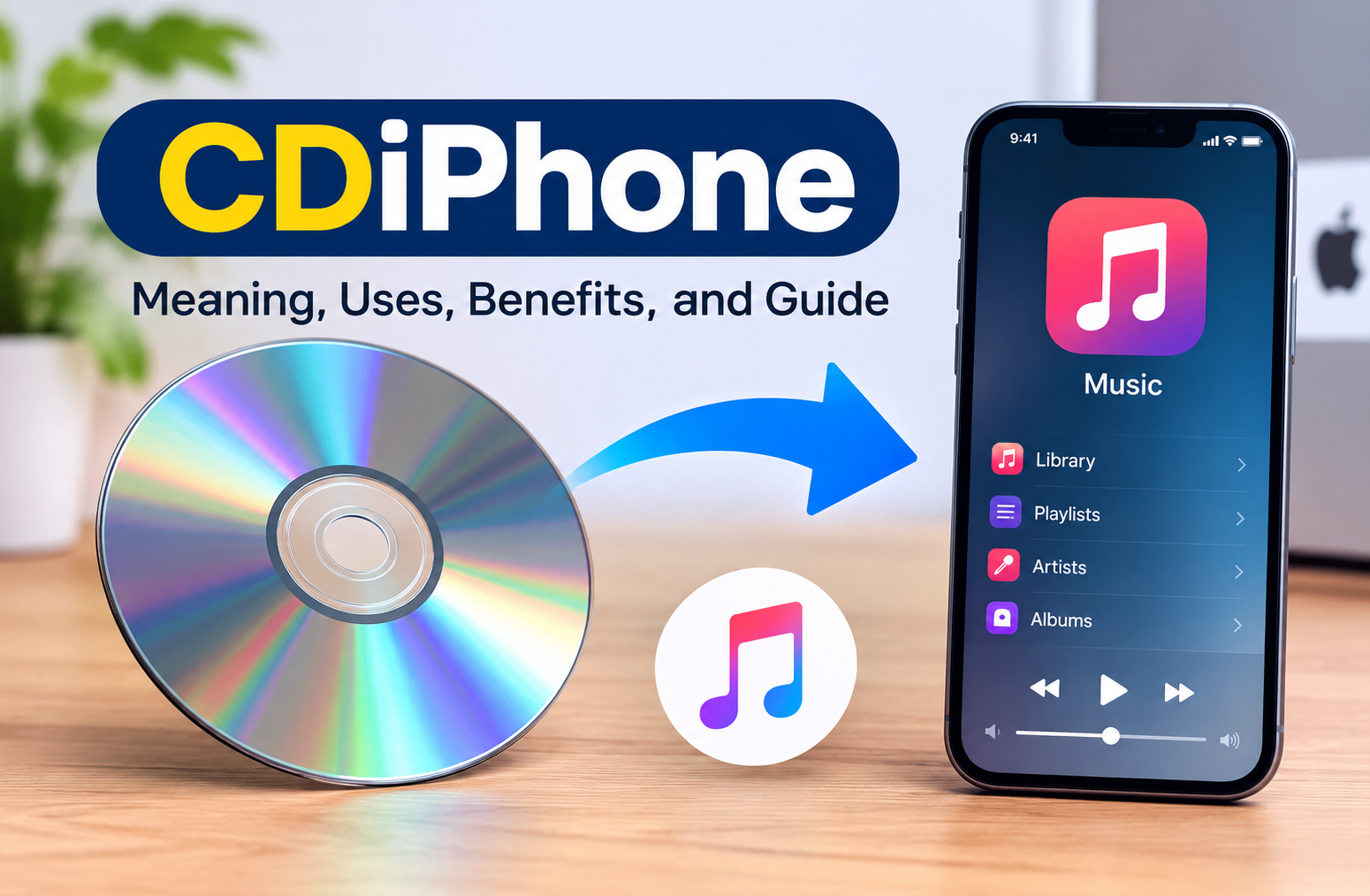
The first thing to understand is that CDiPhone is not a verified official Apple product, registered iPhone model, or recognized iOS feature. Instead, it is an informal term that appears in different online technology discussions. In many contexts, people associate it with moving music from traditional CDs to an iPhone. Other discussions use it to describe hypothetical technology that combines physical media with modern smartphone functionality. These interpretations should not be confused with confirmed Apple products or services.
Understanding the meaning behind this term requires looking at the history of compact discs, the development of smartphones, and the way people now manage digital entertainment. Although streaming platforms have changed how people listen to music, millions of music collections still exist on physical CDs. Many owners want to preserve those collections and enjoy their favorite albums through modern devices.
This guide explores the meaning of CDiPhone, its possible interpretations, its relationship with Apple technology, practical music-transfer methods, advantages, limitations, security considerations, and future possibilities. It also separates confirmed technical information from assumptions so readers can make informed decisions.
What Is CDiPhone?
CDiPhone is an informal technology-related term that combines the words CD and iPhone. It does not have one universally accepted technical definition, and Apple has not officially introduced a device or application under this name.
The meaning generally depends on the context in which someone uses it.
The term is commonly associated with three ideas:
- CD music transfer: Moving songs from physical compact discs to an iPhone through a computer.
- A hypothetical technology concept: An imagined device or system that combines traditional CD functionality with modern smartphone features.
- A general technology reference: An informal expression used in online discussions about physical media, digital music, and Apple’s mobile ecosystem.
These meanings are related, but they do not describe the same thing.
For example, transferring music from an audio CD to an iPhone is a real process that users can perform with compatible computer software. However, a smartphone with a built-in CD player is only a hypothetical concept in this context. There is no verified Apple product called CDiPhone.
This distinction is important because online articles sometimes describe unfamiliar technology terms as if they were official products. Readers should always look for manufacturer announcements, technical documentation, and reliable evidence before accepting claims about a new device.
What Does the Name CDiPhone Actually Mean?
To understand the expression, it helps to examine its two parts separately.
Understanding the CD Part
CD stands for compact disc. It is an optical storage format introduced commercially in the early 1980s.
Compact discs became popular because they provided a convenient way to distribute music in digital form. Unlike traditional vinyl records and cassette tapes, CDs use optical technology to store and reproduce digital information.
A standard audio CD can store approximately 74 to 80 minutes of music, depending on the disc format and recording specifications.
CD technology became widely used for:
- Music albums
- Software distribution
- Educational materials
- Audio recordings
- Personal data storage
- Multimedia content
One of the biggest advantages of CDs was their ability to provide consistent digital audio playback without the gradual physical degradation associated with repeatedly playing cassette tapes.
Although streaming services have reduced the everyday use of physical discs, CDs remain valuable to collectors, musicians, audiophiles, and people who prefer owning physical copies of their music.
Understanding the iPhone Part
The iPhone is Apple’s smartphone product line. Apple introduced the original iPhone in 2007, combining telephone communication, an internet-enabled interface, and digital media functionality in one device.
Modern iPhones offer a wide range of capabilities, including:
- Mobile communication
- Internet browsing
- Photography and video recording
- Music playback
- Application support
- Cloud synchronization
- Digital payments
- File management
- Entertainment and productivity tools
The iPhone changed how people accessed digital content. Instead of depending on separate music players, cameras, and communication devices, users could perform many activities through one smartphone.
When the terms CD and iPhone are combined, they naturally suggest a relationship between traditional physical music and modern mobile entertainment.
However, combining two familiar words does not automatically establish a new product or technical standard.
Is CDiPhone an Official Apple Product?
No verified evidence establishes CDiPhone as an official Apple product or iPhone model.
Apple has established product names, technical documentation, software releases, and official announcements for its devices. There is no confirmed product specification or official announcement identifying a device named CDiPhone.
This means readers should be careful when encountering websites that claim it is a newly released Apple smartphone.
Some unverified descriptions may suggest that it includes:
- A built-in CD or DVD player
- Special music-transfer technology
- Advanced artificial intelligence
- Unique storage capabilities
- A new operating system
- A dedicated optical-media interface
- Exclusive Apple hardware features
These claims should not be treated as facts without reliable documentation.
It is also important to understand that Apple does provide genuine tools for managing music and connecting devices. The absence of an official product called CDiPhone does not mean the underlying idea of using CD music on an iPhone is impossible.
In fact, users can already import audio tracks from physical CDs to a computer and transfer compatible music files to their iPhones.
The practical process uses existing technology rather than a separate smartphone model.
How CDiPhone Relates to Traditional Music and Modern Smartphones
The relationship between compact discs and smartphones reflects a much larger change in entertainment technology.
In the past, people purchased albums in physical formats. They kept their collections at home, carried portable CD players, and selected individual discs whenever they wanted to listen to music.
Smartphones introduced a different experience.
Instead of carrying multiple albums, users could store thousands of digital tracks in relatively small devices. Music applications also made it possible to discover new artists, organize playlists, and access large online music libraries.
However, this change did not make physical music collections irrelevant.
Many people still own CDs containing albums that are difficult to find on streaming platforms. Others prefer original album versions, specific recordings, or the experience of collecting physical releases.
This creates a practical connection between the two technologies.
A person can preserve an existing CD collection by converting its audio tracks into digital files and adding those files to a personal music library. The tracks can then be synchronized with a compatible iPhone.
This is the most useful real-world interpretation associated with CDiPhone.
How to Transfer Music From a CD to an iPhone
One of the most practical reasons people search for CDiPhone is to learn how they can listen to physical CD collections on an iPhone.
The process is straightforward when you have the right equipment and software.
An iPhone does not contain a built-in optical CD drive. Therefore, it cannot read a standard audio CD directly.
Instead, you need a computer with a CD or DVD drive. If your computer does not have one, a compatible external optical drive may provide the necessary hardware.
The process involves three main stages:
- Reading the audio tracks from the CD.
- Importing the tracks into a computer music library.
- Transferring or synchronizing the music with an iPhone.
Step 1: Prepare Your Equipment
Before starting, make sure you have the following:
- An audio CD containing the music you want.
- A Mac or Windows computer.
- A built-in or compatible external CD/DVD drive.
- A USB or USB-C cable for connecting your iPhone when required.
- Appropriate music-management software.
- Enough storage space on your computer and iPhone.
Check the condition of your disc before inserting it.
Scratches, dust, fingerprints, and physical damage can sometimes interfere with the reading process. A clean disc generally makes importing more reliable.
Use a soft, lint-free cloth to clean the disc gently. Avoid abrasive materials that could damage its surface.
Step 2: Import Music on a Mac
Mac users can use Apple’s Music application to import audio CDs into their music libraries.
The general process is:
- Connect an external CD/DVD drive if your Mac does not have a built-in drive.
- Insert the audio CD.
- Open the Music application.
- Select the CD from the available devices.
- Review the displayed track information.
- Select the songs you want to import.
- Choose the Import CD option.
- Wait for the import process to finish.
Apple’s Music application uses AAC as its default import format, although users can adjust the import settings to select another supported format.
If the application cannot identify the album automatically, tracks may appear with generic names such as Track 01 or Track 02.
You can correct this information manually by adding the appropriate song titles, artist names, and album details.
This step is useful because properly organized metadata makes a music library easier to navigate.
Step 3: Organize Your Digital Music Library
After importing the tracks, take some time to organize them.
A well-maintained music library makes the listening experience more enjoyable and reduces confusion when transferring multiple albums.
Consider organizing your collection using:
- Artist names
- Album titles
- Release years
- Music genres
- Custom playlists
- Track numbers
Check that every song has the correct title and artist information.
You should also listen to a few imported tracks before moving to the next stage. This helps identify possible reading errors, incomplete tracks, or incorrect metadata.
Step 4: Transfer Music to Your iPhone
The synchronization process depends on the computer and software version you are using.
On supported Mac systems, users can manage music synchronization through Finder and Apple’s music-management tools.
On Windows, Apple’s Devices application can be used to synchronize compatible music libraries with an iPhone.
The general Windows process is:
- Install the Apple Devices application and Apple Music application where required.
- Connect your iPhone to the computer using a compatible cable.
- Unlock your iPhone and approve the connection if requested.
- Open Apple Devices.
- Select your iPhone from the sidebar.
- Open the Music section.
- Choose whether to synchronize the entire music library or selected albums and playlists.
- Apply the synchronization settings.
- Wait for the transfer to finish.
The exact options can vary depending on software versions and music synchronization settings.
For a supported device and operating system, Apple’s official music synchronization instructions provide the relevant steps.
Step 5: Check the Music on Your iPhone
Once synchronization is complete, safely disconnect your iPhone.
Open the Music application and check whether the imported albums and songs appear correctly.
Play several tracks to confirm that:
- The songs open successfully.
- The audio plays without interruptions.
- Album artwork appears correctly when available.
- Track names are accurate.
- The correct artist information is displayed.
You can also create playlists containing music from multiple CDs.
For example, you might create separate playlists for classical music, old favorites, workout songs, or albums you want to listen to during travel.
This makes your physical collection much more convenient to access.
Can You Play a Physical CD Directly on an iPhone?
No. Standard iPhones do not include an internal optical CD or DVD drive.
A physical CD requires a compatible optical reading mechanism to access its stored information. An iPhone does not provide this hardware as part of its normal design.
This limitation is not necessarily a disadvantage.
Most modern smartphones focus on digital storage, wireless communication, and software-based entertainment rather than supporting older optical media directly.
If you want to listen to CD music, the practical solution is to import the tracks using a computer and then transfer the resulting digital files.
This approach also provides additional benefits.
For example, you can keep a backup of your music library, organize albums more easily, and listen to selected songs without carrying physical discs.
It is worth remembering that an external optical drive does not automatically make every iPhone capable of reading a CD. The computer generally needs to perform the importing process.
Main Benefits of the CDiPhone Concept
Although CDiPhone is not an official product, the connection between CD collections and iPhone technology offers several useful advantages.
1. Preserving Older Music Collections
Many music enthusiasts have spent years building physical collections.
Some albums contain rare recordings, special editions, or music that is no longer easily available through mainstream streaming services.
Digitizing these collections allows owners to preserve convenient copies of their music.
It can also reduce the need to repeatedly handle older discs.
However, digital copies should not be considered a replacement for maintaining and protecting the original physical media. Keeping both versions can provide additional protection against accidental loss.
2. Convenient Access to Personal Music
One of the biggest benefits of transferring music to a smartphone is convenience.
Instead of carrying multiple CDs, users can keep selected albums on their iPhones.
This is especially useful when traveling, exercising, commuting, or spending time away from home.
A properly organized music library can make thousands of songs easier to manage.
3. Offline Listening
Streaming platforms generally depend on an internet connection for online playback unless content has been downloaded in advance.
Imported music stored locally on an iPhone can usually be played without a continuous internet connection.
This is useful in locations where mobile coverage is weak or expensive.
It can also help users avoid unnecessary mobile data consumption when listening to their own music collection.
4. Greater Control Over Music Organization
Physical albums are organized according to their original packaging and track lists.
Digital libraries provide additional flexibility.
Users can create playlists, combine songs from different albums, update track information, and organize music according to personal preferences.
This makes large collections easier to explore.
5. Maintaining Access to Rare Recordings
Some older recordings may not be available on every streaming platform.
Regional restrictions, licensing agreements, and catalog changes can affect music availability.
A personal digital copy of a legitimately owned recording can provide another way to access that music.
This is particularly valuable for collectors who own recordings from independent artists, local music labels, or older releases.
6. Reducing Dependence on Streaming Services
Streaming platforms provide convenience, but they do not always offer the same sense of ownership as a personal music collection.
Subscriptions can change, catalogs can be updated, and individual tracks may become unavailable.
A locally stored music collection gives users more direct control over their files.
It does not eliminate every limitation, but it offers an alternative to relying entirely on online services.
Challenges and Limitations You Should Understand
The connection between CDs and smartphones is useful, but it also comes with practical limitations.
Understanding these issues helps users avoid unnecessary equipment purchases and software problems.
No Built-In CD Hardware
The biggest limitation is that an iPhone cannot directly read a standard audio CD.
Users need an additional computer and compatible optical drive.
This makes the process less immediate than downloading music through an application.
Storage Space Requirements
High-quality audio files require storage space.
A large collection containing hundreds of albums can take up a considerable amount of computer and smartphone storage.
Users should review available storage before transferring their entire collection.
One practical solution is to transfer only the albums they regularly listen to.
Another option is to maintain a larger music archive on a computer or external storage device.
Software Compatibility
Different operating systems use different applications and synchronization methods.
A process that works on one Mac or Windows configuration may not work in exactly the same way on another.
Software updates can also change menus and available features.
Always check that the applications you are using support your computer and iPhone software versions.
Audio Import Quality
The selected import format can influence file size and audio quality.
Compressed formats such as AAC reduce storage requirements, while lossless formats preserve more of the original audio information.
The best option depends on your priorities.
If storage space matters most, a suitable compressed format may be practical. If maintaining the original audio quality is more important, consider a lossless format supported by your music-management software and playback setup.
Metadata Problems
Imported music does not always receive accurate album information.
Some discs may display incomplete track names or incorrect artist details.
This can create a messy library, especially when importing dozens of albums.
Checking metadata during the importing process saves time later.
Physical Disc Damage
Old CDs may contain scratches or other damage that affects reading performance.
Some tracks may import successfully while others produce errors.
If an imported recording sounds unusual, try reading the disc again with error correction enabled when supported.
If problems continue, the disc itself may be damaged.
CDiPhone and Audio Quality: What Should Users Know?
Audio quality is an important consideration when converting physical music into digital files.
The process of importing a CD involves reading its digital audio data and saving it in a selected file format.
Different formats offer different balances between audio quality, compatibility, and storage requirements.
Compressed Audio Formats
Compressed formats reduce file size by using methods that remove or simplify some audio information.
AAC is commonly used within Apple’s music ecosystem.
Its advantages include:
- Smaller file sizes
- Convenient storage
- Broad compatibility with Apple devices
- Practical playback for everyday listening
For many users, a properly encoded AAC file provides a satisfactory listening experience.
Lossless Audio Formats
Lossless formats preserve the original audio information during encoding.
They are useful for listeners who want to maintain the source recording’s audio data.
Common examples include:
- ALAC
- FLAC
- WAV
- AIFF
Not every format offers the same storage efficiency or native support across every application.
ALAC is particularly relevant to Apple users because it is Apple’s lossless audio format.
Which Format Should You Choose?
There is no single best format for every listener.
Consider these factors before importing a large collection:
| Priority | Practical consideration |
| Smaller storage requirements | Consider AAC |
| Preserving audio data | Consider ALAC |
| Everyday mobile listening | Choose a compatible format |
| Long-term music archiving | Keep a high-quality master copy |
| Easy library management | Use consistent formats and metadata |
A sensible approach is to keep a high-quality master archive on your computer and transfer smaller files to your iPhone when storage is limited.
Is CDiPhone Useful for Music Collectors?
The idea is particularly relevant to people who own extensive physical music collections.
Music collectors often have different reasons for keeping CDs.
Some enjoy the original album artwork and packaging. Others value physical ownership, limited editions, or recordings that are difficult to find elsewhere.
Digitization provides a way to combine the advantages of traditional collections with the convenience of modern devices.
For example, imagine someone owns 150 music albums from different decades.
Carrying those discs while traveling would be inconvenient. However, importing selected albums into a digital library allows that person to access favorite recordings through an iPhone.
The original discs remain available as physical collectibles, while digital copies provide everyday convenience.
This is a practical example of how older media can remain useful alongside newer technology.
CDiPhone Compared With Music Streaming Services
CD-based music collections and streaming platforms offer different experiences.
Neither approach is automatically better for every user.
| Feature | Imported CD music | Streaming services |
| Original physical ownership | Yes, when the CD is owned | Depends on the service and subscription |
| Internet required for local playback | No | Usually not after downloading eligible content |
| Music selection | Limited to your collection | Large online catalogs |
| Monthly subscription | Not required for local files | Often required for premium features |
| Personal organization | Highly customizable | Depends on the platform |
| Rare recordings | Useful for preserving existing collections | Availability varies |
| Initial setup | Requires importing and transferring | Usually simpler |
Why Some People Prefer Imported Music
Imported CD music can be attractive to people who value control over their personal libraries.
They can decide which albums to keep, how to organize them, and which tracks to transfer to their devices.
It also provides an alternative when a particular album is unavailable through a streaming platform.
Why Streaming Remains Popular
Streaming services offer convenience and access to large catalogs.
Users can explore unfamiliar artists, discover playlists, and listen to music without first collecting individual albums.
For many people, streaming is the easiest way to enjoy music regularly.
Can Both Methods Work Together?
Yes.
Users can maintain a personal library of imported CD tracks while also using a streaming service.
However, synchronization settings and subscription features can affect how personal files are managed.
It is important to understand the settings of the applications being used so that locally imported music is not accidentally removed or replaced during synchronization.
Common Problems When Transferring CD Music to an iPhone
Even a straightforward importing process can occasionally produce problems.
Most issues are related to hardware recognition, software settings, file compatibility, or synchronization.
The Computer Cannot Read the CD
Possible reasons include:
- A dirty or scratched disc.
- A disconnected external optical drive.
- An incompatible drive.
- An outdated device driver.
- A damaged CD.
Try another disc to determine whether the problem comes from the drive or the original CD.
Music Does Not Appear on the iPhone
If imported songs do not appear after synchronization, check that the correct albums and playlists were selected.
Also confirm that synchronization completed successfully.
On Windows, check the selected device and Music synchronization settings in Apple Devices.
On supported Mac systems, review the Finder and Music synchronization settings.
Songs Have Incorrect Names
If the importing application cannot identify the disc, it may display generic track numbers.
You can manually edit the song information before synchronization.
This is particularly important when working with albums that have unusual titles or limited online metadata.
Audio Contains Clicking or Popping Sounds
Unusual sounds can indicate that the optical drive did not read the CD correctly.
Check the physical condition of the disc and try importing the affected songs again.
Where available, enable error correction in the importing application’s settings.
The iPhone Does Not Have Enough Storage
If the music library is larger than the available storage, select only the albums you need.
You can also remove unused downloads or other unnecessary files after reviewing your storage settings.
Avoid deleting important personal data just to make room for music.
Is CDiPhone Safe to Use?
The term itself is not software that users can install, so it does not have a separate safety rating.
The safety question usually concerns websites, applications, or accessories advertised using this name.
Because there is no verified official Apple application called CDiPhone, users should be cautious about unfamiliar downloads claiming to provide special CDiPhone functionality.
Before installing software, consider the following:
- Check the developer’s identity.
- Download applications from trusted sources.
- Review the permissions requested by the application.
- Avoid installing unknown configuration profiles.
- Never share Apple Account passwords with unfamiliar websites.
- Avoid connecting devices to untrusted computers.
- Keep your iPhone and computer software updated.
Be especially careful with websites claiming that a special download can unlock hidden Apple features or provide access to secret hardware functions.
A genuine technical tool should have a clear developer, documented purpose, and reliable support information.
There is no reason to install an unfamiliar application simply to import music from a CD. Existing music-management tools are generally sufficient for this task.
Understanding CDiPhone as a Hypothetical Technology Concept
Beyond music transfer, the expression can also be used to describe an imagined combination of traditional optical media and smartphone technology.
This idea is interesting because it connects two different periods in consumer electronics.
CD players were designed around physical media. Smartphones are designed around digital files, wireless communication, and software applications.
A hypothetical device combining these technologies might offer:
- Physical media playback.
- Digital music storage.
- Mobile connectivity.
- Music organization.
- Offline entertainment.
- Wireless audio output.
However, these are possible concept features, not verified specifications of an existing Apple device.
Why Would Anyone Want a Smartphone With CD Functionality?
A physical-media smartphone could appeal to people who enjoy collecting albums and prefer direct access to their recordings.
It might also provide an interesting alternative for people who want to combine traditional music ownership with modern portable technology.
However, there would be significant design challenges.
Optical drives require physical space and mechanical components. They also consume power and introduce moving parts into a device that is generally expected to be lightweight and durable.
These considerations help explain why transferring CD music to a smartphone is more practical than expecting a conventional iPhone to contain a built-in disc player.
How to Make Your CD Music Collection Easier to Manage
If your main interest is preserving music from CDs, a little planning can improve the entire experience.
Create a Master Music Folder
Start by creating one main folder for your imported albums.
Inside it, organize music according to artist and album names.
A consistent structure makes it easier to locate files and maintain backups.
Use Consistent File Names
Avoid confusing names such as Song1 or Track2.
Use clear naming conventions that include the artist, album, and track title when appropriate.
This reduces the risk of duplicate files and makes library management easier.
Keep a Separate Backup
Do not rely entirely on your iPhone as the only location for your music.
A phone can be lost, damaged, or replaced.
Keep an additional copy on a computer or external storage device.
For particularly valuable collections, consider maintaining more than one backup in separate locations.
Review Audio Formats
Check the format used for imported tracks.
If you plan to maintain a long-term archive, consider using a lossless format supported by your software.
For everyday listening, you may prefer smaller files to conserve smartphone storage.
Update Album Information
Correct artist names, track titles, album artwork, and release information where possible.
These details make a personal library easier to browse and help avoid confusion between different versions of the same recording.
Who Can Benefit From the CDiPhone Approach?
The practical connection between CDs and iPhones can help several types of users.
Music Collectors
Collectors can preserve convenient digital copies of their existing albums while maintaining their physical collections.
Frequent Travelers
Travelers can transfer favorite albums to their phones and listen without relying on a continuous internet connection.
People With Limited Internet Access
Locally stored music can be useful in places where reliable internet access is unavailable.
Fans of Older Music
Some older recordings are difficult to locate on modern streaming services.
Digitizing an existing collection can make these recordings easier to access.
Everyday Smartphone Users
Even people without extensive collections may own a few CDs containing favorite albums.
Transferring selected tracks provides a convenient way to keep that music available.
The Future of Physical Music and Smartphone Technology
Digital entertainment continues to develop, but the existence of newer technology does not automatically make older formats useless.
Physical music collections still have cultural, personal, and practical value.
Vinyl records have maintained a strong collector market, and CDs continue to appeal to people who appreciate physical ownership and album collections.
At the same time, smartphones have become central to everyday entertainment.
They provide portable access to digital libraries, wireless headphones, music applications, and offline downloads.
The future is therefore likely to involve multiple ways of accessing music rather than one format completely replacing every other option.
For people interested in CDiPhone, the most realistic opportunity is the continued integration of personal media collections with modern digital devices.
Better file organization, improved storage options, reliable synchronization, and high-quality audio formats can make that experience increasingly convenient.
It is also possible that future accessories and software will make it easier to work with physical media. However, such possibilities should not be mistaken for confirmed Apple announcements.
The most useful approach today is to understand the tools that already exist and use them to preserve personal music collections safely.
Frequently Asked Questions About CDiPhone
1. What is CDiPhone?
CDiPhone is an informal technology-related term combining CD and iPhone. It is commonly associated with transferring music from compact discs to an iPhone, although some online discussions use it for hypothetical technology concepts. It is not an officially recognized Apple product.
2. Is CDiPhone a real Apple smartphone?
No. There is no verified Apple smartphone officially named CDiPhone. Apple has not published an official product announcement or specification for a device with this name.
3. Can I play a CD directly on my iPhone?
No. Standard iPhones do not have built-in optical CD drives. You need a compatible computer and CD/DVD drive to import audio tracks before transferring the resulting digital files to your iPhone.
4. How can I transfer music from a CD to an iPhone?
Insert the CD into a compatible computer drive, import the audio tracks using suitable music software, and synchronize the resulting files with your iPhone. Mac and Windows users have different synchronization options depending on their software versions.
5. Do I need a special CDiPhone application?
No. There is no verified official CDiPhone application required for transferring music. Existing Apple music-management applications and synchronization tools can handle compatible personal music files.
6. Is CDiPhone related to CDMA iPhone technology?
There is no verified connection between the two terms. CDMA stands for Code Division Multiple Access, a mobile network technology used by some older iPhone models. CDiPhone is an informal expression generally associated with CDs and iPhone technology.
7. Can I listen to imported CD music without internet access?
Yes. Once compatible music files are stored locally on your iPhone, you can generally play them without an internet connection. This makes imported music useful for travel and locations with limited connectivity.
8. Is transferring CD music to an iPhone legal?
Importing music from CDs you own for personal use depends on the copyright laws and exceptions applicable in your country. Ownership of a physical CD does not automatically grant permission to distribute or share unauthorized copies. Avoid uploading copyrighted recordings without the necessary rights.
9. Does transferring CD music reduce audio quality?
It depends on the selected import format and settings. Lossless formats can preserve the original audio information, while lossy formats such as AAC reduce file size by removing some audio information. The choice depends on your storage needs and listening preferences.
10. Is CDiPhone worth exploring?
The concept is worth exploring if you own physical music collections and want convenient digital access to them. Rather than searching for an unverified product, users can achieve the practical goal with existing computer hardware and supported music-management software.
Conclusion
CDiPhone is an interesting term because it connects traditional compact disc technology with the modern smartphone experience. However, it is important to understand that the name does not represent a verified Apple product, official iPhone model, or recognized iOS feature.
Its most practical interpretation involves transferring music from physical CDs to an iPhone through a compatible computer. This process allows music collectors and everyday users to preserve existing recordings, organize personal libraries, and enjoy their favorite albums without carrying physical discs.
The approach also offers several benefits, including offline playback, greater control over personal music collections, and convenient access to recordings that may not be available through streaming services.
There are some limitations, such as the need for an optical drive, sufficient storage, compatible software, and proper synchronization settings. Nevertheless, these challenges are manageable when users follow a reliable process and maintain appropriate backups.
Ultimately, the value of this technology-related concept comes from combining the lasting appeal of physical music with the convenience of modern digital devices. Understanding what is confirmed, what is hypothetical, and which tools are already available helps readers make better decisions without being misled by unsupported product claims.