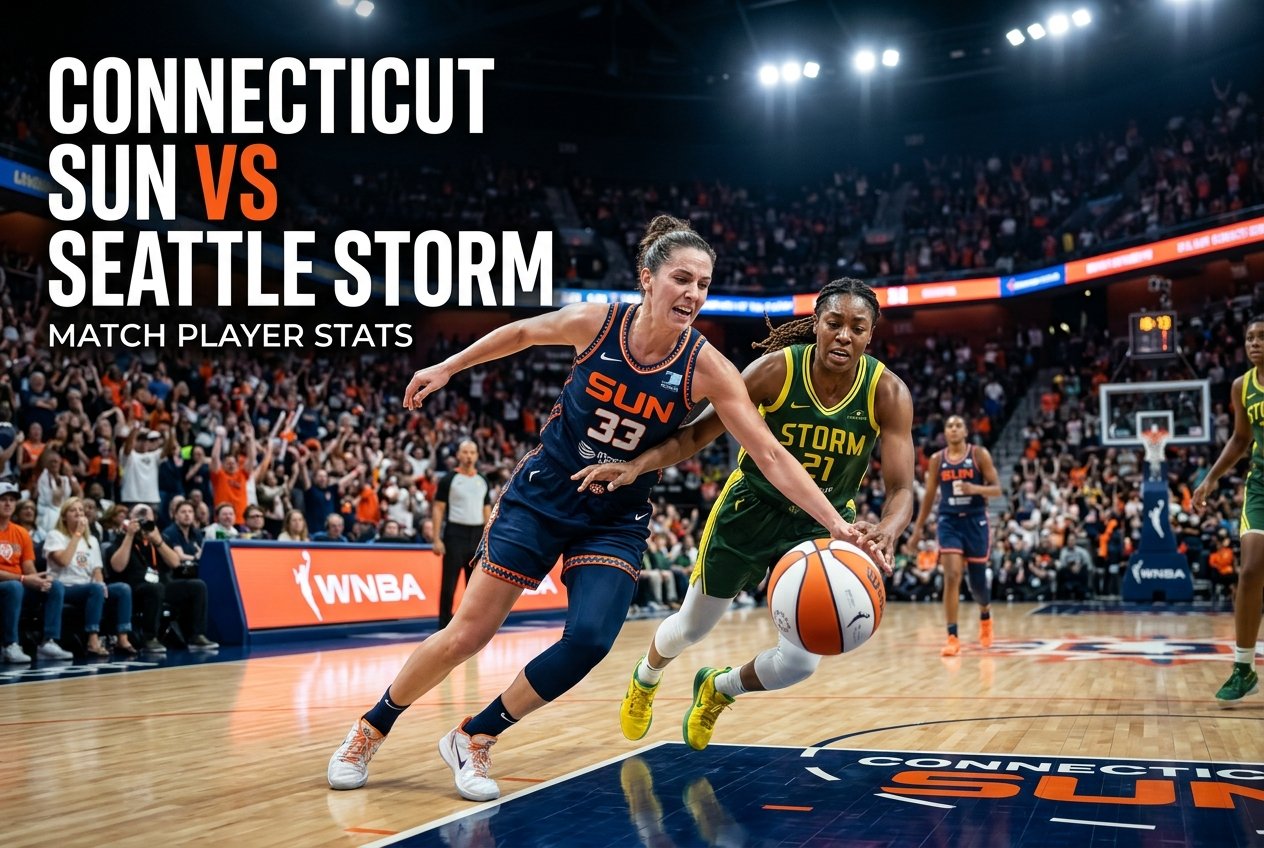
Connecticut Sun vs Seattle Storm Match Player Stats
The connecticut sun vs seattle storm match player stats reveal how the Seattle Storm turned an early deficit into a convincing 77-59 victory over the Connecticut Sun on May 22, 2026, at Climate Pledge Arena in Seattle. Zia Cooke delivered a career-high 25 points, Flau’jae Johnson added 17 points, seven rebounds, and five assists, and Seattle produced a strong defensive performance to secure an important home win. Connecticut struggled to maintain its first-quarter momentum, scoring only seven points in the second quarter and finishing the contest with considerably weaker shooting numbers.
The matchup was particularly interesting because Connecticut initially appeared capable of controlling the game. The Sun scored 21 points in the opening period, but Seattle responded with better ball movement, more efficient shooting, and stronger defensive pressure. The Storm gradually established control and finished the fourth quarter with a commanding 24-16 scoring advantage.
For basketball fans looking beyond the final score, this game offers several important statistical details. Cooke’s scoring efficiency, Johnson’s all-around contribution, Natisha Hiedeman’s playmaking, and Seattle’s advantage in shooting percentages all help explain why the Storm won by 18 points. Connecticut had some encouraging individual performances, particularly from Diamond Miller and Aaliyah Edwards, but the team’s offensive production was not consistent enough to challenge Seattle throughout the game.
This article examines the complete matchup, individual player contributions, team statistics, quarter-by-quarter scoring, important turning points, and the wider significance of the result. It also explains which numbers mattered most and what the performances reveal about both teams.
Connecticut Sun vs Seattle Storm Match Player Stats: Game Overview
The Seattle Storm defeated the Connecticut Sun 77-59 in their 2026 WNBA regular-season matchup. The game took place at Climate Pledge Arena, where Seattle recovered from a two-point first-quarter deficit and gradually built an advantage that Connecticut could not overcome.
The most significant individual performance came from Zia Cooke. Coming off the bench, she scored 25 points in approximately 24 minutes. Her ability to create scoring opportunities and convert free throws gave Seattle an offensive advantage during important stretches.
Flau’jae Johnson also played an important role. The rookie contributed across several statistical categories, showing that her value extended beyond scoring. Her seven rebounds, five assists, and three blocks helped Seattle maintain control on both ends of the court.
For Connecticut, Diamond Miller led the team with 13 points, while Aaliyah Edwards finished with 10 points and seven rebounds. Both players provided useful offensive production, but the Sun struggled to receive enough consistent scoring support from the rest of the lineup.
Match Information
| Match Detail | Information |
| Matchup | Connecticut Sun vs Seattle Storm |
| Competition | 2026 WNBA regular season |
| Game date | May 22, 2026 |
| Final score | Seattle Storm 77-59 Connecticut Sun |
| Venue | Climate Pledge Arena |
| Location | Seattle, Washington |
| Attendance | 9,741 |
| Television coverage | ION |
| Streaming | WNBA League Pass |
| Winning team | Seattle Storm |
| Winning margin | 18 points |
The game is listed as May 22 in the official WNBA schedule, although some international score services display May 23 because of time-zone differences. This distinction is useful when searching for historical results.
The official WNBA box score and player statistics provide the primary reference for the matchup.
Final Score and Quarter-by-Quarter Results
Seattle did not dominate from the opening tip. Connecticut started more confidently and established an early scoring advantage. However, the second quarter completely changed the direction of the contest.
| Quarter | Connecticut Sun | Seattle Storm |
| First Quarter | 21 | 19 |
| Second Quarter | 7 | 18 |
| Third Quarter | 15 | 16 |
| Fourth Quarter | 16 | 24 |
| Final Score | 59 | 77 |
The most important period was the second quarter. Seattle scored 18 points while restricting Connecticut to just seven. That 11-point difference transformed a two-point deficit into a nine-point halftime advantage.
Seattle then maintained its lead in the third quarter before producing its strongest scoring period in the fourth.
The final 18-point margin reflected more than one strong offensive performance. It was the result of improved defensive organization, better shooting efficiency, and contributions from several Seattle players.
Seattle Storm Player Stats and Individual Performances
Seattle’s victory was built around a combination of individual scoring and team-oriented basketball. Zia Cooke supplied the biggest scoring contribution, but Johnson, Hiedeman, and several supporting players helped create the overall statistical advantage.
Zia Cooke: 25 Points and a Career-High Performance
Seattle’s leading scorer
Zia Cooke delivered the standout offensive performance of the evening, finishing with 25 points in approximately 24 minutes.
Her shooting numbers demonstrated why she was such an important part of Seattle’s offensive success.
| Statistical Category | Zia Cooke |
| Points | 25 |
| Rebounds | 5 |
| Assists | 1 |
| Steals | 1 |
| Blocks | 0 |
| Field Goals | 7/14 |
| Three-Pointers | 2/6 |
| Free Throws | 9/10 |
| Minutes | 24 |
| Plus/Minus | +18 |
Cooke’s 50% field-goal shooting was particularly valuable. She converted seven of her 14 attempts, including two successful three-pointers.
Her free-throw performance was equally important. Nine successful attempts from the line helped her reach 25 points without needing an unusually high number of field-goal attempts.
One interesting aspect of her performance was the impact of her minutes. Scoring 25 points in approximately 24 minutes demonstrated how quickly she could generate offense when given opportunities.
Cooke also contributed five rebounds and one steal. Although her primary responsibility was scoring, she remained involved in other areas of the game.
Her performance was especially important because Seattle needed reliable offensive production after Connecticut had started the game strongly.
Flau’jae Johnson: 17 Points, 7 Rebounds, and 5 Assists
Flau’jae Johnson delivered one of her most complete performances of the season.
The rookie recorded 17 points, seven rebounds, five assists, and three blocks. Her contribution was important because Seattle received production in several different areas rather than depending exclusively on scoring.
| Statistical Category | Flau’jae Johnson |
| Points | 17 |
| Rebounds | 7 |
| Assists | 5 |
| Steals | 0 |
| Blocks | 3 |
| Field Goals | 7/12 |
| Three-Pointers | 3/6 |
| Free Throws | 0/0 |
| Minutes | 31 |
| Plus/Minus | +18 |
Johnson converted seven of her 12 field-goal attempts, producing an impressive shooting percentage of approximately 58%.
Her three-point shooting was another important element. She made three of six attempts from beyond the arc, giving Seattle an additional scoring threat.
The five assists demonstrated her ability to create opportunities for teammates. Instead of forcing difficult shots, she also helped move the offense and find better scoring positions.
Her three blocks were particularly valuable. Defensive statistics do not always receive as much attention as points and assists, but Johnson’s rim protection helped Seattle challenge Connecticut’s attempts around the basket.
The combination of scoring, rebounding, passing, and shot-blocking made her one of the most influential players in the game.
Natisha Hiedeman: Important Backcourt Playmaking
Natisha Hiedeman contributed 11 points and six assists.
Her performance was important because Seattle needed a player capable of connecting its scoring options and organizing offensive possessions.
| Statistical Category | Natisha Hiedeman |
| Points | 11 |
| Rebounds | 2 |
| Assists | 6 |
| Steals | 0 |
| Blocks | 0 |
| Field Goals | 4/10 |
| Three-Pointers | 1/4 |
| Free Throws | 2/2 |
| Turnovers | 1 |
Hiedeman’s six assists represented the highest individual assist total for Seattle.
Her contribution also demonstrated why a player’s influence cannot be measured by scoring alone. The ability to create opportunities for Cooke, Johnson, and other teammates helped Seattle produce 22 total assists.
She gave the Storm a useful combination of scoring and playmaking from the backcourt.
Jordan Horston: Defensive Pressure and Eight Points
Jordan Horston finished with eight points, four rebounds, and three steals.
Her three steals were especially important because they helped Seattle disrupt Connecticut’s offensive rhythm.
Horston also provided defensive activity away from the ball. Her contribution helped the Storm create difficult possessions for Connecticut rather than allowing the Sun to establish comfortable offensive positions.
Although eight points did not make her one of the game’s leading scorers, her defensive production added value to Seattle’s overall performance.
Stefanie Dolson: Efficient Shooting and Strong Plus/Minus
Stefanie Dolson recorded five points, four rebounds, four assists, and one steal.
Her statistical contribution was balanced, particularly considering her role in helping Seattle maintain offensive organization.
One notable figure was her reported +24 plus/minus, the highest individual figure shown among Seattle’s players.
Plus/minus measures the team’s scoring difference while a player is on the court. It does not prove that one player personally caused every scoring advantage, but it provides useful context when evaluating lineup performance.
Dolson’s ability to contribute rebounds, assists, and efficient shooting helped Seattle maintain its advantage.
Other Seattle Storm Player Contributions
Seattle also received useful production from its bench and supporting lineup.
| Player | Points | Rebounds | Assists | Additional Contribution |
| Jade Melbourne | 4 | 3 | 4 | 2 steals |
| Joyner Holmes | 2 | 5 | 1 | 3 blocks |
| Mackenzie Holmes | 2 | 6 | 1 | 1 block |
| Lexie Brown | 3 | 1 | 0 | Made her only field-goal attempt |
| Taylor Thierry | 0 | 1 | 0 | Played approximately 4 minutes |
These contributions demonstrate the importance of Seattle’s supporting players.
Jade Melbourne provided four assists and two steals, while Joyner Holmes added three blocks. Mackenzie Holmes contributed six rebounds, helping the Storm maintain their advantage on the boards.
Lexie Brown also converted her only field-goal attempt, a three-pointer.
Seattle’s victory was therefore not simply a result of Cooke’s scoring. Several players contributed in ways that supported the team’s overall performance.
Connecticut Sun Player Stats and Individual Performances
Connecticut had several players produce respectable individual numbers, but the team struggled to maintain offensive consistency.
The Sun’s biggest problem was not a complete lack of scoring options. Instead, the challenge was converting individual contributions into sustained team offense.
Diamond Miller led the team with 13 points, while Aaliyah Edwards added 10 points and seven rebounds. Other players contributed smaller scoring totals, but Connecticut could not match Seattle’s offensive efficiency.
Diamond Miller: Connecticut’s Leading Scorer
Diamond Miller was Connecticut’s leading scorer, finishing with 13 points.
She made three of her six field-goal attempts and converted seven of eight free throws. Her ability to draw fouls helped her remain productive even when Connecticut struggled to generate easy scoring opportunities.
| Statistical Category | Diamond Miller |
| Points | 13 |
| Rebounds | 3 |
| Assists | 2 |
| Steals | 2 |
| Blocks | 0 |
| Field Goals | 3/6 |
| Three-Pointers | 0/1 |
| Free Throws | 7/8 |
Miller’s 50% field-goal shooting was one of the more efficient individual performances for Connecticut.
She also recorded two steals, showing that her contribution extended beyond offense.
However, Miller needed more consistent support from her teammates. Thirteen points represented a meaningful contribution, but Seattle had multiple players capable of producing double-digit scoring totals.
Aaliyah Edwards: 10 Points and 7 Rebounds
Aaliyah Edwards provided Connecticut with a valuable interior presence.
She finished with 10 points, seven rebounds, two assists, two steals, and one block.
| Statistical Category | Aaliyah Edwards |
| Points | 10 |
| Rebounds | 7 |
| Assists | 2 |
| Steals | 2 |
| Blocks | 1 |
| Field Goals | 5/11 |
| Field-Goal Percentage | 45.5% |
Edwards converted five of her 11 attempts from the field.
Her seven rebounds were especially important because Connecticut needed additional possessions and second-chance opportunities.
She also contributed defensively with two steals and one block.
Although Edwards produced a solid individual performance, Seattle’s collective defensive effort made it difficult for Connecticut to turn its interior opportunities into consistent scoring.
Kennedy Burke: Seven Points and Defensive Activity
Kennedy Burke finished with seven points, three rebounds, one assist, one steal, and one block.
Her contribution was relatively balanced, with defensive activity complementing her scoring.
Burke made three of nine field-goal attempts and converted one three-pointer.
Her seven points helped Connecticut maintain some offensive production, but the Sun needed greater efficiency from their supporting players.
Charlisse Leger-Walker: Five Assists and Playmaking Responsibility
Charlisse Leger-Walker contributed five points, three rebounds, and five assists.
Her five assists were particularly important because they represented Connecticut’s highest individual assist total.
Leger-Walker helped organize the offense and create opportunities for other players.
However, Connecticut’s overall shooting performance limited the value of those opportunities. Passing can create open shots, but teammates still need to convert them.
Her contribution illustrates the difference between creating scoring chances and successfully finishing offensive possessions.
Gianna Kneepkens: Four Points
Gianna Kneepkens recorded four points and one rebound.
She made two of her five field-goal attempts and provided another scoring option in Connecticut’s lineup.
Although her statistical contribution was limited, her presence gave the Sun an additional perimeter option.
Aneesah Morrow: Seven Points Off the Bench
Aneesah Morrow provided seven points and six rebounds as a reserve.
Her rebounding contribution was particularly useful because Connecticut needed more activity around the basket.
Morrow’s seven points also helped the Sun receive some offensive support from the bench.
However, the team’s overall scoring production remained below Seattle’s level.
Hailey Van Lith: Five Points in Limited Minutes
Hailey Van Lith scored five points in approximately 10 minutes.
She converted two of her five field-goal attempts and provided Connecticut with additional backcourt scoring.
Her limited playing time meant that her overall statistical contribution was relatively small, but she made a useful contribution when on the floor.
Other Connecticut Sun Player Contributions
The remaining Connecticut players provided additional support in different areas.
| Player | Points | Rebounds | Assists | Additional Contribution |
| Raegan Beers | 4 | 4 | Not specified | Interior presence |
| Nell Angloma | 2 | 3 | Not specified | Bench contribution |
| Saniya Rivers | 2 | 2 | 2 | 1 steal |
| Ashlon Jackson | 0 | Not specified | Not specified | Played approximately 9 minutes |
These performances demonstrate that Connecticut had contributions from several players, even though the overall offensive production was insufficient.
Connecticut Sun Players Who Missed the Game
Player availability also influenced the matchup.
The supplied game information lists the following Connecticut players as unavailable:
- Brittney Griner: Right rib injury.
- Olivia Nelson-Ododa: Right ankle sprain.
Griner’s absence was particularly relevant because of her experience and interior presence.
Without her, Connecticut had fewer established options in the center position. That placed additional responsibility on players such as Edwards and Beers.
It is important not to assume that injuries alone explain the defeat. Seattle also executed its offensive and defensive responsibilities effectively. Nevertheless, player availability provides useful context when evaluating the team’s performance.
Complete Team Statistical Comparison
The team statistics provide a clearer explanation of why Seattle won.
The Storm performed better in field-goal shooting, three-point shooting, free-throw efficiency, assists, and blocks.
Connecticut did produce more steals and committed fewer turnovers, but those advantages were not enough to compensate for its offensive difficulties.
| Statistical Category | Connecticut Sun | Seattle Storm |
| Final Points | 59 | 77 |
| Field Goals | 23/62 | 28/60 |
| Field-Goal Percentage | 37% | 47% |
| Three-Pointers | 4/17 | 8/21 |
| Three-Point Percentage | 24% | 38% |
| Free Throws | 9/14 | 13/17 |
| Free-Throw Percentage | 64% | 76% |
| Assists | 15 | 22 |
| Turnovers | 12 | 15 |
| Steals | 9 | 7 |
| Blocks | 3 | 7 |
| Offensive Rebounds | 8 | 6 |
| Personal Fouls | 18 | 18 |
Note: Rebound totals differ across some third-party statistical summaries. The individual player figures and the official box score should take priority when checking exact totals.
1. Field-Goal Percentage: Seattle’s Biggest Advantage
Seattle converted 28 of 60 field-goal attempts, finishing at approximately 47%.
Connecticut made 23 of 62 attempts, producing a shooting percentage of approximately 37%.
This 10-percentage-point difference was one of the most important factors in the result.
Seattle did not need significantly more attempts to produce a much higher scoring total. Instead, it converted a greater percentage of its opportunities.
That efficiency allowed the Storm to build their advantage without depending entirely on offensive rebounds or transition scoring.
Connecticut, meanwhile, struggled to convert enough possessions into points.
2. Three-Point Shooting: The Storm Created More Spacing
Three-point shooting was another major difference.
Seattle made eight of 21 attempts, while Connecticut converted only four of 17.
| Three-Point Statistic | Connecticut | Seattle |
| Successful Attempts | 4 | 8 |
| Total Attempts | 17 | 21 |
| Shooting Percentage | 24% | 38% |
Seattle made twice as many three-pointers as Connecticut.
This difference mattered because perimeter shooting can change how a defense positions itself.
When opponents respect outside shooting, defenders must cover more space. That can create additional opportunities for drives, cuts, and interior passes.
Seattle’s improved perimeter accuracy gave its offense more flexibility.
3. Free-Throw Shooting: Cooke Made the Difference
Seattle converted 13 of 17 free throws, while Connecticut made nine of 14.
The Storm’s 76% free-throw percentage compared with the Sun’s 64%.
Cooke was particularly effective, making nine of her 10 attempts.
Those free throws represented a substantial part of her 25-point performance.
In a game where Connecticut was already struggling to score, Seattle’s ability to convert opportunities at the line helped prevent the Sun from reducing the deficit.
4. Assists: Seattle Moved the Ball More Effectively
Seattle recorded 22 assists compared with Connecticut’s 15.
This seven-assist advantage provides useful insight into the offensive difference between the teams.
The Storm had multiple players involved in creating scoring opportunities.
Hiedeman contributed six assists, Johnson recorded five, and Melbourne added four.
Connecticut also had individual playmaking contributions, particularly from Leger-Walker, who recorded five assists.
However, the team’s total remained lower.
The difference suggests that Seattle produced more successful assisted scoring opportunities throughout the game.
5. Turnovers: Connecticut Had a Small Advantage
Seattle committed 15 turnovers, while Connecticut recorded 12.
This was one statistical category in which the Sun performed better.
Turnovers are important because they can prevent teams from taking shots and give opponents additional transition opportunities.
However, Connecticut did not convert this advantage into enough points to change the result.
Seattle’s better shooting efficiency and stronger offensive production outweighed its additional turnovers.
6. Steals and Blocks: Different Defensive Strengths
Connecticut recorded nine steals compared with Seattle’s seven.
The Sun therefore generated more defensive takeaways.
Seattle, however, recorded seven blocks, compared with Connecticut’s three.
Johnson’s three blocks and Joyner Holmes’ three blocks were important individual contributions.
This difference suggests that Seattle provided stronger rim protection, while Connecticut generated more defensive activity through steals.
Both statistics offer different perspectives on defensive performance.
Why Seattle Storm Defeated Connecticut Sun
The final score tells us which team won, but the underlying numbers explain how the result developed.
Seattle’s victory came from several connected factors rather than one isolated performance.
The Second Quarter Changed the Game
Connecticut entered the second quarter with a 21-19 lead.
However, Seattle outscored the Sun 18-7 during that period.
This was the game’s most important scoring swing.
The Storm improved their defensive pressure and limited Connecticut’s opportunities.
The Sun managed only seven points, allowing Seattle to move ahead 37-28 by halftime.
An 11-point advantage in a single quarter can completely change a basketball game, especially when the team trailing has difficulty finding consistent scoring options.
Zia Cooke Provided Immediate Offensive Production
Cooke’s 25 points were central to Seattle’s victory.
Her scoring gave the Storm an offensive option capable of producing points without requiring every possession to involve a complicated sequence.
She also made nine free throws, helping Seattle maintain its advantage.
Her performance was particularly valuable because she produced a career-high scoring total in limited minutes.
Flau’jae Johnson Contributed Beyond Scoring
Johnson’s 17 points were important, but her overall contribution was even more impressive.
She recorded:
- Seven rebounds.
- Five assists.
- Three blocks.
- Three successful three-pointers.
These numbers show why her performance had an impact across several areas.
Seattle benefited from having a player who could score, create opportunities, collect rebounds, and challenge shots defensively.
Seattle’s Shooting Efficiency Created Separation
The Storm shot approximately 47% from the field, compared with Connecticut’s 37%.
They also made eight three-pointers, while the Sun converted only four.
The difference was not simply about the number of attempts. Seattle was more effective at turning those attempts into points.
When a team shoots more efficiently from both inside and outside the three-point line, it becomes much harder for its opponent to keep pace.
Connecticut Could Not Recover in the Fourth Quarter
The Sun entered the final period trailing by 10 points.
They needed a strong offensive start to create pressure.
Instead, Seattle scored 24 points compared with Connecticut’s 16.
The Storm’s eight-point advantage in the fourth quarter increased the margin to 18.
That closing performance removed any realistic opportunity for Connecticut to mount a comeback.
Quarter-by-Quarter Match Analysis
Understanding the scoring pattern provides a better picture of how the game unfolded.
First Quarter: Connecticut Established an Early Lead
Connecticut scored 21 points in the opening quarter, while Seattle finished with 19.
The Sun started confidently and appeared comfortable creating scoring opportunities.
Miller helped establish the offensive rhythm, while Edwards provided support around the basket.
Seattle was competitive but needed to improve its offensive execution.
A two-point deficit was not particularly concerning, but the Storm needed a stronger response to avoid allowing Connecticut to build momentum.
Second Quarter: Seattle Took Control
The second quarter completely changed the direction of the game.
Seattle scored 18 points and restricted Connecticut to just seven.
Cooke played an important role during this period, scoring eight points in the quarter alone.
The Storm’s defensive improvement was equally important. Connecticut could not maintain the offensive production it had demonstrated in the opening period.
At halftime, Seattle held a 37-28 advantage.
This was the first major indication that the Storm had found a more effective approach.
Third Quarter: Seattle Protected Its Advantage
Seattle continued its positive performance in the third quarter.
The Storm scored 16 points, while Connecticut managed 15.
Although the difference was only one point, the result was important because Seattle prevented Connecticut from making a meaningful comeback.
The Storm entered the final period with a 53-43 lead.
Connecticut still had an opportunity to compete, but it needed a much more productive fourth quarter.
Fourth Quarter: The Storm Finished Strongly
Seattle produced its highest-scoring quarter of the game, recording 24 points.
Connecticut scored 16.
The Storm’s offense remained productive, while its defensive organization prevented the Sun from building sustained momentum.
Johnson and Cooke continued to provide valuable offensive contributions.
Seattle ultimately secured a 77-59 victory, completing a convincing performance in front of its home crowd.
Connecticut Sun vs Seattle Storm Match Player Stats: Most Important Statistical Takeaways
The individual numbers become more meaningful when considered together.
Several performances and statistical differences deserve particular attention.
Zia Cooke Was the Difference-Maker
Cooke finished with 25 points, the highest individual scoring total in the game.
Her contribution was important for three reasons:
- She scored efficiently, making seven of 14 field-goal attempts.
- She converted nine of 10 free throws.
- She produced her scoring total in approximately 24 minutes.
Her performance demonstrated the importance of having a reliable scoring option who can produce points without needing an unusually high number of possessions.
Johnson Delivered an All-Around Performance
Johnson’s 17 points, seven rebounds, five assists, and three blocks represented one of the most complete individual stat lines.
Her performance was valuable because it helped Seattle in both offensive and defensive situations.
The three blocks were particularly impressive, while her five assists demonstrated her ability to involve teammates.
She was not simply another scoring option. She contributed to the overall structure of Seattle’s performance.
Connecticut Needed More Scoring Support
Miller and Edwards combined for 23 points.
That was a respectable contribution from two important players, but Connecticut needed more production from its supporting lineup.
The team’s total of 59 points highlighted its offensive difficulties.
Seattle had multiple players reaching double figures, while Connecticut relied more heavily on a smaller group of contributors.
Seattle’s Passing Created Better Opportunities
The 22-15 assist difference was another important part of the result.
Seattle’s ball movement helped create scoring opportunities for different players.
Hiedeman, Johnson, and Melbourne combined for 15 assists.
Their passing contributions helped the Storm maintain offensive movement instead of relying exclusively on individual scoring.
Defensive Production Helped Seattle Maintain Control
Seattle recorded seven blocks, while Connecticut managed three.
The Storm also restricted the Sun to 59 points.
The ability to challenge shots around the basket and limit comfortable scoring opportunities was particularly important after Connecticut’s strong opening quarter.
Season Series: Connecticut Sun vs Seattle Storm in 2026
The May matchup was part of the teams’ 2026 regular-season series.
Seattle ultimately finished with a 2-1 advantage in the season series.
The most important results reported for the series included:
| Match Result | Winning Team | Score |
| Earlier regular-season meeting | Seattle Storm | 89-82 |
| Second meeting | Connecticut Sun | 80-78 |
| Final reported meeting | Seattle Storm | 77-59 |
The results demonstrated that the matchup was competitive despite Seattle’s comfortable victory in the final game.
Connecticut had already shown that it could challenge Seattle, winning a close 80-78 contest.
However, the Storm responded with a stronger performance and secured the overall series advantage.
The 77-59 result was particularly significant because Seattle won by 18 points, its largest margin among the three reported meetings.
What the Season Series Revealed
There are several useful conclusions from the three-game matchup.
First, the teams were capable of producing different types of games.
The 80-78 Connecticut victory demonstrated how closely matched the sides could be when the scoring remained competitive.
Second, Seattle found a more effective offensive rhythm in the final meeting.
The Storm’s 77-point performance was supported by better field-goal and three-point percentages.
Third, individual performances played an important role.
Cooke’s career-high 25 points and Johnson’s all-around contribution provided Seattle with the production it needed.
The final meeting therefore offered a useful example of how adjustments and individual execution can influence a series.
What the Match Reveals About Both Teams
The statistical performance offers several lessons about the strengths and challenges of the two teams.
Seattle Storm: Offensive Balance and Defensive Activity
Seattle demonstrated that it could produce scoring from different positions.
Cooke led the scoring, Johnson contributed across multiple categories, and Hiedeman provided playmaking.
This combination made the Storm more difficult to defend.
Their shooting efficiency was also a major positive.
However, the 15 turnovers were an area that required attention. Although Seattle won comfortably, unnecessary turnovers can become more costly against teams that are better at converting transition opportunities.
The Storm’s ability to improve ball security while maintaining their shooting efficiency would be an important factor in future performances.
Connecticut Sun: Improving Offensive Consistency
Connecticut showed early promise by scoring 21 points in the opening quarter.
The problem was maintaining that production.
Scoring only seven points in the second quarter created a difficult situation, and the team never fully recovered.
The Sun also needed better perimeter efficiency.
Making just four of 17 three-point attempts limited their ability to stretch Seattle’s defense.
Their nine steals and lower turnover total were positive indicators, but those advantages needed to translate into more effective offense.
The Importance of Player Availability
Player availability also matters when evaluating team performance.
Connecticut entered the game without Brittney Griner and Olivia Nelson-Ododa, according to the supplied availability information.
Seattle also had several players listed as unavailable, including Ezi Magbegor, Dominique Malonga, Katie Lou Samuelson, and Awa Fam.
These absences affected the available rotation options.
However, it is important to distinguish between confirmed statistical outcomes and assumptions about what might have happened with different lineups.
The final score reflects the players who actually participated, not hypothetical performances from unavailable players.
How to Understand Basketball Player Statistics
For readers who regularly follow WNBA games, understanding the most important statistical categories can make box scores much more useful.
The numbers provide information about individual performance, but they also reveal how a team creates and prevents scoring opportunities.
Points (PTS)
Points represent the total number of points a player scores.
They come from:
- Two-point field goals.
- Three-point field goals.
- Successful free throws.
Cooke’s 25 points made her the leading scorer in this matchup.
Rebounds (REB)
Rebounds measure how many missed shots a player collects.
There are two primary types:
- Offensive rebounds: Recovering a missed shot by the player’s own team.
- Defensive rebounds: Collecting a missed shot by the opposing team.
Edwards and Johnson each recorded seven rebounds, demonstrating their contributions around the basket.
Assists (AST)
An assist is credited when a player’s pass directly leads to a teammate’s successful field goal under the official scoring rules.
Hiedeman led Seattle with six assists, while Leger-Walker recorded five for Connecticut.
Assists help readers understand how players create scoring opportunities for teammates.
Steals (STL)
A steal occurs when a defensive player legally takes possession of the ball from an opponent.
Connecticut recorded nine steals, compared with Seattle’s seven.
This suggests that the Sun created more defensive takeaways, even though they did not win the game.
Blocks (BLK)
A block is recorded when a defensive player legally deflects an opponent’s field-goal attempt.
Seattle recorded seven blocks.
Johnson and Joyner Holmes were particularly active in this category.
Field-Goal Percentage (FG%)
Field-goal percentage measures the percentage of field-goal attempts that a player or team converts.
The calculation is:
\[ FG\% = \frac{\text{Successful Field Goals}}{\text{Total Field-Goal Attempts}}\times100 \]
Seattle’s 28 successful field goals from 60 attempts produced approximately 46.7%.
Connecticut made 23 of 62 attempts, producing approximately 37.1%.
This difference helps explain Seattle’s offensive advantage.
Plus/Minus (+/-)
Plus/minus measures the difference between a team’s points scored and points allowed while a particular player is on the court.
For example, a player with a +18 figure was on the court during a period in which their team outscored the opponent by 18 points.
It is useful for evaluating lineup performance, but it should not be treated as an individual measure of overall ability.
A player’s plus/minus can also be influenced by teammates, opponents, substitutions, and game circumstances.
Why the Connecticut Sun vs Seattle Storm Matchup Matters to WNBA Fans
This game provides more than a historical result.
It demonstrates several important aspects of professional women’s basketball, including offensive efficiency, defensive adjustments, player development, and bench contributions.
Individual Scoring Does Not Always Determine the Result
Cooke’s 25 points were the biggest individual scoring contribution, but Seattle’s victory involved several players.
Johnson, Hiedeman, Horston, and Dolson all contributed in meaningful ways.
Connecticut also had individual performers who produced respectable numbers.
However, the team with the better combined performance ultimately won.
This is an important distinction when evaluating basketball games. The leading scorer does not necessarily represent every aspect of a team’s success.
Bench Contributions Can Change the Game
Cooke’s performance is a strong example of how bench players can influence a result.
She did not need starter-level minutes to become the game’s leading scorer.
Her 25 points gave Seattle an additional offensive advantage.
Morrow also provided useful production for Connecticut, recording seven points and six rebounds.
These performances highlight why bench statistics should not be overlooked when analyzing a WNBA box score.
Defensive Adjustments Can Change Scoring Momentum
Connecticut’s 21-point first quarter showed that the Sun could create scoring opportunities.
Seattle’s response was to become more effective defensively.
The result was a seven-point second quarter for Connecticut.
This change demonstrates how defensive adjustments can influence the direction of a game.
When an opponent struggles to score, the team applying defensive pressure can establish control without necessarily producing an extraordinary offensive performance in every possession.
Shooting Efficiency Is More Important Than Raw Attempts Alone
Seattle attempted slightly fewer field goals than Connecticut.
Nevertheless, the Storm made five more field goals and scored 18 additional points.
This difference shows why shooting percentages are important.
Simply taking more shots does not guarantee a higher scoring total.
Teams need to create good opportunities and convert them consistently.
Frequently Asked Questions
1. Who won the Connecticut Sun vs Seattle Storm game in May 2026?
The Seattle Storm defeated the Connecticut Sun 77-59 on May 22, 2026, at Climate Pledge Arena in Seattle. The Storm produced a strong second quarter and maintained their advantage throughout the remainder of the game.
2. Who scored the most points in the game?
Zia Cooke was the leading scorer with 25 points for Seattle. She also collected five rebounds, recorded one assist, and converted nine of her 10 free-throw attempts.
3. How many points did Flau’jae Johnson score against Connecticut?
Flau’jae Johnson scored 17 points. She also recorded seven rebounds, five assists, and three blocks, delivering an impressive all-around performance for Seattle.
4. Who was Connecticut’s leading scorer?
Diamond Miller led Connecticut with 13 points. She also recorded three rebounds, two assists, and two steals while converting three of six field-goal attempts.
5. What was the biggest difference between the two teams?
Shooting efficiency was one of the biggest differences. Seattle converted approximately 47% of its field-goal attempts, while Connecticut finished at approximately 37%. Seattle also made eight three-pointers compared with Connecticut’s four.
6. How did the teams perform in the second quarter?
Seattle outscored Connecticut 18-7 in the second quarter. This 11-point advantage helped the Storm turn a two-point first-quarter deficit into a nine-point halftime lead.
Conclusion
The Connecticut Sun vs Seattle Storm matchup on May 22, 2026, demonstrated how shooting efficiency, defensive pressure, and balanced player contributions can determine the outcome of a WNBA game.
Seattle secured a convincing 77-59 victory after overcoming Connecticut’s early advantage. The Storm’s second-quarter performance was the defining moment, as they restricted the Sun to just seven points and established control of the contest.
Zia Cooke was the standout performer with 25 points, while Flau’jae Johnson contributed 17 points, seven rebounds, five assists, and three blocks. Natisha Hiedeman also played an important role with 11 points and six assists.
For Connecticut, Diamond Miller led the scoring with 13 points, and Aaliyah Edwards added 10 points and seven rebounds. Despite these individual contributions, the Sun struggled to maintain offensive consistency, particularly during the second quarter.
The team statistics further explain the result. Seattle shot more efficiently from the field, converted twice as many three-pointers, recorded more assists, and produced additional blocks. Connecticut had more steals and committed fewer turnovers, but those advantages could not overcome Seattle’s stronger overall offensive performance.
Ultimately, this game highlighted the importance of teamwork and efficient execution. Individual scoring performances can attract attention, but successful basketball depends on how effectively players combine their offensive and defensive responsibilities.