Denver Nuggets vs Memphis Grizzlies Match Player Stats
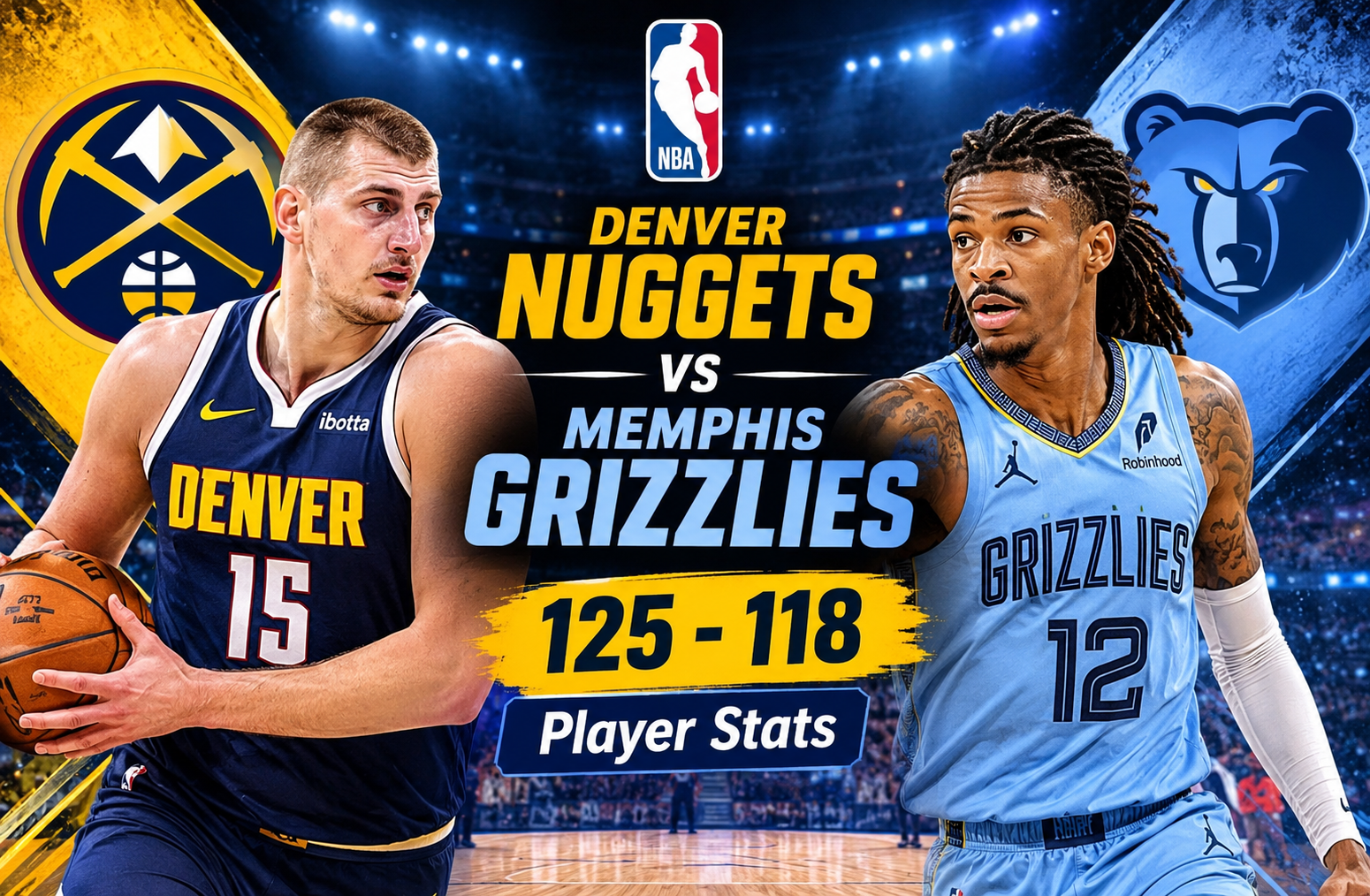
The Denver Nuggets vs Memphis Grizzlies match player stats from March 19, 2026, reveal an exciting contest in which Memphis secured a 125-118 victory over Denver at FedExForum in Memphis, Tennessee. Despite Nikola Jokic delivering an impressive performance with 29 points and 14 rebounds, the Nuggets could not overcome Memphis’s defensive pressure, superior ball security, and ability to create extra scoring opportunities. Ty Jerome led the Grizzlies with 21 points, nine rebounds, and nine assists, producing an all-around performance that helped his team control important stretches of the game.
The seven-point difference tells only part of the story. Denver actually shot a better percentage from the field and recorded more assists, but Memphis created a significant advantage through steals, offensive rebounds, and fewer turnovers. Those differences became especially important in the third quarter, when the Grizzlies scored 39 points and established the separation they needed to protect their lead.
For basketball fans, this matchup offers several interesting statistical details. Jokic’s scoring and rebounding, Jamal Murray’s playmaking, Christian Braun’s contribution, and Ty Jerome’s balanced performance all deserve closer examination. Looking beyond the final score helps explain why Memphis won and where Denver struggled despite having several productive individual performances.
Match Overview: Denver Nuggets vs Memphis Grizzlies
The March 19 matchup brought together two Western Conference teams with different competitive situations. Denver entered the contest with a 42-28 overall record, while Memphis came into the game at 24-44.
The Nuggets had the stronger season record and were also performing well away from home. Memphis, meanwhile, had experienced a more difficult campaign, particularly in its home results. However, the Grizzlies produced an effective performance in front of their home supporters and found ways to disrupt Denver’s offensive rhythm.
| Match detail | Information |
| Game date | March 19, 2026 |
| Competition | NBA regular season |
| Home team | Memphis Grizzlies |
| Away team | Denver Nuggets |
| Final score | Memphis 125, Denver 118 |
| Venue | FedExForum |
| Location | Memphis, Tennessee |
| Attendance | 15,612 |
| Game status | Final |
| Game ID | 401858693 |
| Denver season record | 42-28 |
| Memphis season record | 24-44 |
| Denver away record | 23-15 |
| Memphis home record | 13-20 |
Memphis entered the game with a difficult season record, but its performance demonstrated how defensive activity and possession management can make a difference against a more successful opponent.
The Nuggets had several reasons to feel confident. They possessed an experienced offensive leader in Jokic, a capable playmaker in Murray, and additional scoring support from Braun. However, Memphis found ways to make Denver work for its possessions.
The Grizzlies also benefited from playing at FedExForum, where 15,612 spectators watched the home team complete an important victory.
Denver Nuggets vs Memphis Grizzlies Match Player Stats: Full Team Comparison
The team statistics provide the clearest explanation of the result. Denver was more accurate with its field-goal attempts, but Memphis generated more defensive disruptions and additional opportunities through offensive rebounding.
| Statistical category | Denver Nuggets | Memphis Grizzlies |
| Points | 118 | 125 |
| Field goals | 44/90 | 42/98 |
| Field-goal percentage | 49% | 43% |
| Three-pointers | 13/36 | 16/49 |
| Three-point percentage | 36% | 33% |
| Free throws | 17/22 | 25/32 |
| Free-throw percentage | 77% | 78% |
| Total rebounds | 46 | 48 |
| Offensive rebounds | 7 | 12 |
| Defensive rebounds | 39 | 36 |
| Assists | 34 | 22 |
| Turnovers | 19 | 10 |
| Steals | 6 | 12 |
| Blocks | 5 | 9 |
These numbers reveal an important contrast between the teams.
Denver was more efficient in its regular half-court shooting and ball movement. Memphis, however, did a better job of creating additional possessions and making Denver uncomfortable.
Field-goal efficiency favored Denver
The Nuggets converted 44 of their 90 field-goal attempts, producing a 49% shooting percentage. Memphis made 42 of 98 attempts, finishing at 43%.
At first glance, this difference suggests that Denver should have enjoyed a substantial offensive advantage. The Nuggets converted a higher percentage of their attempts despite taking fewer shots.
However, shooting percentage does not measure every part of offensive performance.
Memphis attempted eight more field goals than Denver. This difference was connected to its 12 offensive rebounds and Denver’s 19 turnovers.
In basketball, a missed shot does not always end an offensive possession. A successful offensive rebound can create another scoring opportunity, while a defensive steal can prevent the opponent from attempting a shot altogether.
Memphis benefited from both situations.
The Grizzlies did not need to shoot as accurately as Denver because they created more opportunities to score.
Three-point shooting and perimeter production
Three-point shooting was another important part of the contest.
Denver made 13 of its 36 attempts from beyond the arc, giving the Nuggets a 36% conversion rate.
Memphis connected on 16 of 49 three-point attempts, finishing at 33%.
Although Memphis attempted considerably more three-pointers, Denver was more accurate.
The difference in made three-pointers was three baskets. Memphis therefore gained nine points from its additional successful attempts in this category.
This is a useful reminder that three-point volume and three-point efficiency are separate measures.
A team can have a lower percentage but still make more perimeter baskets when it generates a larger number of attempts.
For Denver, the challenge was not simply to improve three-point accuracy. The Nuggets also needed to limit Memphis’s opportunities to take those shots.
Free throws helped Memphis establish its scoring advantage
The free-throw numbers provide another important explanation for the final result.
Denver converted 17 of 22 attempts, while Memphis made 25 of 32.
Both teams were relatively similar in accuracy:
- Denver: 77%
- Memphis: 78%
However, Memphis attempted ten more free throws and converted eight more.
Those additional successful free throws contributed significantly to the Grizzlies’ seven-point victory.
The difference also illustrates why free-throw attempts deserve attention when evaluating a close NBA game. A team can shoot a lower percentage from the field but compensate through additional trips to the free-throw line.
Rebounding created extra scoring opportunities
Memphis finished with 48 total rebounds, compared with Denver’s 46.
The overall difference was relatively small, but offensive rebounding told a more interesting story.
The Grizzlies collected 12 offensive rebounds, while the Nuggets recorded only seven.
That five-rebound difference meant Memphis had more opportunities to recover missed shots and extend possessions.
Denver actually collected more defensive rebounds, finishing with 39 compared with Memphis’s 36. However, the Grizzlies’ offensive activity helped balance that advantage.
For the Nuggets, securing defensive rebounds would have been particularly important against a team that was already generating extra opportunities.
Turnovers were one of the biggest differences
Perhaps the most revealing statistical category was turnovers.
Denver committed 19 turnovers, while Memphis committed only 10.
That means the Nuggets gave the ball away nine more times.
In a game decided by seven points, this difference deserves serious attention.
Every turnover represents an offensive opportunity that disappears without a shot being attempted. It can also create a transition opportunity for the opposing team.
Memphis recorded 12 steals, twice Denver’s six.
The Grizzlies’ ability to pressure Denver’s ball handlers and disrupt passing sequences helped them control the possession battle.
Denver’s 34 assists showed that its passing offense was productive, but the 19 turnovers suggest that the team struggled to maintain possession consistently.
Quarter-by-Quarter Scoring Breakdown
The scoring progression shows how Memphis gradually established its advantage, particularly during the third quarter.
| Quarter | Denver Nuggets | Memphis Grizzlies |
| First quarter | 30 | 31 |
| Second quarter | 30 | 29 |
| Third quarter | 31 | 39 |
| Fourth quarter | 27 | 26 |
| Final score | 118 | 125 |
First quarter: Memphis established a narrow lead
Memphis opened the game with a one-point advantage, scoring 31 points against Denver’s 30.
The opening period was closely contested. Neither team established a significant scoring gap, and both offenses found opportunities to produce points.
Denver’s ability to score 30 points immediately showed that its offensive system was functioning.
Memphis, however, managed to finish the quarter slightly ahead.
A one-point difference was not especially meaningful at this stage, but it gave the Grizzlies a small advantage heading into the second period.
Second quarter: Denver kept the contest close
Denver responded during the second quarter.
The Nuggets scored 30 points, while Memphis managed 29.
This allowed Denver to recover the one-point deficit from the opening period and enter halftime with the teams tied.
The first half demonstrated that Denver could compete offensively without needing an extraordinary shooting performance from one player.
Jokic’s scoring and rebounding, combined with Murray’s playmaking, provided a strong foundation.
However, the close score also suggested that Memphis was finding enough offensive opportunities to remain competitive.
Third quarter: The decisive Memphis run
The third quarter was the most important period of the game.
Memphis scored 39 points, while Denver managed 31.
That eight-point difference transformed a tied game into a situation where the Grizzlies held a meaningful advantage.
The Grizzlies’ ability to generate extra possessions was particularly valuable during this period.
Their overall performance included 12 offensive rebounds and 12 steals. Those figures demonstrate the type of activity that can create scoring opportunities even when shooting efficiency is not especially high.
Denver continued to score, but it could not match Memphis’s offensive output.
The third-quarter performance ultimately became the foundation of the home team’s victory.
Fourth quarter: Denver remained competitive but could not complete the comeback
Denver scored 27 points in the final quarter, one more than Memphis’s 26.
The Nuggets therefore performed slightly better in the fourth period, but the improvement was not enough to erase the deficit created earlier.
Memphis did not need to dominate the final quarter. It simply needed to maintain its advantage and avoid giving Denver a major scoring opportunity.
The Grizzlies managed to do that.
Their seven-point victory reflected the importance of the third-quarter performance rather than a dramatic scoring difference throughout the entire game.
Denver Nuggets Player Performance Analysis
Denver had several productive individual performances, particularly from its leading players.
Nikola Jokic led the team in both scoring and rebounding, while Jamal Murray controlled the playmaking side of the offense. Christian Braun also provided valuable scoring support.
These contributions explain why Denver remained competitive despite losing the game.
Nikola Jokic: 29 points and 14 rebounds
DENVER NUGGETS | CENTER
Nikola Jokic delivered the most prominent individual performance for Denver.
He finished with:
- 29 points
- 14 rebounds
His scoring total made him Denver’s leading scorer, while his rebounding performance placed him at the top of the team’s rebounding statistics.
Jokic’s contribution was important because he provides Denver with more than traditional center production.
His offensive value comes from his ability to score around the basket, create opportunities through positioning, and make decisions that help teammates find open shots.
His 14 rebounds also helped Denver compete in a game where Memphis was particularly active on the offensive glass.
However, even a strong performance from a leading center cannot guarantee victory when the opposing team creates more possessions.
Jokic’s 29 points represented a major part of Denver’s offense, but Memphis still managed to finish seven points ahead.
An important lesson from this performance is that individual production and team success are connected, but they are not identical.
A player can deliver an excellent statistical performance while his team struggles with turnovers, defensive assignments, or possession control.
Jamal Murray: 12 assists and offensive leadership
DENVER NUGGETS | GUARD
Jamal Murray recorded 12 assists, making him Denver’s leading playmaker.
This was an important contribution because the Nuggets generated 34 assists as a team.
Murray’s passing helped distribute the offense and create opportunities for teammates.
His role was particularly valuable alongside Jokic. Their partnership gives Denver two players who can initiate offensive actions, read defensive coverage, and create scoring chances for other players.
Twelve assists indicate that Murray was heavily involved in creating successful scoring opportunities.
However, the Nuggets’ 19 turnovers reveal that their overall ball security was not consistent enough.
There is a difference between creating opportunities and maintaining possession throughout a game.
Murray’s assist production was a positive feature of Denver’s performance, but the team needed fewer mistakes to turn that playmaking advantage into a victory.
Christian Braun: 26 points
DENVER NUGGETS | GUARD/FORWARD
Christian Braun was another major contributor for the Nuggets.
He scored 26 points, making him Denver’s second-leading scorer according to the supplied game data.
His contribution was especially important because it prevented Memphis from concentrating its entire defensive strategy on Jokic.
When another player scores consistently, opposing defenses must consider additional threats.
This can create more space for the primary offensive option and make defensive rotations more difficult.
Braun’s 26-point performance demonstrated his importance as a scoring option alongside Denver’s established stars.
The Nuggets received 55 combined points from Jokic and Braun.
That production represented a significant portion of their final 118-point total.
Nevertheless, Memphis’s defensive pressure and possession advantage prevented Denver’s leading scorers from turning their production into a win.
Denver’s supporting lineup
Denver’s listed starting lineup included:
- Cameron Johnson
- Spencer Jones
- Nikola Jokic
- Jamal Murray
- Christian Braun
The listed bench players were:
- Jonas Valanciunas
- Tim Hardaway Jr.
- Bruce Brown
- Julian Strawther
- Zeke Nnaji
- David Roddy
- Tyus Jones
- Jalen Pickett
The starting group provided Denver with its main offensive structure, while the bench options offered additional depth.
However, the available statistical information does not provide complete individual minutes, shooting splits, rebounds, assists, or plus-minus figures for every player.
It would therefore be inaccurate to assign specific box-score totals to the remaining players without verified individual statistics.
The team totals still allow several useful observations.
Denver’s 34 assists demonstrate that its offense created successful passing sequences. Its 49% field-goal percentage also indicates that the team converted its attempts efficiently.
The primary weakness was maintaining possession.
Nineteen turnovers made it harder for the Nuggets to take advantage of their shooting efficiency.
Memphis Grizzlies Player Performance Analysis
Memphis received important contributions from Ty Jerome and Olivier-Maxence Prosper.
Jerome delivered the most balanced statistical performance among the listed Grizzlies players, while Prosper added significant scoring support.
Together, their contributions helped Memphis maintain offensive pressure against a Denver team with a considerably stronger season record.
Ty Jerome: 21 points, 9 rebounds, and 9 assists
MEMPHIS GRIZZLIES | GUARD
Ty Jerome produced one of the most complete individual performances of the matchup.
His recorded statistics were:
- 21 points
- 9 rebounds
- 9 assists
These numbers show that Jerome contributed in three major areas of the game.
He scored effectively, helped Memphis secure rebounds, and created opportunities for teammates.
His nine assists were particularly important in a game where Memphis finished with 22 team assists.
Jerome’s contribution also demonstrated the value of having a player who can influence several parts of the game without relying exclusively on scoring.
His nine rebounds placed him at the top of Memphis’s listed rebounding performances.
That contribution was useful in a matchup where the Grizzlies needed to compete physically against Jokic and Denver’s frontcourt.
Jerome finished just one rebound and one assist short of a triple-double.
Although he did not reach that statistical milestone, his overall production was a major part of Memphis’s success.
The combination of 21 points, nine rebounds, and nine assists provides a strong example of an all-around performance.
Olivier-Maxence Prosper: 19 points
MEMPHIS GRIZZLIES | FORWARD
Olivier-Maxence Prosper scored 19 points and served as an important scoring contributor for Memphis.
His performance was valuable because it gave the Grizzlies another source of offense alongside Jerome.
A team facing Denver needs multiple players capable of creating scoring opportunities.
Jokic can make defensive coverage difficult through his passing and interior scoring. Having additional offensive contributors helps Memphis avoid depending on a single player to match Denver’s production.
Prosper’s 19 points represented a significant contribution to the team’s 125-point total.
His scoring also helped Memphis maintain offensive balance during a contest in which the team attempted 98 field goals.
Although the available data does not provide his individual shooting breakdown, his total points demonstrate that he played an important role in the offensive result.
Memphis’s starting lineup
The Grizzlies’ listed starting players were:
- Olivier-Maxence Prosper
- Cedric Coward
- GG Jackson
- Jaylen Wells
- Ty Jerome
This lineup combined Jerome’s playmaking with scoring support from Prosper and the other listed starters.
Memphis’s overall statistics suggest that the starting group and supporting players contributed to an energetic team performance.
The Grizzlies recorded 12 steals, 12 offensive rebounds, and nine blocks.
These figures show that the team’s defensive activity extended beyond simply contesting shots.
Memphis also created opportunities through ball pressure and second-chance possessions.
Memphis’s bench options
The listed Memphis bench players were:
- Taj Gibson
- Tyler Burton
- Taylor Hendricks
- DeJon Jarreau
- Cam Spencer
- Javon Small
- Walter Clayton Jr.
The available information identifies these players as bench options but does not provide their individual game statistics.
For that reason, their specific scoring or defensive contributions should not be assumed.
A complete individual bench analysis would require the full player-by-player ESPN box score.
What can be established from the available figures is that Memphis finished with 125 points despite shooting 43% from the field.
Its additional possessions, free throws, and defensive activity helped compensate for the lower shooting percentage.
Key Statistical Battles That Decided the Game
The most interesting aspect of this matchup was the contrast between Denver’s offensive efficiency and Memphis’s ability to create extra possessions.
Several statistical battles explain why the Grizzlies won.
1. Jokic’s production against Memphis’s collective defense
Jokic recorded 29 points and 14 rebounds.
Those numbers demonstrate that Memphis did not completely shut down Denver’s primary offensive option.
Instead, the Grizzlies won through their collective performance.
They generated 12 steals, nine blocks, and 12 offensive rebounds.
This combination allowed Memphis to create problems even when Jokic was producing points.
Defending a player like Jokic is rarely about preventing every successful possession. It is also about limiting the opportunities available to his teammates and making the rest of the offense work harder.
Memphis’s defensive statistics suggest that it succeeded in disrupting Denver’s overall rhythm.
2. Murray’s playmaking against Memphis’s ball pressure
Murray finished with 12 assists, demonstrating his importance as Denver’s offensive organizer.
However, the Nuggets committed 19 turnovers.
This created a clear contrast.
Denver moved the ball successfully enough to produce 34 assists, but it also struggled to protect possession.
Memphis recorded 12 steals, giving it opportunities to turn defensive pressure into offense.
The lesson is that assist production should always be considered alongside turnovers.
A high number of assists can indicate good offensive movement, but excessive turnovers can reduce the value of that production.
3. Offensive rebounding against defensive positioning
Memphis recorded five more offensive rebounds than Denver.
That difference may appear small, but offensive rebounds can change the structure of an entire possession.
A successful offensive rebound can provide another shot, force defensive rotations, and create opportunities for a foul.
Memphis also attempted 32 free throws compared with Denver’s 22.
These additional attempts helped the Grizzlies generate points without needing to depend entirely on field-goal accuracy.
4. Three-point volume against shooting accuracy
Denver made 36% of its three-point attempts, while Memphis converted 33%.
Denver was more efficient from beyond the arc.
However, Memphis made 16 three-pointers compared with Denver’s 13.
The Grizzlies attempted 49 shots from long range, while Denver attempted 36.
This difference illustrates how shooting volume can affect the final result.
Memphis did not need to outperform Denver in percentage terms to make more three-point baskets.
5. Defensive disruption against offensive rhythm
Denver finished with six steals and five blocks.
Memphis recorded 12 steals and nine blocks.
The Grizzlies therefore had twice as many steals and four additional blocks.
These defensive numbers help explain how Memphis prevented Denver from fully capitalizing on its better shooting percentage.
Defensive statistics are not a complete measure of team defense, but they provide useful evidence of activity around the ball and the basket.
Why Did the Memphis Grizzlies Beat the Denver Nuggets?
Memphis won because it combined several advantages instead of relying on one exceptional statistical category.
The most important reasons were ball security, defensive pressure, offensive rebounding, and free-throw opportunities.
Memphis protected the basketball
The Grizzlies committed only 10 turnovers.
That was nine fewer than Denver.
In a close game, avoiding unnecessary turnovers can be as important as making difficult shots.
Memphis generally preserved more of its offensive opportunities, allowing the team to continue attacking.
Denver’s 19 turnovers had the opposite effect.
They reduced the number of possessions available to the Nuggets and gave Memphis additional chances to score.
Memphis created second-chance opportunities
The Grizzlies collected 12 offensive rebounds.
Denver collected seven.
This advantage helped Memphis increase its field-goal attempts and keep pressure on the Nuggets’ defense.
Second-chance opportunities are especially important when a team is shooting less accurately than its opponent.
Memphis shot 43% from the field, but its ability to recover missed attempts helped compensate for that lower percentage.
The Grizzlies attacked the basket and reached the free-throw line
Memphis attempted 32 free throws and made 25.
Denver attempted 22 and converted 17.
The additional free-throw opportunities were an important source of scoring.
This suggests that Memphis was able to generate situations in which Denver had to defend without conceding easy scoring opportunities.
The difference was especially relevant because the final margin was only seven points.
The third quarter changed the game
Memphis outscored Denver 39-31 in the third quarter.
That eight-point advantage created the separation that Denver could not eliminate in the final period.
The Nuggets actually outscored Memphis by one point in the fourth quarter.
However, the earlier damage had already been done.
This illustrates why individual quarter performances can matter more than the final-quarter score alone.
A team does not necessarily need to dominate the entire game. One strong period can create enough separation to determine the outcome.
What Went Wrong for the Denver Nuggets?
Denver’s defeat was not caused by poor shooting.
The Nuggets actually recorded the better field-goal percentage and three-point percentage.
Instead, the biggest problems came from possession management and the inability to consistently stop Memphis from creating additional scoring chances.
Too many turnovers
Nineteen turnovers were a significant problem.
Denver’s offense produced 34 assists, but that passing success was partly undermined by losing possession too frequently.
Against a team that recorded 12 steals, careless passes and disrupted offensive sequences can become particularly costly.
The Nuggets needed more controlled possessions, especially during the third quarter.
Insufficient offensive rebounding
Denver collected seven offensive rebounds.
Memphis collected 12.
The difference limited Denver’s ability to recover missed shots and extend possessions.
Although the Nuggets secured 39 defensive rebounds, their offensive rebounding numbers were lower.
That made it more difficult to generate second-chance points.
Defensive pressure was not consistent enough
Memphis scored 125 points despite shooting 43% from the field.
The Grizzlies benefited from their ability to attack different areas of the game.
They recorded 25 made free throws, 16 three-pointers, and 12 offensive rebounds.
Denver needed to limit at least one of these opportunities more effectively.
The Nuggets’ five blocks and six steals showed some defensive activity, but Memphis produced stronger numbers in both categories.
The third quarter created too large a deficit
Denver’s eight-point disadvantage in the third quarter proved decisive.
The Nuggets did not collapse offensively, but they could not match Memphis’s scoring pace.
A more balanced defensive performance during that period could have changed the final result.
What This Matchup Reveals About Both Teams
This game offers useful information about the different ways teams can win basketball games.
Denver demonstrated the importance of shooting efficiency and organized offensive play.
Memphis demonstrated how pressure defense, rebounding, and possession management can overcome a shooting disadvantage.
What Denver can learn
The Nuggets’ most important improvement area is possession control.
Their 49% field-goal percentage and 34 assists suggest that the offensive system produced good opportunities.
However, those strengths become less valuable when the team commits 19 turnovers.
Denver would also benefit from stronger offensive rebounding in matchups where opponents generate second-chance opportunities.
The game showed that even a high-level offensive performance from Jokic cannot fully compensate for weaknesses across the team’s possessions.
What Memphis can learn
Memphis can take confidence from its ability to defeat a team with a much better season record.
The Grizzlies demonstrated that they could compete through defensive activity and offensive aggression.
However, the 43% field-goal percentage and 33% three-point percentage also show that shooting efficiency remains an area worth monitoring.
The team created enough opportunities to win, but maintaining that level of possession control while improving shooting accuracy would make its offense more consistent.
Why the result matters beyond the final score
The matchup demonstrates why basketball analysis should consider several categories together.
Looking only at points would highlight Jokic and Jerome.
Looking only at shooting percentage would favor Denver.
Looking at turnovers, offensive rebounds, free throws, and steals explains why Memphis won.
A complete analysis needs all these measurements because they describe different parts of the game.
Season Series and Team Context
According to the supplied matchup summary, Denver led the season series 2-1 despite losing this March 19 contest.
That detail provides useful context.
A single game does not necessarily define the relationship between two teams across an entire season.
Denver’s 42-28 overall record and 23-15 away record indicated a stronger season performance than Memphis’s 24-44 record and 13-20 home record.
Nevertheless, the Grizzlies managed to win this particular meeting.
The result also demonstrates that season records are indicators of overall performance, not guarantees of individual game outcomes.
Memphis’s victory was built on the statistics it produced on the court that night.
The seven-point margin was the result of a combination of factors rather than a simple difference in team quality.
How to Read NBA Player Statistics Correctly
Understanding an NBA box score requires more than identifying which player scored the most points.
Several statistical categories provide different information about individual and team performance.
Points
Points measure a player’s direct scoring contribution.
Jokic’s 29 points made him Denver’s leading scorer, while Jerome’s 21 points led Memphis.
However, points should be evaluated alongside shooting efficiency and the number of attempts.
A player who scores 20 points on efficient shooting may have a different offensive impact from someone who needs significantly more attempts to reach the same total.
Rebounds
Rebounds are divided into offensive and defensive categories.
Offensive rebounds allow teams to extend possessions after missed shots.
Defensive rebounds help teams end an opponent’s offensive possession.
Jokic’s 14 rebounds made him Denver’s leading rebounder, while Jerome’s nine rebounds led Memphis.
At the team level, Memphis’s 12 offensive rebounds were especially important.
Assists
Assists measure successful passes that directly lead to a teammate’s basket.
Murray’s 12 assists were a major part of Denver’s offensive production.
Jerome’s nine assists helped Memphis distribute its scoring opportunities.
Assists are useful for understanding playmaking, but they do not capture every valuable pass or every aspect of offensive creation.
Steals
Steals measure defensive actions that result in a player taking possession of the ball from the opposing team.
Memphis recorded 12 steals, compared with Denver’s six.
This difference reflects the Grizzlies’ greater success in disrupting Denver’s possessions.
Blocks
Blocks occur when a defender legally deflects an opponent’s shot attempt.
Memphis recorded nine blocks, while Denver recorded five.
Blocks can prevent scoring opportunities, but they do not describe every successful defensive possession.
Positioning, contested shots, and forcing difficult attempts also matter.
Turnovers
Turnovers occur when a team loses possession without completing a successful field-goal attempt.
Denver’s 19 turnovers were one of the clearest weaknesses in its performance.
Memphis’s 10 turnovers allowed it to preserve more possessions.
This category is particularly useful when analyzing close games because every lost possession can affect the final scoring difference.
Shooting percentages
Field-goal percentage measures successful field goals divided by total field-goal attempts.
Three-point percentage measures successful three-point attempts divided by total three-point attempts.
Free-throw percentage measures successful free throws divided by total free-throw attempts.
These figures should not be interpreted independently.
Denver led in field-goal and three-point accuracy, but Memphis made more three-pointers and free throws.
The complete scoring picture explains more than any single percentage.
Where to Find the Official Box Score and Game Details
For readers who want to check the original statistical record, the ESPN game page provides the relevant box-score information.
The official game record is particularly useful for checking individual player appearances, minutes played, field-goal attempts, rebounds, assists, steals, blocks, and turnovers.
You can consult the ESPN Denver Nuggets vs Memphis Grizzlies box score for the March 19, 2026 matchup.
The game ID is 401858693.
The supplied game information also identifies the game recap, play-by-play, and team matchup pages as additional sources for understanding how the contest developed.
For statistical accuracy, it is important to distinguish between the team-level figures available in a summary and the complete individual box score.
The information used in this article includes the leading player statistics and team totals supplied for the game. It does not establish every individual player’s minutes, shooting breakdown, or advanced metrics.
This distinction prevents unsupported claims and helps readers understand exactly what the available numbers demonstrate.
FAQs About the Match
1. Who won the Denver Nuggets vs Memphis Grizzlies game on March 19, 2026?
The Memphis Grizzlies defeated the Denver Nuggets 125-118 on March 19, 2026. The game was played at FedExForum in Memphis, Tennessee.
2. How many points did Nikola Jokic score against Memphis?
Nikola Jokic scored 29 points and collected 14 rebounds. He was Denver’s leading scorer and rebounder in the matchup.
3. Who was the leading scorer for the Memphis Grizzlies?
Ty Jerome led Memphis with 21 points. He also recorded nine rebounds and nine assists, delivering an all-around performance.
4. How many assists did Jamal Murray record?
Jamal Murray recorded 12 assists, making him Denver’s leading playmaker. The Nuggets finished with 34 team assists.
5. Why did Memphis beat Denver despite shooting a lower field-goal percentage?
Memphis won because it committed fewer turnovers, collected more offensive rebounds, recorded more steals, and made more free throws. These advantages helped compensate for its lower field-goal percentage.
6. What was the biggest scoring difference between the two teams?
The third quarter produced the largest difference. Memphis scored 39 points, while Denver scored 31, giving the Grizzlies an eight-point advantage during that period.
Conclusion
The March 19, 2026 matchup between Denver and Memphis demonstrated how different aspects of basketball contribute to a final result. Memphis secured a 125-118 victory through stronger possession management, defensive pressure, offensive rebounding, and free-throw production.
Nikola Jokic delivered an impressive 29-point, 14-rebound performance, while Jamal Murray contributed 12 assists and Christian Braun added 26 points. However, Ty Jerome’s 21 points, nine rebounds, and nine assists helped Memphis maintain offensive balance. Olivier-Maxence Prosper also played an important role with 19 points.
Denver finished with better field-goal and three-point percentages, but its 19 turnovers proved costly. Memphis recorded only 10 turnovers, collected 12 offensive rebounds, and generated 12 steals. The third-quarter scoring advantage ultimately gave the Grizzlies enough separation to protect their lead.
The most important takeaway is that shooting accuracy alone does not determine an NBA game. Rebounding, ball security, defensive pressure, and free-throw opportunities can be equally important. This matchup is a clear example of how a team can overcome a shooting disadvantage by creating more opportunities and making better use of its possessions.