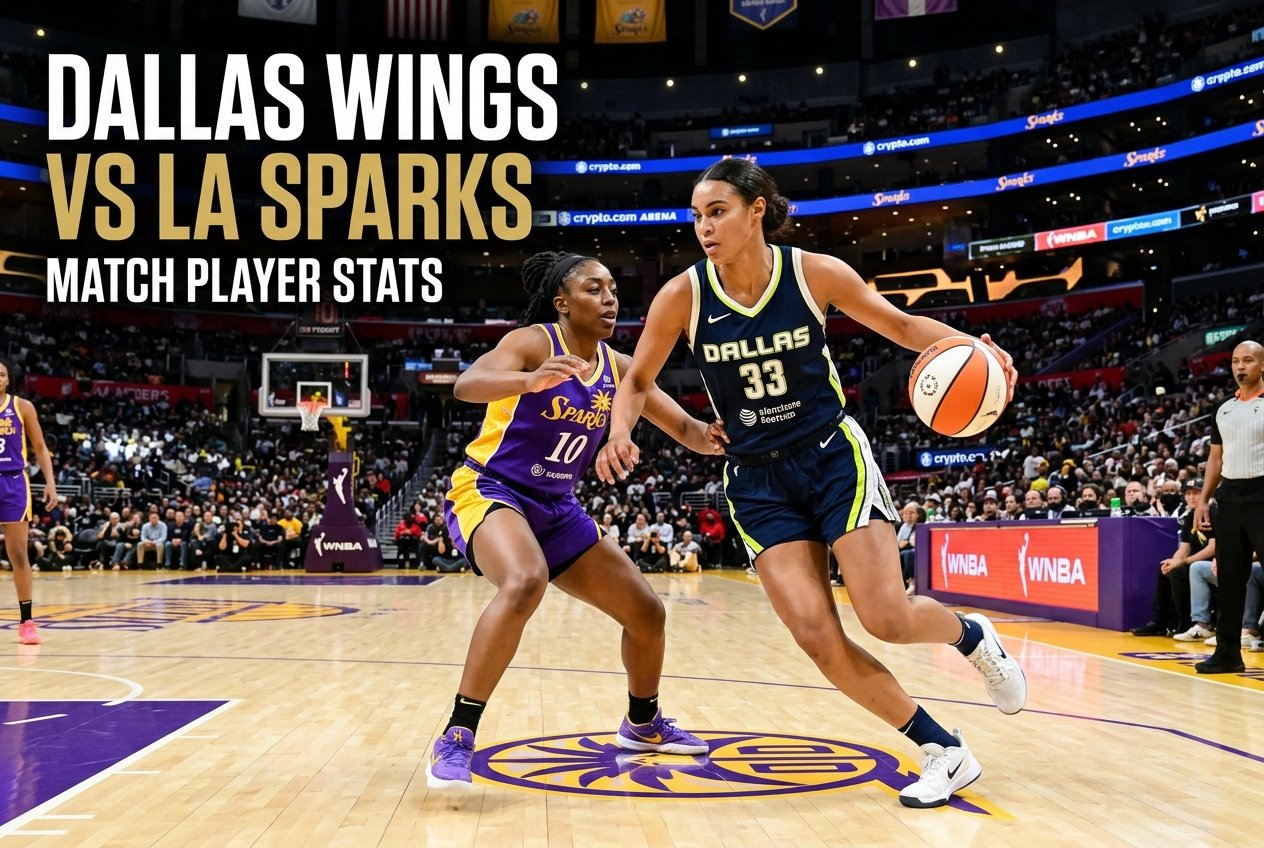
Dallas Wings vs Los Angeles Sparks Match Player Stats
The Dallas Wings vs Los Angeles Sparks match player stats reveal how Dallas secured an impressive 104-96 victory over Los Angeles in the 2026 WNBA Commissioner’s Cup. The matchup featured outstanding offensive performances, efficient three-point shooting, strong playmaking, and a decisive fourth-quarter performance from the Wings. Arike Ogunbowale led Dallas with 30 points, while Paige Bueckers delivered 18 points and a career-high 14 assists. Jessica Shepard also played a major role, recording an impressive double-double with 22 points and 15 rebounds.
Played at Crypto.com Arena in Los Angeles, the contest was competitive for three quarters. The Sparks started confidently and maintained a narrow halftime advantage. However, Dallas increased its offensive pressure in the final period, outscoring the home team 27-18 to complete an eight-point road victory. The game offered an interesting example of how scoring efficiency, ball movement, rebounding, and late-game execution can influence a WNBA result.
Date clarification: The WNBA’s game record identifies the matchup as June 5, 2026, in Los Angeles. Some schedule and recap listings display June 6 because of their publication or time-zone presentation. Both refer to the same game.
Dallas Wings vs Los Angeles Sparks Match Player Stats: Game Overview
The June 2026 Commissioner’s Cup matchup brought together two teams with different objectives. Dallas wanted to continue its strong early-season run, while Los Angeles needed a home victory to improve its position.
The Wings entered the game with a 6-3 record before improving to 7-3. The Sparks entered at 4-5 and fell to 4-6 after the defeat.
The final result was:
Dallas Wings Scores, Stats and Highlights – ESPN (UK)
Dallas Wings
104
Winner
VS
8-point margin
Los Angeles Sparks 2026 Regular Season WNBA Schedule – ESPN
Los Angeles Sparks
96
Home team
Competition
WNBA Commissioner’s Cup
Venue
Crypto.com Arena
Game date
June 5, 2026 (Los Angeles)
Attendance
12,828
Quarter-by-Quarter Score
The scoring pattern explains why the final result was closer than the fourth-quarter performance might suggest. Los Angeles won the opening period, Dallas responded in the second, and both teams remained level in the third.
| Quarter | Dallas Wings | LA Sparks |
| First | 24 | 28 |
| Second | 30 | 27 |
| Third | 23 | 23 |
| Fourth | 27 | 18 |
| Final | 104 | 96 |
Dallas scored 104 points through consistent offensive production. Its strongest advantage came in the last quarter, when the team combined better execution with more effective defensive possessions.
Los Angeles had opportunities to protect its home advantage but could not maintain its earlier offensive rhythm.
Complete Dallas Wings vs Los Angeles Sparks Match Player Stats
Individual statistics provide a clearer understanding of the game than the final score alone. Dallas had several players contributing across different categories, while Los Angeles depended heavily on its leading scorers.
The following figures summarize points, rebounds, assists, shooting performance, and other important contributions. Shooting figures are presented as made attempts out of total attempts.
Dallas Wings Player Statistics
| Player | PTS | REB | AST | FG |
| Arike Ogunbowale | 30 | 6 | 6 | 10/21 |
| Jessica Shepard | 22 | 15 | 5 | 9/13 |
| Paige Bueckers | 18 | 3 | 14 | 7/14 |
| Maddy Siegrist | 16 | 4 | 0 | 7/10 |
| Azzi Fudd | 11 | 1 | 2 | 5/10 |
| Alanna Smith | 4 | 2 | 0 | 2/4 |
| Aziaha James | 3 | 1 | 3 | 1/4 |
| Alysha Clark | 0 | 0 | 0 | 0/0 |
| Odyssey Sims | 0 | 1 | 0 | 0/1 |
Source: Game player box-score figures. Individual rebounds are shown separately from team rebound totals.
Dallas received major contributions from its starting lineup. Ogunbowale led the scoring, Shepard controlled the glass, and Bueckers directed the offense.
Maddy Siegrist also made an important contribution from the forward position, while Azzi Fudd added valuable scoring support.
Los Angeles Sparks Player Statistics
| Player | PTS | REB | AST | FG |
| Kelsey Plum | 27 | 2 | 6 | 10/16 |
| Ariel Atkins | 16 | 5 | 3 | 6/12 |
| Dearica Hamby | 15 | 5 | 1 | 6/8 |
| Nneka Ogwumike | 13 | 10 | 5 | 6/8 |
| Erica Wheeler | 7 | 1 | 6 | 2/8 |
| Cameron Brink | 10 | 5 | 0 | 3/7 |
| Kennedy Martin | 5 | 0 | 0 | 2/2 |
| Rae Burrell | 3 | 2 | 4 | 1/5 |
| Crystal Dangerfield Gray | 0 | 0 | 0 | 0/1 |
Los Angeles had four players reach double figures, with Plum leading the team. Hamby and Ogwumike were particularly efficient from the field, while Atkins contributed important perimeter shooting.
However, the Sparks did not receive enough consistent offensive production to match Dallas during the final period.
Arike Ogunbowale Leads Dallas With 30 Points
Los Angeles Sparks v Dallas Wings
Arike Ogunbowale
30 PTS
6 rebounds | 6 assists | 10/21 field goals
Dallas leading scorer
Arike Ogunbowale delivered the highest-scoring individual performance of the contest. Her 30 points provided Dallas with a reliable offensive foundation and helped the Wings remain competitive when the Sparks were scoring efficiently.
She finished with:
- 30 points
- 6 rebounds
- 6 assists
- 10 successful field goals on 21 attempts
- 6 successful three-pointers on 11 attempts
- 4 successful free throws on 5 attempts
- 3 turnovers
Her three-point shooting was particularly important. Ogunbowale converted 54.5% of her attempts from beyond the arc, giving Dallas an effective way to stretch the Sparks’ defense.
She also contributed as a playmaker. Her six assists helped create scoring opportunities for teammates instead of forcing every possession to end with her own shot.
One important moment came late in the fourth quarter. Ogunbowale recovered her own missed attempt and scored on the putback, helping Dallas establish a 99-95 advantage.
That sequence demonstrated the value of offensive persistence. Rather than depending entirely on perimeter shooting, she found a way to create another scoring opportunity through rebounding and positioning.
Her overall performance combined scoring, passing, and timely decision-making. Although the Wings had several other productive players, Ogunbowale’s offensive production made her one of the central figures in the victory.
Paige Bueckers Records 14 Assists in a Standout Performance
Los Angeles Sparks v Dallas Wings
Paige Bueckers
14 AST
18 points | 3 rebounds | 7/14 field goals
Game playmaking leader
Paige Bueckers produced one of the most significant statistical performances of the game. Her 18 points were valuable, but her passing made an even greater impact.
She recorded 14 assists, establishing a career high at the time and tying Arike Ogunbowale’s Dallas franchise record for assists in a single game.
Her complete contribution included:
- 18 points
- 3 rebounds
- 14 assists
- 7-of-14 field-goal shooting
- 1-of-4 three-point shooting
- 3-of-4 free-throw shooting
- 1 steal
- 1 turnover
The most impressive part of her performance was her ability to create opportunities for other players.
A player who records 14 assists is directly involved in a substantial number of successful scoring possessions. Bueckers helped Ogunbowale, Shepard, and other Wings players benefit from better offensive opportunities.
Her performance also highlights an important difference between scoring and playmaking.
A high-scoring guard can influence a game through individual shooting, but a guard who creates opportunities for several teammates can improve the entire offensive structure.
Bueckers demonstrated both abilities against Los Angeles. Her 18 points kept the defense occupied, while her passing helped Dallas generate 30 team assists.
Her late free throws also helped secure the victory after the Wings established their advantage.
Jessica Shepard Delivers a Powerful Double-Double
Jessica Shepard
22 PTS
15 rebounds | 5 assists | 9/13 field goals
Double-double
Jessica Shepard was another major reason Dallas controlled important stretches of the game.
She finished with 22 points and 15 rebounds, recording a double-double that combined scoring efficiency with strong work around the basket.
Her shooting performance was especially impressive:
- 9-of-13 field goals
- 4-of-6 free throws
- 15 total rebounds
- 5 assists
- 2 steals
- 4 turnovers
Shepard converted approximately 69.2% of her field-goal attempts. That efficiency helped Dallas score without requiring a large number of possessions to produce points.
Her 15 rebounds were also significant. Rebounding helps a team control possession, reduce second-chance opportunities for opponents, and create additional offensive chances.
Shepard’s five assists showed that her influence was not limited to scoring and rebounding.
Her performance was particularly important because the Sparks had experienced frontcourt players capable of competing around the basket. Shepard’s ability to produce efficiently against that opposition gave Dallas another dependable scoring option.
She also finished with a team-best plus-minus of +10 among Dallas starters, indicating that the Wings outscored Los Angeles by 10 points during her time on the floor.
Maddy Siegrist and Azzi Fudd Provide Valuable Scoring Support
Dallas did not rely exclusively on its three leading players. Maddy Siegrist and Azzi Fudd provided additional offensive production that helped the Wings reach 104 points.
Maddy Siegrist: 16 Points
Dallas Wings v Los Angeles Sparks
Maddy Siegrist
16 points
4 rebounds | 7/10 shooting | 4 steals
Siegrist delivered an efficient offensive performance, converting seven of her 10 field-goal attempts.
She also made both of her three-point attempts, giving Dallas another perimeter scoring option.
Her fourth-quarter contribution was especially important. She scored 10 points in the final period, including a putback with 50.3 seconds remaining that extended Dallas’s advantage to 101-96.
That basket helped maintain the Wings’ control during a crucial closing stretch.
Siegrist also recorded four steals, showing that her contribution extended beyond offensive production.
Azzi Fudd: 11 Points
Los Angeles Sparks v Dallas Wings
Azzi Fudd
11 points
1 rebound | 2 assists | 5/10 shooting
Fudd added 11 points while shooting 50% from the field. She also contributed two assists and two steals.
Although her three-point shooting was limited to one successful attempt on four tries, her overall shooting efficiency helped Dallas maintain its offensive balance.
The importance of these contributions becomes clear when considering the final score. Dallas had five players score at least 11 points, making it more difficult for Los Angeles to focus its defensive attention on a single player.
Kelsey Plum Leads the Los Angeles Sparks With 27 Points
Dallas Wings v Los Angeles Sparks
Kelsey Plum
27 PTS
2 rebounds | 6 assists | 10/16 field goals
Sparks leading scorer
Kelsey Plum was the leading offensive player for Los Angeles. She scored 27 points and converted 10 of her 16 field-goal attempts.
Her performance was particularly notable because she returned after missing three games with an ankle injury.
Her statistical contribution included:
- 27 points
- 2 rebounds
- 6 assists
- 10-of-16 field goals
- 1-of-6 three-pointers
- 6-of-8 free throws
- 5 turnovers
Plum demonstrated strong scoring efficiency inside the three-point line. Her 62.5% overall field-goal percentage showed that she could create and convert opportunities effectively.
However, her three-point shooting was less productive. She made only one of six attempts from beyond the arc.
That difference matters because three-point shooting can significantly change the spacing of a team’s offense. When a leading perimeter player is not converting from long range, opposing defenses may become more comfortable protecting the paint.
Plum also recorded six assists, showing that she contributed to the Sparks’ offensive organization.
Her performance was strong enough to keep Los Angeles competitive, but she needed more consistent support during the final quarter.
Ariel Atkins and Dearica Hamby Add 31 Combined Points
Ariel Atkins: 16 Points
Los Angeles Sparks v Phoenix Mercury
Ariel Atkins
16 points | 5 rebounds | 3 assists
6-of-12 field goals and 4-of-7 three-pointers
Atkins contributed 16 points and was one of Los Angeles’s most effective perimeter shooters.
She made four of her seven three-point attempts, converting approximately 57.1% from long range.
Her outside shooting helped the Sparks maintain their early advantage and provided another scoring option alongside Plum.
Atkins also recorded five rebounds and three assists. However, she finished with five personal fouls, which limited her ability to remain consistently aggressive.
Dearica Hamby: 15 Points
Dallas Wings v Los Angeles Sparks
Dearica Hamby
15 points | 5 rebounds | 1 assist
6-of-8 field goals and 3-of-4 free throws
Hamby was one of the most efficient Sparks players in the contest.
She converted 75% of her field-goal attempts, scoring 15 points on only eight shots.
Her ability to finish near the basket helped Los Angeles maintain offensive pressure during the opening three quarters.
She also recorded five rebounds and played an important role in the frontcourt.
Her performance illustrates that individual shooting efficiency does not always translate into a team victory. Los Angeles had several efficient scorers, but its overall execution declined during the final period.
Nneka Ogwumike Records a Double-Double
Dallas Wings v Los Angeles Sparks
Nneka Ogwumike
13 PTS
10 rebounds | 5 assists | 6/8 field goals
Double-double
Nneka Ogwumike produced a balanced performance for Los Angeles.
She finished with 13 points, 10 rebounds, and five assists, recording a double-double.
Her shooting efficiency was excellent, with six successful field goals on eight attempts.
Ogwumike also contributed one steal and played 35 minutes.
Her performance showed that the Sparks had productive frontcourt players capable of scoring and rebounding. However, the team could not turn those individual contributions into enough points during the final period.
Her five assists were another positive element. They helped Los Angeles maintain offensive movement and create opportunities for teammates.
Cameron Brink Makes an Impact From the Bench
Cameron Brink provided useful production after entering the game as a reserve.
She finished with:
- 10 points
- 5 rebounds
- 3-of-7 field goals
- 1 successful three-pointer
- 3-of-4 free throws
- 1 block
Brink’s 10 points gave Los Angeles another double-digit scorer. Her five rebounds also helped the Sparks compete on the boards.
She was one of the team’s important defensive options, recording a block during her 15 minutes on the court.
Her contribution was valuable, but Los Angeles needed more consistent production from its entire rotation to overcome Dallas.
Team Statistical Comparison: Dallas Wings vs Los Angeles Sparks
Individual performances explain who contributed most, but team statistics reveal why Dallas won.
The most important differences appeared in assists, three-point shooting, turnovers, and steals.
| Statistical category | Dallas | Los Angeles |
| Total points | 104 | 96 |
| Field goals | 41/77 | 36/67 |
| Field-goal percentage | 53.2% | 53.7% |
| Three-pointers | 10/25 | 9/28 |
| Three-point percentage | 40.0% | 32.1% |
| Free throws | 12/18 | 15/21 |
| Free-throw percentage | 66.7% | 71.4% |
| Total rebounds | 37 | 42 |
| Offensive rebounds | 13 | 8 |
| Defensive rebounds | 20 | 22 |
| Assists | 30 | 25 |
| Steals | 10 | 5 |
| Blocks | 2 | 2 |
| Turnovers | 12 | 17 |
| Personal fouls | 18 | 16 |
Team statistics are based on the game scoreboard. Team rebound totals include team rebounds, which is why they can differ from the sum of individual player rebounds.
Three-Point Shooting Gave Dallas an Important Advantage
Dallas made 10 three-pointers from 25 attempts, producing a 40% success rate.
Los Angeles converted nine of 28 attempts, shooting approximately 32.1%.
The difference may look small in terms of successful shots, but it created a meaningful scoring advantage.
Dallas scored 30 points from three-point baskets, compared with 27 for Los Angeles.
That three-point advantage helped the Wings maintain their scoring output even when the Sparks were efficient from inside the arc.
Assists Demonstrated Dallas’s Better Ball Movement
One of the most important differences was the assist count.
Dallas recorded 30 assists, while Los Angeles finished with 25.
This five-assist advantage reflected the Wings’ ability to create scoring opportunities through passing and coordinated offensive movement.
Bueckers was central to that success with her 14 assists.
Ogunbowale added six, while Shepard contributed five.
Together, those three players accounted for 25 of Dallas’s 30 assists.
This demonstrates how several players can contribute to a more organized offense rather than relying entirely on individual scoring.
Turnovers Helped Dallas Maintain Control
Dallas committed 12 turnovers, compared with 17 for Los Angeles.
The five-turnover difference was important because every lost possession reduced the Sparks’ chances to score.
A turnover can also create a transition opportunity for the opposing team. Dallas’s ability to protect possession helped it maintain offensive pressure and avoid giving Los Angeles unnecessary scoring chances.
The Wings also recorded 10 steals, twice the Sparks’ total of five.
That defensive activity contributed to their ability to disrupt the home team’s offensive rhythm.
Los Angeles Won the Rebounding Battle
The Sparks collected 42 total rebounds, compared with 37 for Dallas.
This was one statistical area where Los Angeles held an advantage.
Nneka Ogwumike recorded 10 rebounds, while Dearica Hamby and Ariel Atkins added five each.
However, Dallas collected 13 offensive rebounds compared with eight for Los Angeles.
This distinction is important.
Total rebounds measure how often a team secures the ball after missed shots, but offensive rebounds specifically create additional scoring opportunities.
Dallas’s five-rebound advantage on the offensive glass helped compensate for Los Angeles’s lead in total rebounds.
Free-Throw Shooting Did Not Decide the Result
Los Angeles converted 15 of 21 free throws, while Dallas made 12 of 18.
The Sparks therefore had a better free-throw percentage.
However, Dallas made three fewer free throws and still won by eight points.
This shows that the result was influenced more by the Wings’ three-point efficiency, ball movement, and ability to protect possession than by free-throw production.
How Dallas Wings Won the Fourth Quarter
The fourth quarter was the defining period of the matchup.
After three quarters, Los Angeles remained ahead by one point. The Sparks had scored 78 points, while Dallas had recorded 77.
That narrow margin meant the final 10 minutes would determine the outcome.
Dallas responded with 27 points, while Los Angeles managed only 18.
The nine-point quarter advantage turned a one-point deficit into an eight-point victory.
Dallas Improved Its Offensive Execution
The Wings had several players capable of scoring in different ways.
Ogunbowale provided perimeter shooting and individual shot creation. Bueckers created opportunities through passing. Shepard offered efficient interior scoring, while Siegrist became particularly important in the closing stretch.
This variety made Dallas difficult to defend.
The Sparks could not focus exclusively on one offensive threat because several Wings players were capable of producing points.
Siegrist Delivered Important Late Scoring
Maddy Siegrist scored 10 points in the fourth quarter.
Her contribution was especially important during the final minutes, when Dallas needed to protect a narrow lead.
Her putback with 50.3 seconds remaining gave the Wings a 101-96 advantage.
That basket created additional separation and reduced the time available for a Los Angeles comeback.
Bueckers Helped Secure the Result
Paige Bueckers finished the game by converting two free throws with 47.1 seconds remaining.
Those points helped Dallas maintain its advantage and close out the contest.
Her performance demonstrated the value of having a dependable ball handler during late-game situations.
The Wings needed someone who could make smart decisions, manage possessions, and convert opportunities under pressure. Bueckers fulfilled that role.
Why the Los Angeles Sparks Lost Despite Strong Individual Performances
Los Angeles did not have a poor offensive performance overall.
The team scored 96 points, shot 53.7% from the field, collected 42 rebounds, and had four players reach double figures.
However, several factors prevented the Sparks from converting those contributions into a victory.
The Fourth-Quarter Scoring Decline
The biggest problem was the offensive drop during the final period.
Los Angeles scored 28 points in the first quarter, 27 in the second, and 23 in the third.
Its fourth-quarter production fell to just 18 points.
That was a significant decline at the most important stage of the game.
When Dallas increased its offensive pressure, the Sparks struggled to respond with the same level of scoring.
Too Many Turnovers
The Sparks committed 17 turnovers, five more than Dallas.
Those lost possessions reduced their scoring opportunities and gave the Wings more chances to control the game.
Plum recorded five turnovers, while Erica Wheeler and Cameron Brink each committed three.
Turnovers were particularly costly because Los Angeles was already trying to protect a narrow lead.
Inconsistent Three-Point Shooting
Los Angeles made nine three-pointers but attempted 28.
Its 32.1% success rate was below Dallas’s 40%.
Although Atkins shot effectively from outside, the overall team performance did not match the Wings’ perimeter efficiency.
That difference became more important as the game progressed.
Limited Production From Some Rotation Players
The Sparks received valuable scoring from their leading players, but several reserves produced limited offensive numbers.
The team needed additional consistency from its rotation, particularly during the fourth quarter.
Brink scored 10 points and Martin added five, but the overall scoring balance was not enough to match Dallas’s deeper offensive contribution.
Dallas Wings Bench vs Los Angeles Sparks Bench
Bench production can influence the outcome of a basketball game, especially when starters need rest or opposing defenses begin adjusting.
Both teams received contributions from their reserves, but Dallas benefited from a more balanced overall offensive performance.
Dallas Bench Contributions
Dallas received scoring support from several reserve players.
| Player | Points | Rebounds | Assists | Steals |
| Alanna Smith | 4 | 2 | 0 | 0 |
| Aziaha James | 3 | 1 | 3 | 1 |
| Alysha Clark | 0 | 0 | 0 | 0 |
| Odyssey Sims | 0 | 1 | 0 | 0 |
Alanna Smith provided four points and two rebounds. Aziaha James contributed three points, three assists, and one steal.
Alysha Clark played a short role, while Odyssey Sims appeared for five minutes before leaving with a left ankle injury in the first half. She did not return.
Although the bench scoring was not particularly high, Dallas received important contributions from its starters and maintained a productive offensive structure.
Los Angeles Bench Contributions
| Player | Points | Rebounds | Assists | Steals |
| Cameron Brink | 10 | 5 | 0 | 0 |
| Kennedy Martin | 5 | 0 | 0 | 0 |
| Rae Burrell | 3 | 2 | 4 | 2 |
| Crystal Dangerfield Gray | 0 | 0 | 0 | 0 |
Cameron Brink was the most productive Sparks reserve, scoring 10 points and collecting five rebounds.
Rae Burrell contributed three points, four assists, and two steals. Her passing and defensive activity provided additional value beyond her scoring total.
Kennedy Martin scored five points in limited playing time, while Crystal Dangerfield Gray did not score.
The bench comparison suggests that Los Angeles received useful production from Brink, but Dallas’s overall lineup balance helped the visitors maintain their advantage.
Shooting Efficiency and Offensive Decision-Making
One of the most useful ways to evaluate a basketball performance is to examine how efficiently players convert their scoring opportunities.
Points alone do not tell the complete story.
For example, a player who scores 20 points on 10 successful shots may have contributed more efficiently than someone who scores the same number after taking 25 attempts.
The same principle applies to three-point shooting, free throws, and overall field-goal production.
Dallas’s Efficient Scoring Options
Several Dallas players produced strong shooting numbers.
- Jessica Shepard converted 9 of 13 attempts, approximately 69.2%.
- Maddy Siegrist made 7 of 10 attempts, shooting 70%.
- Azzi Fudd converted 5 of 10 attempts, shooting 50%.
- Paige Bueckers made 7 of 14 attempts, also shooting 50%.
- Arike Ogunbowale scored 30 points while converting 10 of 21 attempts.
These performances demonstrate that Dallas had multiple ways to generate offense.
The team did not depend entirely on difficult shots from its leading scorer. Shepard and Siegrist provided efficient production, while Bueckers created opportunities for teammates.
Los Angeles’s Efficient Frontcourt Shooting
The Sparks also had several players with excellent shooting percentages.
Dearica Hamby converted 6 of 8 field-goal attempts, while Nneka Ogwumike made the same number.
Both players shot 75% from the field.
Kelsey Plum converted 10 of 16 attempts, producing a 62.5% field-goal percentage.
Ariel Atkins made six of 12 attempts, shooting 50%.
These figures show that Los Angeles was capable of scoring efficiently. Its problem was not simply poor shooting throughout the game.
Instead, the combination of turnovers, lower three-point efficiency, and reduced fourth-quarter production made it difficult to maintain its advantage.
What the Plus-Minus Statistics Reveal
Plus-minus measures the difference between a team’s points scored and points allowed while a particular player is on the court.
It should not be treated as a complete measurement of individual ability because it is influenced by teammates, opponents, substitutions, and game situations.
However, it can provide additional context when considered alongside traditional statistics.
Dallas recorded several positive individual plus-minus figures:
| Dallas player | Plus-minus |
| Jessica Shepard | +10 |
| Maddy Siegrist | +10 |
| Arike Ogunbowale | +6 |
| Azzi Fudd | +5 |
| Paige Bueckers | +5 |
Jessica Shepard and Maddy Siegrist shared the strongest recorded figure among the Dallas starters.
Their positive numbers reflected the team’s success during their minutes on the floor.
For Los Angeles, the leading individual figures were:
| Sparks player | Plus-minus |
| Ariel Atkins | -1 |
| Dearica Hamby | -4 |
| Kelsey Plum | -7 |
| Erica Wheeler | -8 |
| Nneka Ogwumike | -8 |
Every Sparks starter finished with a negative plus-minus figure.
This does not mean that each player performed poorly. Plum scored 27 points, Hamby shot efficiently, and Ogwumike recorded a double-double.
Rather, it reflects the fact that Dallas outscored Los Angeles during their playing time.
Important Moments That Shaped the Match
The final score provides the result, but several moments explain how the game developed.
Los Angeles Takes the Early Lead
The Sparks opened with 28 points in the first quarter.
Their early offensive production helped them establish a four-point advantage.
Plum, Atkins, and Hamby provided scoring support, allowing Los Angeles to take control of the opening period.
Dallas Responds in the Second Quarter
The Wings scored 30 points in the second quarter.
Their improved offensive production reduced the Sparks’ advantage and brought the game closer.
Dallas’s scoring was supported by the combination of Ogunbowale’s shooting, Bueckers’ passing, and Shepard’s interior production.
The first half ended with Los Angeles leading 55-54.
An important detail came at the halftime buzzer. Bueckers appeared to make a baseline jumper, but a review overturned the basket.
As a result, the Sparks maintained their one-point advantage.
The Third Quarter Keeps the Contest Close
Both teams scored 23 points in the third period.
Neither side managed to establish a significant advantage.
The Sparks entered the fourth quarter with a one-point lead, leaving the game open for either team to win.
Dallas Takes Control in the Final Period
The fourth quarter changed the direction of the matchup.
Dallas scored 27 points, while Los Angeles managed 18.
The Wings benefited from late contributions by Ogunbowale, Siegrist, and Bueckers.
Ogunbowale’s offensive rebound and putback helped Dallas move ahead 99-95.
Siegrist then scored another important basket, making it 101-96 with 50.3 seconds remaining.
Bueckers converted two free throws with 47.1 seconds left to help secure the final result.
These moments show why late-game execution is so important in professional basketball. A team can remain competitive for most of a contest but still lose if it cannot produce efficient possessions in the closing minutes.
What the Match Statistics Tell Basketball Fans
The numbers from this game offer several useful lessons for understanding basketball performance.
1. A Balanced Offense Can Be More Difficult to Defend
Dallas had five players score at least 11 points.
This balance reduced the defensive pressure on any single player and allowed the Wings to generate points from different areas of the court.
When a team has multiple scoring options, opponents must make more defensive adjustments.
2. Assists Reveal More Than Individual Scoring
Bueckers’ 14 assists were one of the defining statistics of the contest.
They showed how a player can influence a game without taking the majority of the team’s shots.
Assists help explain offensive coordination, player movement, and the ability to create high-quality scoring opportunities.
3. Offensive Rebounds Can Offset a Total Rebound Deficit
Los Angeles collected more total rebounds, but Dallas secured more offensive rebounds.
This helped the Wings create additional opportunities after missed shots.
It also demonstrates why looking at only one statistical category can lead to an incomplete understanding of a game.
4. Turnover Control Has a Direct Impact on Possessions
Dallas committed five fewer turnovers.
That difference helped the Wings maintain possession and limited the Sparks’ opportunities to generate offense.
Protecting the basketball becomes especially important when a game is close.
5. Fourth-Quarter Execution Can Decide the Result
The Wings entered the final period one point behind.
They finished it with a nine-point scoring advantage.
The difference was not simply about making more shots. Dallas combined offensive efficiency, rebounding, passing, and late-game decision-making.
Why These Player Statistics Matter for WNBA Analysis
Player statistics are useful for more than identifying the leading scorer.
They help fans understand individual roles, team strengths, offensive strategies, and defensive performance.
For example, a player who records 14 assists may be influencing the result through playmaking, while a player with 15 rebounds may be controlling possession and limiting second-chance opportunities.
Similarly, a player who scores 27 points on efficient shooting can be an important offensive contributor even if her team loses.
When reviewing the Dallas and Los Angeles matchup, it is useful to consider several statistical categories together.
Points: Show how much scoring a player contributed.
Rebounds: Help measure a player’s ability to secure missed shots.
Assists: Indicate how effectively a player creates scoring opportunities for teammates.
Steals: Measure defensive actions that take possession away from opponents.
Blocks: Show how effectively a player challenges or stops shots.
Turnovers: Reveal lost possessions and potential offensive problems.
Field-goal percentage: Measures shooting accuracy across two-point and three-point attempts.
Three-point percentage: Shows efficiency from beyond the three-point line.
Plus-minus: Provides context about the team’s scoring margin while a player is on the court.
No single statistic explains everything. A stronger analysis combines several measurements with the actual game situation.
Where to Find the Official Game Box Score
Readers who want to examine the complete statistical record should use official league records rather than relying only on short match summaries.
The WNBA’s game center provides access to the matchup, box score, game charts, and play-by-play information.
The official record can be accessed through the WNBA game box score for Dallas Wings vs Los Angeles Sparks.
This is useful for checking individual player contributions, shooting attempts, rebounds, assists, steals, blocks, and other recorded statistics.
It is also important to distinguish between a player’s individual rebound total and the team’s total rebounds, which may include team rebounds.
For readers comparing multiple games, using the same statistical categories and official records helps maintain consistency.
Frequently Asked Questions
1. Who won the Dallas Wings vs Los Angeles Sparks game in June 2026?
The Dallas Wings defeated the Los Angeles Sparks 104-96 in their 2026 Commissioner’s Cup matchup at Crypto.com Arena in Los Angeles. Dallas secured the victory with a strong fourth-quarter performance, scoring 27 points while limiting the Sparks to 18.
2. Who scored the most points in the Dallas Wings vs Los Angeles Sparks matchup?
Arike Ogunbowale was the leading scorer with 30 points for Dallas. Kelsey Plum led Los Angeles with 27 points. Both players also contributed six assists.
3. How many points and assists did Paige Bueckers record?
Paige Bueckers finished with 18 points, three rebounds, and 14 assists. Her 14 assists were a career high at the time and tied the Dallas Wings franchise record for assists in a single game.
4. Which player recorded the most rebounds in the game?
Jessica Shepard led all players with 15 rebounds for Dallas. She also scored 22 points and recorded five assists, producing a double-double. Nneka Ogwumike led Los Angeles with 10 rebounds.
5. What was the score in each quarter?
Dallas scored 24, 30, 23, and 27 points across the four quarters. Los Angeles scored 28, 27, 23, and 18 points. The Wings won the final period by nine points and finished with a 104-96 victory.
6. Which team had more assists and fewer turnovers?
Dallas recorded 30 assists and 12 turnovers. Los Angeles finished with 25 assists and 17 turnovers. The Wings therefore had five more assists and five fewer turnovers, demonstrating stronger ball movement and possession control.
Conclusion
The Dallas Wings’ 104-96 victory over the Los Angeles Sparks was a strong example of how balanced scoring and effective team execution can determine a close basketball game.
Arike Ogunbowale led Dallas with 30 points, while Paige Bueckers delivered an outstanding playmaking performance with 14 assists. Jessica Shepard added 22 points and 15 rebounds, giving the Wings another major offensive and rebounding advantage.
For Los Angeles, Kelsey Plum scored 27 points, Ariel Atkins contributed 16, and Dearica Hamby added 15. Nneka Ogwumike also recorded a double-double with 13 points and 10 rebounds.
Although the Sparks won the total rebounding battle and shot slightly better from the field, Dallas performed better in several important categories. The Wings made more three-pointers, recorded more assists, collected more steals, and committed fewer turnovers.
The fourth quarter ultimately separated the teams. Dallas scored 27 points compared with Los Angeles’s 18, turning a one-point deficit into an eight-point victory.
The individual performances also demonstrate why complete box-score analysis is more useful than looking at points alone. Rebounds, assists, shooting percentages, turnovers, and defensive contributions all help explain how a team performs.
Overall, this matchup highlighted Dallas’s offensive balance and late-game execution, while Los Angeles showed promising individual scoring performances but struggled to maintain its early momentum.