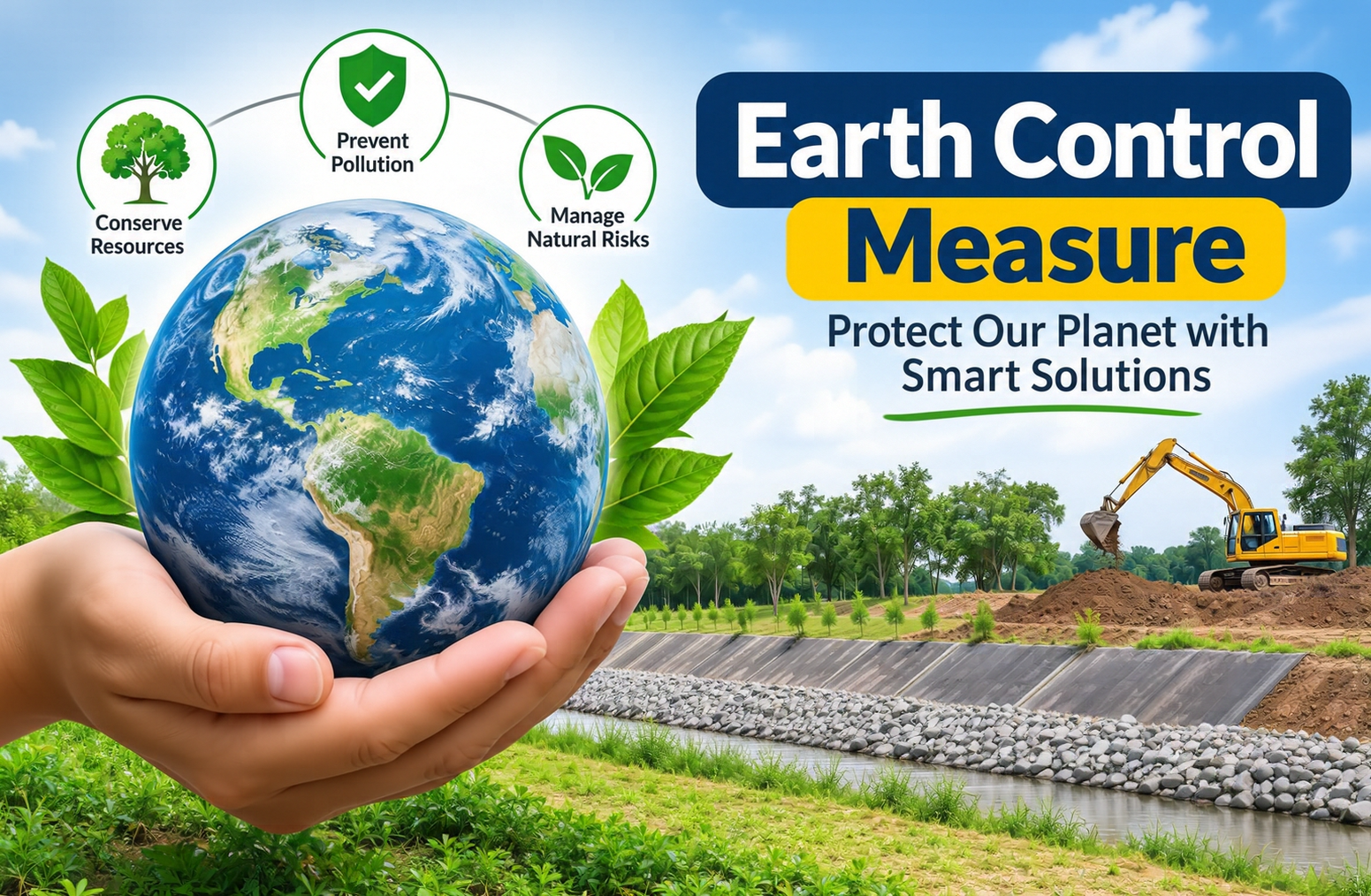
Earth Control Measure: Methods, Benefits, and Best Practices
Construction and land development projects often disturb large areas of soil. When rain falls on exposed ground, loose soil particles can move with surface water and enter nearby drains, rivers, ponds, and other waterways. This can cause water pollution, drainage problems, soil loss, and environmental damage. An effective earth control measure helps prevent these problems by controlling soil erosion and managing sediment before it leaves a construction site.
Earth control measures are important in modern construction because they protect the surrounding environment while allowing building, excavation, road development, and infrastructure projects to continue safely. These measures combine practical engineering methods, proper site planning, soil protection, drainage management, and regular inspections. Rather than waiting for muddy water to leave a construction site and then trying to clean it, the better approach is to prevent soil from becoming loose and control runoff at its source.
Understanding how these systems work is useful for construction companies, civil engineers, contractors, developers, environmental professionals, and property owners. Whether a project involves a small building site or a large infrastructure development, proper soil and water management can reduce environmental risks and prevent expensive problems.
This guide explains the meaning, purpose, working principles, benefits, common methods, challenges, applications, and maintenance requirements of earth control systems. It also explains how to select suitable methods for different construction conditions and why erosion prevention should be considered before excavation begins.
What Is an Earth Control Measure?
An earth control measure is a collection of techniques, structures, and management practices used to prevent soil erosion and control sediment movement, particularly during construction and earthwork activities.
The main purpose is to keep disturbed soil within the project area and prevent sediment-containing water from entering public drainage systems or natural waterways.
Earth control systems generally focus on two closely connected activities:
- Erosion control: Preventing or reducing the movement of soil from its original position.
- Sediment control: Capturing, containing, filtering, or treating soil particles that have already entered surface runoff.
These two activities work together. When erosion is reduced, less sediment enters the water. When sediment control systems are properly installed, they help prevent remaining soil particles from escaping the construction site.
For example, consider a construction project where workers remove vegetation to prepare the ground for a building foundation. The exposed soil becomes vulnerable to rainfall. Without protection, rainwater can carry loose particles toward nearby drains.
A suitable control system might include temporary soil covers, perimeter drainage, silt fences, sediment traps, and a treatment facility. Each component performs a different function, but together they help manage the movement of soil and water.
Understanding the Difference Between Earth Control and General Soil Management
Earth control is not simply about keeping a construction site clean. It involves managing the relationship between disturbed land, rainfall, surface water, soil stability, and surrounding environmental systems.
General soil management may focus on improving soil quality, preparing land for planting, or maintaining agricultural productivity.
Earth control measures, on the other hand, are particularly concerned with preventing erosion and controlling sediment-laden runoff during activities that disturb the ground.
This distinction matters because a site can look clean while still releasing polluted water through an underground drainage connection. Effective management must therefore consider both visible conditions and the quality of water leaving the site.
Why Earth Control Measures Are Important
Soil is a valuable natural resource. It supports vegetation, stores water, provides a foundation for construction, and contributes to the health of surrounding ecosystems.
However, construction activities can remove the natural protection that keeps soil stable. Excavation, grading, vegetation clearance, stockpiling, and heavy machinery can expose large quantities of loose material.
Without appropriate controls, rainfall can transport this material away from the site.
1. Preventing Soil Erosion
Soil erosion occurs when water, wind, or other forces detach and transport soil particles.
Construction sites are especially vulnerable because vegetation and natural ground cover are frequently removed.
An effective system reduces this risk by:
- Covering exposed soil.
- Retaining existing vegetation where possible.
- Stabilizing slopes.
- Managing surface water.
- Reducing uncontrolled runoff.
- Limiting the area of exposed ground.
Preventing erosion is generally more effective than trying to recover soil after it has already been washed away.
2. Protecting Nearby Waterways
Sediment entering rivers, lakes, streams, and drainage channels can affect water quality.
Excessive suspended particles can reduce water clarity, cover aquatic habitats, and interfere with the natural conditions required by fish and other organisms.
Fine sediment can be particularly difficult to remove because small particles may remain suspended in water for extended periods.
Earth control systems reduce these risks by intercepting sediment before contaminated runoff reaches sensitive water bodies.
3. Reducing Drainage Problems
Construction runoff often carries sand, silt, clay, and other materials.
When these particles enter drainage infrastructure, they may accumulate and reduce the available flow capacity.
This can contribute to:
- Blocked drainage channels.
- Reduced stormwater flow.
- Increased maintenance requirements.
- Localized water accumulation.
- Greater flooding risks in vulnerable areas.
Proper sediment management helps protect drainage infrastructure and reduces the need for repeated cleaning.
4. Supporting Environmental Compliance
Many jurisdictions have environmental requirements for construction activities that disturb land.
These requirements may cover drainage management, sediment discharge, construction-site inspections, treatment facilities, and environmental documentation.
In Singapore, for example, the Public Utilities Board provides specific guidance for Earth Control Measures on construction sites. Projects subject to those requirements may need appropriately designed plans, professional oversight, and approval before earthworks begin.
Requirements differ between countries, states, and local authorities. Contractors should always check the regulations that apply to their project rather than assuming that one country’s requirements apply everywhere.
5. Protecting Construction Investments
Poor erosion management can create financial problems.
Sediment may damage drainage systems, affect neighboring properties, delay construction activities, and create additional cleaning or repair costs.
A properly designed system can help reduce these risks by identifying potential problems before they become serious.
It can also improve project organization because drainage routes, exposed surfaces, storage areas, and inspection responsibilities are considered in advance.
How an Earth Control Measure System Works
An earth control system works by managing water and soil movement throughout a construction site.
It is not usually a single structure. Instead, it is a coordinated arrangement of preventive measures, drainage facilities, sediment barriers, and treatment methods.
The system should be designed around the site’s soil characteristics, slope, drainage pattern, rainfall conditions, construction schedule, and surrounding environment.
Step 1: Identify Potential Erosion Areas
The first step is to understand where soil disturbance is most likely to occur.
A site assessment should consider:
- Existing ground conditions.
- Soil type and erodibility.
- Natural slope direction.
- Existing drainage channels.
- Areas of vegetation.
- Excavation locations.
- Soil stockpiles.
- Nearby water bodies.
- Locations where runoff may leave the property.
This information helps engineers identify areas that require additional protection.
For example, a steep excavated slope near a drainage channel generally requires more attention than a flat, protected area located far from a water outlet.
Step 2: Minimize Exposed Soil
The next step is to reduce the amount of unprotected ground.
Large exposed areas create more opportunities for rainwater to detach and transport soil particles.
Construction managers can reduce this risk by:
- Clearing vegetation only when necessary.
- Dividing earthwork into smaller stages.
- Covering completed excavation areas.
- Stabilizing finished slopes.
- Protecting temporary soil storage areas.
- Coordinating land clearing with construction progress.
This approach is often called phased construction or staged land disturbance.
Instead of clearing an entire site at once, contractors disturb only the areas needed for the next stage of work.
Step 3: Control Surface Water
Water management is a central part of an effective system.
Clean water entering a construction area should be separated from runoff that has contacted exposed soil whenever practical.
Temporary drainage channels, diversion berms, slope drains, and other conveyance structures can guide water along planned routes.
The purpose is to reduce uncontrolled flow and prevent concentrated runoff from damaging exposed ground.
Drainage systems must be designed according to expected water volumes, site conditions, and applicable engineering requirements.
Step 4: Capture Sediment
Even with preventive measures, some soil particles may enter runoff.
Sediment control facilities provide an additional layer of protection.
Depending on the site, these may include:
- Silt fences.
- Sediment traps.
- Sedimentation tanks.
- Temporary settling basins.
- Drain inlet protection.
- Filter systems.
- Turbidity curtains in suitable water environments.
These facilities slow water movement, retain sediment, or filter particles before discharge.
Step 5: Treat Water When Necessary
Some construction sites produce runoff containing fine particles that cannot be removed effectively through simple barriers or settling alone.
In such situations, additional treatment may be necessary.
A treatment system can use a combination of settling, filtration, chemical treatment where appropriate, and controlled discharge arrangements.
Treatment methods should be selected by qualified professionals according to the water characteristics, applicable discharge standards, and environmental requirements.
Step 6: Inspect and Maintain the System
Installing control facilities is not enough.
Heavy rainfall, construction traffic, equipment movement, and changing excavation conditions can reduce their effectiveness.
Regular inspections help identify:
- Damaged barriers.
- Blocked drainage channels.
- Sediment accumulation.
- Overflow risks.
- Leaking connections.
- Unstable slopes.
- Poorly maintained treatment facilities.
Any identified problem should be corrected promptly.
A system that is inspected and maintained throughout construction is more reliable than one that is installed and forgotten.
Main Types of Earth Control Measures Used in Construction
Different construction sites require different control methods. The most suitable approach depends on soil conditions, rainfall, site size, slope, water movement, and the type of construction activity.
The following methods are commonly used to manage erosion and sediment.
1. Silt Fences
Silt Fence Installation Guide (SWPPP)
A silt fence is a temporary barrier designed to intercept sediment in surface runoff.
It is commonly made from a permeable geotextile fabric supported by posts. The fabric allows water to pass through while retaining a portion of the suspended soil particles.
Silt fences are generally installed around disturbed areas, soil stockpiles, and suitable site boundaries.
How silt fences work:
- Rainwater flows toward the barrier.
- The fabric slows and filters the water.
- Some sediment particles are retained on the upstream side.
- Filtered water passes through the fabric.
- Accumulated sediment is removed when necessary.
Important installation considerations:
- Install the lower edge securely into the ground.
- Follow the manufacturer’s installation specifications.
- Avoid installing the fence where concentrated water flow could damage it.
- Inspect the fabric after heavy rainfall.
- Remove accumulated sediment before it affects performance.
A silt fence should not be treated as a complete solution for every drainage problem. It works best when runoff is relatively shallow and distributed rather than concentrated into a fast-moving stream.
2. Sediment Traps
Sediment traps are small temporary facilities designed to collect soil particles from runoff.
They provide an area where water can slow down, allowing heavier sediment to settle before water moves toward another drainage facility or approved outlet.
They are particularly useful for smaller drainage areas where a large sedimentation basin may not be necessary.
Common functions include:
- Reducing sediment movement.
- Collecting suspended soil particles.
- Slowing runoff.
- Protecting downstream drainage systems.
- Providing temporary storage for sediment.
The trap must have sufficient capacity for the expected runoff conditions. Accumulated material should be removed before it significantly reduces storage capacity.
3. Sedimentation Tanks
Water Treatment Settling Tanks & Bag | Prime Fluid Management
Sedimentation tanks are used to separate suspended particles from water through gravity-based settling.
Water enters the tank and moves through a controlled flow arrangement. As its velocity decreases, heavier particles settle toward the bottom.
Some systems contain multiple compartments to improve the settling process.
Sedimentation tanks can be useful on construction sites where substantial quantities of silty runoff require collection and treatment.
Their main advantages include:
- Controlled water treatment.
- Easier collection of settled material.
- Reduced uncontrolled sediment discharge.
- Integration with additional filtration equipment.
- More organized management of silty runoff.
However, sedimentation tanks require suitable sizing, regular cleaning, and monitoring. Very fine clay particles may remain suspended even after a considerable settling period.
In those circumstances, additional treatment may be required.
4. Erosion Control Blankets
Erosion Control Blanket for Steep Slopes: Contractor Selection Guide
Erosion control blankets are protective materials placed over exposed soil.
They are commonly made from biodegradable fibers, natural materials, or synthetic products designed for particular environmental conditions.
Their main purpose is to protect the soil surface from raindrop impact and reduce the movement of soil during runoff.
They are particularly useful on slopes, embankments, drainage channels, and newly seeded areas.
Benefits include:
- Protecting exposed soil.
- Reducing surface erosion.
- Supporting vegetation establishment.
- Improving surface stability.
- Reducing the movement of loose material.
The selected blanket should match the slope gradient, expected water flow, soil conditions, and intended duration of protection.
Correct installation is important. Poorly secured edges and gaps can allow water to move underneath the material, reducing its effectiveness.
5. Vegetation and Turfing
Turfgrass for Infrastructure – Atlas Turf Arabia (English)
Vegetation is one of the most effective natural methods of protecting soil.
Grass, shrubs, and other suitable plants help stabilize the ground through their root systems. Leaves and stems also reduce the direct impact of rainfall on the soil surface.
Vegetation can provide long-term erosion protection when it is properly established.
Common techniques include:
- Turfing.
- Grass seeding.
- Hydroseeding.
- Planting suitable ground cover.
- Retaining existing trees and vegetation.
- Replanting disturbed areas.
Vegetation is especially valuable because it provides environmental benefits beyond soil protection.
It can improve the appearance of developed land, support biodiversity, and help maintain natural soil conditions.
However, newly planted areas may remain vulnerable until vegetation becomes established. Temporary covers and other protective measures may therefore be necessary during the early stages.
6. Perimeter Drains
What Is A Drainage Flume at Alesia Lehr blog
Perimeter drains are designed to collect or direct surface water around designated areas of a construction site.
They help prevent uncontrolled water movement across exposed soil.
Depending on the engineering design, perimeter drainage may use temporary channels, lined drains, pipes, or other suitable structures.
Their functions include:
- Directing runoff toward controlled collection points.
- Reducing water movement across vulnerable soil.
- Protecting excavation areas.
- Separating clean water from sediment-laden runoff.
- Supporting the overall drainage arrangement.
Drainage capacity and outlet protection are important considerations.
A poorly designed channel may concentrate water and create erosion rather than prevent it.
7. Check Dams
National Erosion Control | SWPPP & Erosion Control Contractor — AR, LA, OK, TX
Check dams are small barriers installed across suitable drainage channels.
They reduce water velocity and help control the movement of sediment.
Common materials include rock, gravel-filled structures, and other engineered products.
They are particularly useful in temporary drainage channels where flowing water may otherwise cause erosion.
Key advantages:
- Slowing concentrated runoff.
- Reducing channel erosion.
- Encouraging sediment deposition.
- Improving temporary drainage management.
Check dams must be properly designed and installed. Incorrect placement can cause water to bypass the structure, undermine its foundation, or create erosion around its edges.
8. Sediment Basins
Water & Environment – Covey – Consulting Engineers, South East Queensland
Sediment basins are larger facilities designed to temporarily store runoff and provide time for sediment particles to settle.
They are generally used when a construction site produces significant volumes of sediment-laden water.
A properly designed basin considers:
- Drainage area.
- Expected runoff volume.
- Soil particle characteristics.
- Storage requirements.
- Water discharge arrangements.
- Maintenance access.
- Emergency overflow conditions.
Sediment basins can be highly useful on large development sites, road projects, and infrastructure construction areas.
However, their performance depends on appropriate design and sufficient retention time. Fine particles may require additional filtration or treatment.
9. Construction Site Wheel Wash Systems
Commercial Vehicle Wash Equipment | Automatic Car Wash Manufacturer | KMRON
Construction vehicles can carry soil from an excavation area onto public roads.
This creates dust, muddy surfaces, drainage contamination, and road-cleaning problems.
Wheel wash systems help remove soil from vehicle tires before vehicles leave designated construction areas.
A typical system may include:
- A washing platform.
- Water supply equipment.
- Spray nozzles.
- Collection channels.
- A sediment collection tank.
- A water treatment or recycling arrangement.
Wheel washing supports site cleanliness and reduces the movement of loose soil beyond construction boundaries.
The collected water must also be managed appropriately. It should not simply be discharged into public drains without checking applicable treatment and discharge requirements.
10. Temporary Soil Covers
Construction site; construction pit with metal pipes supporting the ground.
Temporary soil covers protect exposed ground from rainfall and other environmental conditions.
Common materials include tarpaulins, protective sheets, geotextiles, and suitable manufactured covers.
They are particularly useful when:
- Excavated soil must remain exposed temporarily.
- Rain is expected.
- Work has stopped for a short period.
- Soil stockpiles require protection.
- Permanent stabilization has not yet been completed.
Covers should be secured properly to prevent wind movement and water from collecting beneath them.
Drainage should also be considered so that covered areas do not redirect concentrated runoff toward vulnerable locations.
Erosion Control vs. Sediment Control: Understanding the Difference
Erosion control and sediment control are closely related, but they solve different problems.
Understanding the distinction is essential when planning an effective system.
| Erosion control | Sediment control |
| Prevents soil particles from becoming detached. | Captures particles that have already been detached. |
| Focuses on protecting exposed ground. | Focuses on managing sediment in runoff. |
| Uses vegetation, covers, and stabilization. | Uses silt fences, traps, and settling facilities. |
| Reduces sediment generation. | Reduces sediment leaving the site. |
| Works mainly at the source. | Works along the runoff pathway or at collection points. |
For example, covering an exposed slope with an erosion control blanket reduces the amount of soil that rain can detach.
Installing a sediment trap below that slope helps collect particles that still enter runoff.
Both methods are important, but preventing erosion at its source should generally receive priority.
This is because sediment control facilities cannot always capture every particle, especially very fine clay and silt.
Important Components of an Effective Earth Control Measure Plan
A successful system requires more than selecting suitable equipment.
It needs a practical plan that considers how construction activities will change the site over time.
1. Site Assessment and Soil Investigation
The first major component is a proper understanding of the land.
Different soils react differently to water.
Sandy soil generally drains more quickly than clay-rich soil, while fine particles can remain suspended in runoff for longer periods.
Site assessment should identify:
- Soil composition.
- Soil erodibility.
- Existing vegetation.
- Ground elevations.
- Slope direction.
- Natural drainage routes.
- Nearby environmental receptors.
- Areas of concentrated runoff.
The information helps engineers select appropriate methods rather than relying on a standard arrangement that may not suit the actual site.
2. Drainage Planning
A good drainage plan determines where water enters, moves through, and leaves the construction area.
It should identify separate routes for clean water and water that has contacted exposed soil wherever practical.
This separation can reduce the volume of runoff requiring sediment treatment.
Drainage planning should also consider the effects of temporary construction structures, changing ground levels, and excavation activities.
3. Construction Phasing
Construction activities should be organized to minimize unnecessary soil disturbance.
For example, clearing a large area before construction equipment or stabilization materials are ready can create avoidable erosion risks.
A phased approach allows contractors to:
- Prepare control facilities before excavation.
- Disturb smaller areas at a time.
- Stabilize completed sections.
- Protect soil stockpiles.
- Adjust drainage as the project develops.
This makes environmental management part of the construction schedule rather than an activity performed only after problems occur.
4. Proper Equipment Selection
Every site has different requirements.
A silt fence may be appropriate for shallow perimeter runoff but unsuitable for a channel carrying concentrated water.
Similarly, a small sediment trap may not provide enough storage for a large development site.
Equipment selection should consider:
- Expected water flow.
- Sediment particle size.
- Soil type.
- Site dimensions.
- Rainfall conditions.
- Maintenance requirements.
- Applicable environmental standards.
Qualified professionals should review the design where engineering calculations or regulatory approvals are required.
5. Inspection and Documentation
Inspection records provide evidence that the system is being maintained.
A practical inspection program should record:
- Inspection dates.
- Weather conditions.
- Condition of control facilities.
- Sediment accumulation.
- Drainage performance.
- Water treatment observations.
- Maintenance activities.
- Corrective actions.
Photographs can help document changes and provide a useful comparison between inspections.
Records also help project managers identify recurring problems and improve future site arrangements.
Step-by-Step Guide to Implementing Earth Control Measures
Implementing an effective system requires a logical sequence.
The following approach provides a practical framework for construction managers and contractors.
Step 1: Review Project Requirements
Before work begins, identify all applicable environmental and construction requirements.
Check whether local authorities require:
- An erosion and sediment control plan.
- A professionally endorsed design.
- Approval before earthworks.
- Water quality monitoring.
- Routine inspections.
- Specific discharge limits.
- Environmental reporting.
Requirements vary by jurisdiction, project size, and type of activity.
Step 2: Conduct a Detailed Site Survey
A site survey provides information about the existing land and its drainage characteristics.
Engineers should understand how water naturally moves through the area.
They should also identify locations where construction activities could change existing drainage patterns.
This assessment helps prevent problems such as directing runoff toward neighboring properties or concentrating water at the base of an exposed slope.
Step 3: Prepare the Control Plan
The plan should identify the location and purpose of each control facility.
It should also explain how the arrangement will change during different construction stages.
A practical plan may include:
- Soil protection arrangements.
- Temporary drainage routes.
- Sediment collection facilities.
- Water treatment arrangements.
- Construction access protection.
- Inspection responsibilities.
- Maintenance schedules.
- Emergency response procedures.
The design should be clear enough for site workers and contractors to understand their responsibilities.
Step 4: Install Controls Before Earthworks
Preventive systems should be ready before significant soil disturbance begins.
Depending on the project, this may include installing perimeter barriers, drainage facilities, sediment collection structures, and water treatment equipment.
Installing controls after excavation begins leaves the site vulnerable during the period when exposed soil is most likely to be washed away.
Step 5: Train Site Workers
Workers should understand the purpose of the control facilities and know how their daily activities affect them.
For example, construction vehicles should not drive through protected drainage areas without authorization.
Workers should also know how to report damaged barriers, blocked drains, overflowing facilities, and unusual water discharge.
Training does not need to be complicated. Clear instructions and regular reminders can significantly improve site practices.
Step 6: Monitor Water and Sediment Conditions
Monitoring should focus on whether the system is performing as intended.
Depending on project requirements, this may include checking:
- Water clarity.
- Visible sediment movement.
- Drainage flow.
- Sediment accumulation.
- Treatment performance.
- Discharge quality.
Visual observations are useful, but they should not replace required laboratory testing or instrument-based monitoring.
Step 7: Review and Improve the Arrangement
Construction conditions change.
A drainage route that works during early excavation may become unsuitable after the ground level changes.
Likewise, additional controls may be needed when work expands into a new section.
The control plan should therefore be reviewed throughout the project and adjusted when site conditions require it.
Benefits of Earth Control Measures for Construction Projects
A properly managed system offers environmental, operational, financial, and safety benefits.
Its value is not limited to preventing muddy water from leaving a construction site. It also improves the way construction activities are organized and reduces the likelihood of unexpected environmental problems.
1. Better Environmental Protection
The most important benefit is reducing the amount of soil entering surrounding water systems.
Sediment pollution can affect aquatic habitats, reduce water clarity, and disturb the natural balance of waterways.
By keeping exposed soil stable and managing runoff, construction companies can reduce their environmental impact.
2. Lower Construction Maintenance Costs
Uncontrolled sediment can create additional work.
Contractors may need to clean blocked drains, remove deposited soil, repair damaged drainage channels, and restore affected areas.
Preventive controls help reduce these maintenance requirements.
Although installing and maintaining control facilities requires an initial investment, preventing repeated problems can make the overall project more economical.
3. Improved Site Organization
An organized control system gives workers a clear understanding of drainage routes, soil storage locations, protected areas, and maintenance responsibilities.
This can reduce confusion and improve coordination between contractors, engineers, and site supervisors.
It also makes it easier to identify problems before they affect other construction activities.
4. Reduced Risk to Nearby Properties
Construction runoff does not always remain within the project boundary.
Poor drainage management can direct muddy water toward roads, neighboring buildings, agricultural land, and public spaces.
Suitable control measures help manage runoff and reduce the possibility of damage outside the site.
5. Better Regulatory Compliance
Environmental regulations often require construction companies to manage soil erosion and prevent harmful discharges.
A documented control system makes it easier to demonstrate that the project has considered these responsibilities.
It can also support environmental inspections and provide evidence that corrective actions have been taken when problems occur.
6. Improved Long-Term Land Stability
Some erosion prevention methods continue providing benefits after construction.
Vegetation, properly designed slopes, stable drainage channels, and suitable ground protection can help maintain land stability after the main construction work is complete.
This reduces the likelihood of recurring erosion problems around finished infrastructure.
Common Challenges in Earth Control Management
Although these systems are useful, implementing them successfully can be challenging.
Construction sites are constantly changing environments. Rainfall, equipment movement, excavation, and changing ground conditions can affect control facilities.
Understanding common challenges helps project managers prepare better solutions.
1. Heavy Rainfall
Heavy rainfall can produce more runoff than temporary drainage and sediment facilities can safely manage.
This may cause barriers to overflow, sediment traps to fill, or drainage channels to become damaged.
Practical solution:
- Check weather forecasts when planning exposed earthworks.
- Protect vulnerable soil before expected rainfall.
- Keep drainage channels clear.
- Provide suitable storage and overflow arrangements.
- Inspect control facilities after significant rainfall.
- Suspend activities when conditions make safe and effective control impractical.
Facilities should be designed for the rainfall and runoff conditions required by the relevant engineering standards.
2. Poor Installation
Even high-quality materials may fail when installed incorrectly.
For example, a silt fence with an unsecured lower edge can allow sediment-laden water to pass underneath.
Similarly, an incorrectly positioned drainage channel may direct water toward an exposed slope.
Practical solution:
Follow approved drawings, installation specifications, and manufacturer instructions.
Site supervisors should check the installation before earthworks begin.
3. Insufficient Maintenance
Sediment collection facilities gradually accumulate material.
If they are not cleaned, their storage capacity decreases.
Blocked filters and damaged barriers can also reduce system performance.
Practical solution:
Establish a documented maintenance schedule and assign responsibility to specific personnel.
Do not wait until a facility has completely stopped working before arranging maintenance.
4. Changing Construction Conditions
Excavation and grading can change the natural movement of water.
A previously stable drainage arrangement may become ineffective when a new section of land is cleared.
Practical solution:
Review the control plan whenever the project enters a major new stage.
The system should develop alongside the construction work.
5. Fine Soil Particles
Fine silt and clay can be difficult to capture using simple settling methods.
Their small particle size means they may remain suspended in water for longer periods.
Practical solution:
Assess the soil characteristics before selecting treatment methods.
Where necessary, use appropriately designed filtration or treatment systems in addition to conventional sediment collection facilities.
Any chemical treatment should be selected and controlled by competent professionals. Unapproved chemical use can create additional water quality problems.
6. Limited Construction Space
Small construction sites may not have enough room for large sediment basins or extensive temporary drainage systems.
This can make it difficult to manage runoff using conventional arrangements.
Practical solution:
Consider compact treatment equipment, suitable filtration systems, temporary storage tanks, and carefully planned drainage routes.
The design must still provide sufficient treatment capacity and safe access for maintenance.
7. Limited Worker Awareness
Workers may unintentionally damage barriers, block drainage channels, or disturb protected soil areas.
This can happen when environmental responsibilities are not clearly communicated.
Practical solution:
Provide basic environmental training and explain which areas must remain protected.
Make inspection responsibilities clear and encourage workers to report problems immediately.
Real-World Applications of Earth Control Measures
Earth control methods are used in many industries and development activities.
Although construction is a major application, any activity that exposes soil or changes natural drainage conditions may require similar protection.
1. Building Construction
Construction of distribution warehouse. Development of commercial real estate market in the USA
Building projects often involve excavation, foundation preparation, basement construction, and soil removal.
These activities expose soil and change the natural movement of rainwater.
A suitable control arrangement may include:
- Temporary perimeter drainage.
- Soil covers.
- Silt fences.
- Sediment collection tanks.
- Wheel washing facilities.
- Controlled water discharge.
The arrangement should be adjusted as excavation and building activities progress.
2. Road and Highway Construction
MDOT makes progress on southwest Mississippi projects
Road projects often disturb long stretches of land.
Cuttings, embankments, drainage channels, and access roads can create significant erosion risks.
Useful methods include:
- Slope stabilization.
- Erosion control blankets.
- Temporary drainage channels.
- Check dams.
- Vegetation establishment.
- Sediment basins.
Road construction also requires attention to the areas below embankments because runoff can carry sediment toward surrounding properties and watercourses.
3. Bridge Construction
ウェブバン,第 24-41380-0244 号 河川災害復旧助成工事(橋梁下部)
Bridge construction may involve work close to rivers and other sensitive water environments.
Excavation near water can increase the risk of sediment entering aquatic habitats.
Depending on the site, control methods may include:
- Turbidity curtains.
- Sediment barriers.
- Temporary drainage arrangements.
- Protected excavation areas.
- Suitable water treatment systems.
Turbidity curtains are designed for appropriate aquatic conditions and do not replace the need to prevent erosion at its source.
4. Residential Development
Northview Subdivision | Camex Civil
Residential development often involves clearing land, constructing foundations, installing utility networks, and preparing roads.
These activities can disturb large areas of soil.
Earth control systems help protect nearby homes, public drains, green spaces, and community infrastructure.
Phased construction is particularly useful because it reduces the amount of exposed land at any one time.
5. Industrial Development
SAMSON Smart Factory | Main Change – Innovationscampus Offenbach | Werner Hartwig GmbH
Industrial projects may involve extensive excavation, heavy vehicle movement, and large paved areas.
These conditions require careful drainage planning.
In addition to controlling sediment, industrial construction projects may need separate arrangements for water that has contacted construction materials, fuels, chemicals, or other contaminants.
This distinction is important because an ordinary sediment treatment system is not automatically suitable for every type of construction wastewater.
6. Agricultural Land Development
Best Management Practices | Wrestore
Agricultural land preparation can disturb soil through grading, drainage installation, irrigation work, and other activities.
Soil conservation techniques may include:
- Maintaining vegetation strips.
- Contour farming.
- Mulching.
- Grass waterways.
- Cover crops.
- Slope stabilization.
These methods help reduce soil loss and protect agricultural productivity.
7. Mining and Quarrying
Integrated Water Management and Mining Operations
Mining and quarrying activities can expose substantial areas of soil and rock.
Rainwater flowing across disturbed land may carry sediment into surrounding drainage systems.
Control arrangements may include diversion channels, sediment ponds, stabilized access roads, and managed runoff collection.
Mining operations may also produce process water that requires specialized treatment separate from ordinary stormwater management.
How to Select the Right Earth Control Measure
Choosing an appropriate method requires an understanding of site conditions.
Using the wrong equipment can create a false sense of protection and may increase environmental risks.
The following factors should guide the selection process.
Soil Type
Soil characteristics influence how quickly particles become detached and how easily they settle out of water.
| Soil type | General characteristics | Important considerations |
| Sandy soil | Larger particles, relatively fast drainage | Protect loose surfaces and control runoff |
| Silty soil | Fine particles, vulnerable to water erosion | Use effective surface protection and sediment treatment |
| Clay soil | Very fine particles, often slow settling | Consider specialized filtration or treatment |
| Gravelly soil | Larger particles and variable drainage | Control concentrated flow and surface movement |
| Mixed soil | Different particle sizes and properties | Assess actual site conditions before selecting controls |
These are general descriptions. Actual performance also depends on soil structure, compaction, moisture, and other site-specific factors.
Site Slope
Steep slopes can increase runoff velocity and erosion potential.
They may require a combination of surface stabilization, drainage controls, and sediment collection facilities.
Flat sites can still experience erosion, especially where water collects or moves through concentrated drainage routes.
Rainfall Conditions
The expected amount and intensity of rainfall influence the design and maintenance requirements of temporary facilities.
Areas with frequent heavy rainfall may require additional storage capacity and stronger drainage arrangements.
Construction Activities
Different activities produce different environmental risks.
For example:
- Excavation exposes soil.
- Grading changes drainage patterns.
- Soil stockpiling creates vulnerable surfaces.
- Vehicle movement can carry mud beyond the site.
- Demolition may introduce additional pollutants.
- Concrete-related operations may produce wastewater requiring separate treatment.
The control plan should reflect the actual work being performed.
Available Space
The available land determines which facilities can be installed.
A large site may accommodate a sediment basin, while a small urban site may need compact treatment equipment and carefully controlled drainage.
Space limitations should be considered during planning rather than after construction has started.
Local Environmental Requirements
Regulatory requirements are an essential part of equipment selection.
Some jurisdictions specify approved design standards, professional qualifications, monitoring procedures, and water discharge limits.
Contractors should confirm these requirements before deciding which methods to use.
Inspection and Maintenance Best Practices
Inspection and maintenance are among the most important parts of successful environmental management.
Even a professionally designed system can become ineffective if it is damaged or neglected.
Daily Site Checks
Site personnel should regularly examine visible control facilities.
Daily checks are particularly useful during active earthworks because machinery and changing site conditions can quickly affect barriers and drainage routes.
Look for:
- Damaged silt fences.
- Blocked drains.
- Exposed soil.
- Overflowing collection areas.
- Unprotected stockpiles.
- Unusual water movement.
Inspections After Rainfall
Rainfall can reveal weaknesses that may not be obvious during dry weather.
After significant rainfall, inspect the entire runoff management arrangement.
Check whether water has bypassed barriers, whether sediment facilities are filling, and whether any discharge appears unusually muddy.
The inspection frequency should also follow applicable regulatory and project requirements.
Cleaning Sediment Facilities
Sediment traps, basins, and tanks must be cleaned according to their design and operating requirements.
Removing accumulated sediment restores available storage and improves treatment performance.
The removed material should be handled and disposed of appropriately.
Repairing Damaged Controls
Damaged facilities should be repaired or replaced promptly.
Examples include:
- Replacing torn filter fabric.
- Re-securing loose fence posts.
- Removing obstructions from drainage channels.
- Repairing leaking connections.
- Restoring eroded channel outlets.
- Stabilizing damaged slopes.
Temporary repairs should not become permanent substitutes for proper engineering solutions.
Maintaining Inspection Records
Good documentation makes maintenance easier to manage.
A useful record should include the date, location, condition, identified problem, action taken, and person responsible.
These records can help project teams identify repeated failures and make better decisions during later construction stages.
Common Mistakes to Avoid When Using Earth Control Measures
Many environmental problems occur because construction teams underestimate the importance of preventive controls.
Avoiding the following mistakes can improve system performance.
1. Installing Controls Too Late
One common mistake is beginning excavation before installing protective facilities.
This leaves exposed soil vulnerable to rainfall.
Better approach: Complete essential control installations before major earthworks begin.
2. Depending Only on Silt Fences
Silt fences are useful, but they cannot handle every type of runoff.
They may fail when water flows too quickly or becomes concentrated.
Better approach: Combine appropriate erosion prevention, drainage management, and sediment collection methods.
3. Ignoring Soil Characteristics
Different soil types require different control arrangements.
A treatment method that works well for coarse sand may not be effective for fine clay.
Better approach: Assess soil conditions before selecting equipment and treatment processes.
4. Neglecting Sediment Removal
Sediment facilities lose capacity as material accumulates.
Better approach: Establish inspection and cleaning procedures based on the design and actual site conditions.
5. Failing to Update the Control Plan
A construction site changes as work progresses.
Using the same drainage arrangement throughout the project may create problems when excavation areas or ground elevations change.
Better approach: Review and update the control plan whenever construction activities significantly affect runoff patterns.
6. Treating All Construction Water as Stormwater
This is an important technical mistake.
Rainwater runoff containing soil is not necessarily the same as wastewater generated by construction processes.
For example, slurry from drilling, tunnelling, or piling may require separate collection and treatment.
Better approach: Identify the source and characteristics of each water stream before selecting a treatment method.
7. Ignoring the Area Outside the Construction Boundary
A control system should consider where discharged water eventually travels.
Protecting the construction site while transferring sediment pollution to neighboring land does not solve the environmental problem.
Better approach: Assess downstream drainage routes and nearby sensitive areas when preparing the plan.
Earth Control Measures and Environmental Sustainability
Environmental sustainability is an important consideration in modern infrastructure development.
Construction provides buildings, roads, transportation systems, and essential public facilities. However, these activities should be managed responsibly to avoid unnecessary environmental damage.
Earth control practices contribute to sustainability by reducing soil loss and protecting water resources.
Protecting Natural Soil Resources
Healthy soil takes time to develop.
When erosion removes the upper layers, valuable organic material and nutrients can be lost.
Preventive measures help preserve soil that may otherwise need to be replaced or restored.
Reducing Water Pollution
Sediment management helps prevent excessive suspended particles from entering natural water systems.
This supports better water quality and reduces pressure on downstream environmental systems.
Supporting Vegetation Recovery
Temporary erosion protection and suitable vegetation can help disturbed areas recover after construction.
Plants provide ground cover and contribute to long-term soil stability.
Encouraging Responsible Construction
A well-planned system encourages contractors to consider environmental effects before beginning physical work.
This makes environmental protection part of project management rather than an activity reserved for inspections or regulatory complaints.
Supporting Better Resource Management
Proper drainage and treatment arrangements can sometimes allow collected water to be managed more efficiently.
Where technically suitable and legally permitted, treated water may be reused for appropriate non-potable purposes.
Reuse should only take place after checking water quality and confirming that the intended application is safe.
Regulatory Guidance and Professional Responsibilities
Earth control requirements are not identical worldwide.
Different authorities establish their own rules according to local environmental conditions, drainage infrastructure, development practices, and water protection objectives.
Singapore provides a particularly clear example of a formal Earth Control Measures framework.
The country’s Public Utilities Board provides guidance for contractors, developers, and Qualified Erosion Control Professionals. Its framework emphasizes preventing silty discharge, preparing suitable control plans, implementing facilities before earthworks, and maintaining the system throughout construction.
The official PUB Earth Control Measures guidelines explain the responsibilities of different project stakeholders.
Responsibilities of Contractors
Contractors are responsible for implementing the approved arrangements and ensuring that construction activities do not cause uncontrolled silty discharge.
Their responsibilities may include:
- Installing control facilities.
- Following approved plans.
- Maintaining drainage systems.
- Monitoring site conditions.
- Keeping appropriate records.
- Correcting identified problems.
Responsibilities of Developers
Developers should ensure that environmental requirements are included in project planning and construction arrangements.
This includes providing adequate resources for environmental protection and ensuring that contractors understand their responsibilities.
Responsibilities of Environmental Professionals
Qualified environmental and engineering professionals help design systems that match site conditions.
Depending on the jurisdiction, they may be responsible for preparing technical plans, reviewing calculations, supervising implementation, and assessing system performance.
Their involvement is particularly important when projects involve complex drainage conditions or sensitive environmental locations.
Responsibilities of Site Supervisors
Site supervisors help ensure that the control system remains effective during daily construction activities.
They should monitor the condition of facilities, coordinate maintenance, and communicate problems to the responsible engineering or environmental personnel.
Future Developments in Earth Control Technology
Construction technology continues to evolve, and environmental management is becoming more data-driven.
New methods can help project teams identify problems earlier, improve monitoring, and manage runoff more efficiently.
1. Automated Water Quality Monitoring
Water monitoring equipment can measure selected parameters in real time.
Depending on the equipment, these may include turbidity, pH, temperature, and other indicators.
Automated monitoring can help identify unexpected changes in water conditions.
However, equipment must be calibrated, maintained, and interpreted correctly.
2. Smart Construction Site Monitoring
Digital monitoring systems can combine weather information, site observations, and sensor readings.
This information can help supervisors understand changing environmental conditions and prepare for periods of increased rainfall.
For example, a monitoring system may alert site personnel when water levels rise or a treatment facility requires attention.
3. Improved Filtration Materials
New filtration materials and engineered products are expanding the options available for sediment management.
Geotextiles, filter media, and other materials can be selected for different particle sizes and flow conditions.
Their effectiveness depends on proper testing, installation, and maintenance.
4. Sustainable and Biodegradable Materials
Natural fiber products and biodegradable erosion control blankets can provide temporary soil protection.
These products may be suitable for areas where vegetation is expected to become the long-term stabilization method.
Their suitability depends on environmental conditions and the expected service period.
5. Better Construction Planning Software
Digital design tools can help engineers understand site elevations, drainage routes, and construction stages.
These tools can improve coordination between earthworks, drainage installation, and environmental protection.
However, digital models must be based on accurate site information and reviewed by qualified professionals.
6. Greater Integration of Environmental Management
Future construction projects are likely to place greater emphasis on integrating environmental controls into the original design and project schedule.
This approach reduces the need for emergency corrections and encourages contractors to consider environmental performance from the beginning.
Frequently Asked Questions About Earth Control Measures
1. What is the main purpose of an earth control measure?
The main purpose is to prevent soil erosion and control sediment movement during construction and other land-disturbing activities. These methods help keep soil within the project area and prevent sediment-laden runoff from polluting nearby drains and waterways.
2. What are the two main types of earth control measures?
The two main types are erosion control and sediment control. Erosion control prevents soil particles from becoming detached, while sediment control captures or treats particles that have already entered runoff.
3. What are common examples of earth control measures?
Common examples include silt fences, sediment traps, sedimentation tanks, erosion control blankets, vegetation, perimeter drains, check dams, sediment basins, and wheel wash systems.
4. Why are earth control measures important during construction?
They reduce soil loss, protect water quality, prevent drainage blockages, support environmental compliance, and help reduce maintenance problems. They also protect nearby properties and natural environments from uncontrolled construction runoff.
5. When should earth control measures be installed?
Essential control facilities should generally be installed before major earthworks or soil disturbance begins. The system should remain operational throughout construction and should be inspected and maintained as site conditions change.
6. Who is responsible for maintaining earth control measures?
Contractors and designated site personnel generally handle daily implementation and maintenance. Depending on local regulations and project requirements, developers, environmental officers, engineers, and qualified erosion control professionals may also have specific responsibilities.
7. What is the difference between a sediment trap and a sedimentation tank?
A sediment trap is generally a temporary collection facility where runoff slows down and heavier particles settle. A sedimentation tank is an engineered treatment facility that provides controlled settling and may include multiple compartments or additional treatment equipment.
8. Can earth control measures prevent all soil erosion?
No. They are designed to reduce erosion and control sediment movement, but their effectiveness depends on proper planning, installation, maintenance, and site conditions. Severe rainfall or unsuitable designs can still cause erosion and sediment discharge.
9. Are earth control measures required on small construction sites?
Requirements depend on local regulations, the size and nature of the project, site conditions, and environmental risks. Even small sites can produce sediment-laden runoff, so appropriate controls should be considered regardless of project size.
10. What happens if earth control measures are not maintained?
Poor maintenance can reduce the effectiveness of control facilities. Silt fences may become damaged, sediment traps may lose storage capacity, and drainage channels may become blocked. These problems can increase the risk of sediment pollution and environmental non-compliance.
Conclusion
An effective earth control measure is an essential part of responsible construction and environmental management. It helps prevent soil erosion, controls sediment movement, protects nearby waterways, and reduces the environmental problems associated with excavation and land development.
The most effective approach combines erosion prevention, drainage management, sediment collection, suitable water treatment, and regular maintenance. Methods such as silt fences, sediment traps, sedimentation tanks, vegetation, erosion control blankets, and temporary drainage systems each serve different purposes.
However, simply installing these facilities does not guarantee success. Their performance depends on proper site assessment, suitable engineering design, correct installation, trained workers, and continuous monitoring.
Construction conditions also change over time, making regular inspections and adjustments essential. A system that works during one stage of development may require modifications as excavation, grading, and drainage activities progress.
Ultimately, responsible soil and water management should be considered from the earliest planning stages of a construction project. By prioritizing prevention rather than relying only on corrective action, contractors and developers can protect natural resources, reduce unnecessary expenses, and create safer, more environmentally responsible construction sites.